
Results
-
 £14.95
Joy, Peace and Happiness (Brass Band - Score only) - Phillips, Richard
An ideal concert opener (first or second half) where the idea is that the band appear on stage section by section starting with percussion followed by basses and so on!
Estimated dispatch 7-14 working days
-
£60.99
Entry of the Celts (Brass Band - Score and Parts)
Entry of the Celts is a delightful light concert opener. As its title implies, this work features Celtic-inspired music. All the instruments in the band are given the opportunity to display their most beautiful sound colours: from the bass section to the cornets, via the tenor horns, euphoniums/baritones and trombones. Each section plays a solo passage, accompanied by percussion instruments. The solo for soprano cornet leads to a sparkling and impressive finale. A wonderful Celtic work that will enchant and delight your audiences. 04:20
Estimated dispatch 7-14 working days
-
£82.95
EUPHONIUM CONCERTO No.1 (Sparke) (Brass Band - Score and Parts) - Sparke, Philip
This concerto has its origins in a concerto for horn and brass band, commissioned by the River City Brass Band (Pittsburgh) in 1992.It was composed at the request of British euphonium virtuoso, Steven Mead, and first performed by him with the Breeze Brass Band in Osaka, Japan, in 1995.In conventional three-movement form, performed without a break, the concerto covers the panoply of the euphonium's range and character. The first movement is marked Moderato e energico and is rhythmically energetic in style with many meter changes and much syncopation. Only in the central section does the soloist relax in cantabile mood.The second movement opens with tuned percussion taking centre stage, laying for the foundations for a long cantilena from the soloist in resigned mood, but with a touch of optimism. After a central climax for the band, this melody returns, with soloists from the band answering in counterpoint. The finale is a 6/8 romp in caccia style (betraying its origins as a piece for horn). Again, the central section is more legato in mood, though the band keeps the eighth-note figures present throughout. The movement ends in a bravura display from the soloist.
Estimated dispatch 7-14 working days
-
£44.95
EUPHONIUM CONCERTO No.1 (Sparke) (Brass Band - Score only) - Sparke, Philip
This concerto has its origins in a concerto for horn and brass band, commissioned by the River City Brass Band (Pittsburgh) in 1992.It was composed at the request of British euphonium virtuoso, Steven Mead, and first performed by him with the Breeze Brass Band in Osaka, Japan, in 1995.In conventional three-movement form, performed without a break, the concerto covers the panoply of the euphonium's range and character. The first movement is marked Moderato e energico and is rhythmically energetic in style with many meter changes and much syncopation. Only in the central section does the soloist relax in cantabile mood.The second movement opens with tuned percussion taking centre stage, laying for the foundations for a long cantilena from the soloist in resigned mood, but with a touch of optimism. After a central climax for the band, this melody returns, with soloists from the band answering in counterpoint. The finale is a 6/8 romp in caccia style (betraying its origins as a piece for horn). Again, the central section is more legato in mood, though the band keeps the eighth-note figures present throughout. The movement ends in a bravura display from the soloist.
Estimated dispatch 7-14 working days
-
 £15.00
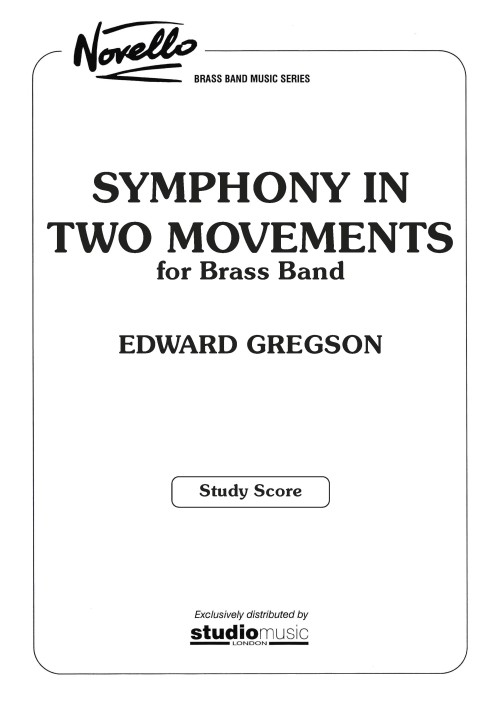
Symphony in Two Movements (Brass Band - Study Score) - Gregson, Edward
Selected as the Championship Section test piece for the National Brass Band Championships of Great Britain 2025This work was jointly commissioned by the National Youth Brass Band of Great Britain (NYBBGB) and the National Youth Brass Band of Wales (NYBBW), the latter with funding from T Cerdd (Music Centre Wales), to celebrate their 60th and 30th anniversaries respectively. The first performances were given at Cadogan Hall, London, in April 2012, by the NYBBGB, conducted by Bramwell Tovey; and at the Great Hall, Aberystwyth University, in July 2012, by the NYBBW, conducted by Nicholas Childs.When I was approached about a joint commission to write a new work to celebrate the anniversaries of these two outstanding youth bands I was delighted to accept, and decided to respond by writing a work apposite for the magnitude of these special occasions, namely a 'symphony for brass'.Through a long journey of writing music for brass band, which commenced with Connotations (1977), and continued with Dances and Arias (1984), Of Men and Mountains (1991), The Trumpets of the Angels (2000) and Rococo Variations (2008), I arrived at what I regard as the most important work of the cycle to date, combining as it does serious musical intent with considerable technical demands. It is perhaps my most abstract work for brass band, avoiding any programmatic content.The symphony lasts for some 19 minutes and is structured in two linked movements. The form is based on that used by Beethoven in his final piano sonata (Op.111), which is in two movements only: a compact sonata-form allegro, followed by a more expansive theme and four variations. Prokofiev also adopted this model in his 2nd Symphony of 1925.The opening Toccata of this Symphony is highly dramatic but compact, whilst still retaining the 'traditional' structural elements of exposition, development and recapitulation; indeed, it also has the 'traditional' element of a contrasting second subject - a gentle, lyrical modal melody first heard on solo cornets.In contrast, the longer and more substantial second movement Variations is built around a theme and four variations. The slowly unfolding chorale-like theme accumulates both added note harmony and increasing instrumentation, whilst the four variations which follow are by turn mercurial (fast, starting with all the instruments muted), march-like (menacing, with short rhythmic articulations underpinning an extended atonal melody), serene (a series of 'romances' for solo instruments alongside echoes of the chorale) with an emerging theme eventually bursting into a climax of passionate intent; whilst the final variation is a dynamic scherzo (concertante-like in its series of rapid-fire solos, duets, trios and quartets) with the music gradually incorporating elements of the main ideas from the first movement, thus acting as a recapitulation for the whole work. It reaches its peroration with a return to the very opening of the symphony, now in the 'home' tonality of F, and thus creating a truly symphonic dimension to the music.Most of the melodic material of the symphony is derived from the opening eleven-note 'row', which contains various intervallic sets, and although the work is not serially conceived it does use some typical quasi-serial procedures, such as canons, inversions, and retrogrades. The symphony uses somewhat limited percussion, in line with a 'classical' approach to the sound world of the brass band, alongside a use of multi-divisi instrumentation, whereby each player has an individual part rather than the traditional doubling within certain sections of the band.- Edward GregsonDuration: 19.00
Estimated dispatch 7-14 working days
-
 £28.95
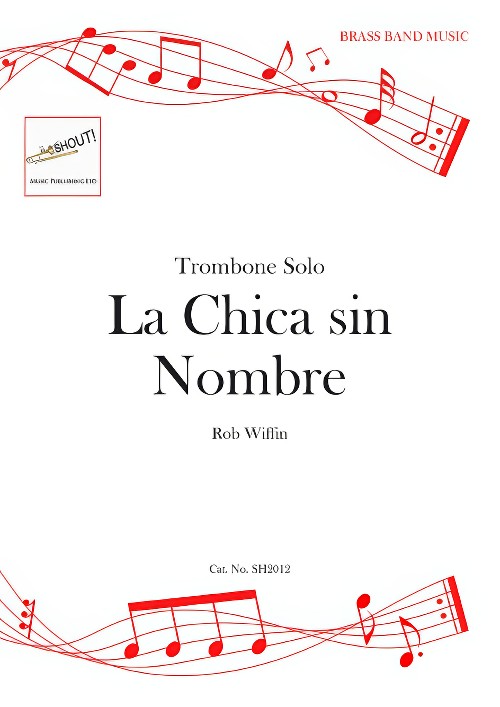
La Chica sin Nombre (Trombone Solo with Brass Band - Score and Parts) - Wiffin, Rob
A vibrant, rhythmic solo for trombone and bandLa Chica sin Nombre was written in March 2020 at the request of Brett Baker. He wanted something in Latin style so I chose to go for a Mambo-type dance piece. In obtaining the right percussion sound I would always ask for Conga drums and Mambo Bell/Timbales rather than drum kit. The piece needs to be played with an appropriate feel for Latin music. It should sound light and easy to play but has a few tricky moments- especially the cadenza-like sections from F to H. The virtuosic section at letter G can be cut if required.- Rob WiffinDuration: 4.15
Estimated dispatch 7-14 working days
-
 £35.00
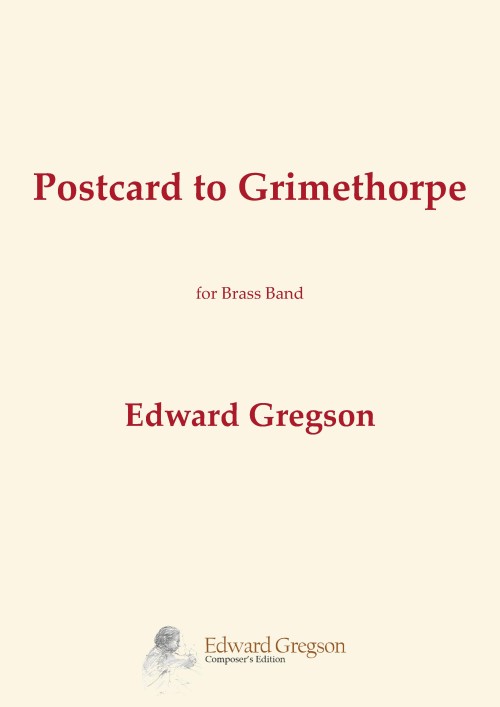
Postcard to Grimethorpe (Brass Band - Score and Parts) - Gregson, Edward
I composed the original version of Postcard to Grimethorpe in 1993 at the request of Elgar Howarth, for a concert at the Queen Elizabeth Hall, London, given by the Grimethorpe Colliery Band. This was at a time when after the Grimethorpe Colliery pit closed the future of the band was in severe jeopardy. The concert was given in aid of the band, both through publicity and funding.Then in late 2022 Jack Stamp, the American composer, conductor and educator, and at that time international composer-in-association with Grimethorpe, contacted me to say that he had discovered my short piece in the band library, and asked if I might extend it for a recording he was sponsoring for the band - the repertoire to consist entirely of music specially composed for Grimethorpe.I agreed and decided to extend the piece by using the miner's hymn Gresford, as a symbolic gesture of protest at the many thousands of miners in the UK who were made redundant from their jobs. After an angular (quasi-atonal) first section, the hymn enters, softly at first, but with each phrase it becomes more powerful and insistent, ending with the final phrase triumphantly accompanied by melodic percussion (replacing the drums and cymbals of the earlier phrases, as if the band were then on the march). However, this short work ends softly and gently, as if anger has been replaced by quiet resolution and determination, looking to the future with confidence.- Edward GregsonDuration: 3.00
Estimated dispatch 7-14 working days
-
£12.00
Postcard to Grimethorpe (Brass Band - Score only) - Gregson, Edward
I composed the original version of Postcard to Grimethorpe in 1993 at the request of Elgar Howarth, for a concert at the Queen Elizabeth Hall, London, given by the Grimethorpe Colliery Band. This was at a time when after the Grimethorpe Colliery pit closed the future of the band was in severe jeopardy. The concert was given in aid of the band, both through publicity and funding.Then in late 2022 Jack Stamp, the American composer, conductor and educator, and at that time international composer-in-association with Grimethorpe, contacted me to say that he had discovered my short piece in the band library, and asked if I might extend it for a recording he was sponsoring for the band - the repertoire to consist entirely of music specially composed for Grimethorpe.I agreed and decided to extend the piece by using the miner's hymn Gresford, as a symbolic gesture of protest at the many thousands of miners in the UK who were made redundant from their jobs. After an angular (quasi-atonal) first section, the hymn enters, softly at first, but with each phrase it becomes more powerful and insistent, ending with the final phrase triumphantly accompanied by melodic percussion (replacing the drums and cymbals of the earlier phrases, as if the band were then on the march). However, this short work ends softly and gently, as if anger has been replaced by quiet resolution and determination, looking to the future with confidence.- Edward GregsonDuration: 3.00
Estimated dispatch 7-14 working days
-
 £23.99
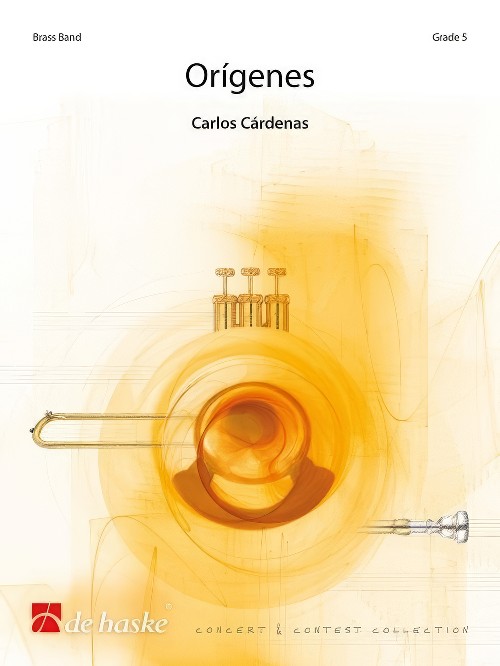
Origenes (Brass Band - Score only) - Cardenas, Carlos
Origenes (Origins) was commissioned by the European Brass Band Association as a test piece for the challenge section of the 38th European Brass Band Championship in Freiburg, Germany 2015. It is a spectacular piece from the pen of Carlos Cardenas, who belongs to a new generation of composing talent. The clave, a rhythmic pattern, which originally comes from African music, was the inspiration for this innovative piece, all motifs and structures being derived from it. The six parts feature a wide spectrum of percussion instruments, reveal an impressive range of new sound combinations and yet are very accessible for the audience.Duration: 10.45
Estimated dispatch 7-14 working days
-
£134.99
Origenes (Brass Band - Score and Parts) - Cardenas, Carlos
Origenes (Origins) was commissioned by the European Brass Band Association as a test piece for the challenge section of the 38th European Brass Band Championship in Freiburg, Germany 2015. It is a spectacular piece from the pen of Carlos Cardenas, who belongs to a new generation of composing talent. The clave, a rhythmic pattern, which originally comes from African music, was the inspiration for this innovative piece, all motifs and structures being derived from it. The six parts feature a wide spectrum of percussion instruments, reveal an impressive range of new sound combinations and yet are very accessible for the audience.Duration: 10.45
Estimated dispatch 7-14 working days
 View Music