
Results
-
 £76.99
Let's Celebrate - Dagmar Kildevann
Is there something to be celebrated? Then let's play 'Let's Celebrate'! This four-part suite has been based on two birthday songs: the world-famous 'Happy Birthday to you' (which is also sung in many other languages), and the Dutch song 'Lang zal hij/zij leven'. The Fanfare opens in grand style with the motif of 'Lang zal hij leven' and is followed by a cheerful March in which the motifs of both songs can be heard. The third part, Song, forms a moment of contemplation, and the birthday presents are unwrapped by the percussion section in the fourth part, Surprise Party. The yell may be adapted to the occasion. (the sleigh bells caused the composer to note down this somewhat peculiar yell). Of course everybody is expected to join in.
Estimated dispatch 5-14 working days
-
 £60.99
Four Easy Dances - Peter Martin
'Four Easy Dances' is a four-part suite from Gobelin's 'Flexy Band Collection'. This series is meant for starter ensembles, i.e. youth orchestras which may not have the full range of instruments available yet. Therefore, it is possible to combine various instruments. 'Four Easy Dances' comes from the 'Flexy 3 Series' and can in principle be played by only three instruments, completed with three percussion instruments. 'Four Easy Dances' consists of: 1. Hop, Skip and Jump, 2. Little Polka, 3. Spanish Dance (castanets are obligatory) and finally 4. Tango.
Estimated dispatch 5-14 working days
-
£76.99
Jubilant Prelude - Toon Hagen - Dirk Annema
'Jubilant Prelude' is an orchestration of the 'Preludium over Psalm 150' originally composed for organ by Toon Hagen. Since 1998 Toon Hagen has been organ-player of the 'Grote or Sint Michaelskerk' in Zwolle (the Netherlands). He has written several 'contemporary' compositions for organ.'Jubilant Prelude' has a capricious character by the use of irregular measures and its many measure changes. The structure of the Prelude is that of a fugue and is based on motives from the psalm.After the first climax, which is both dynamic and harmonic, the theme in the Andante Jubiloso is clearly audible and it is alternated with erratic motifs. Tension increases until at last the psalm itself isheard in all its glory. The melody of the psalm sounds as a cantus firmus in tenor register, with motifs in ornamentation for saxophones, bugles and trumpets. The finale, like the prelude is capricious and vehement.The instrumentation for brassband was made by Dirk Annema. It is particularly colourful and has a surprising role for the percussion section.
Estimated dispatch 5-14 working days
-
 £76.99
Ever so samba - Peter Martin
The rhythm of the samba was originally created in Africa and brought to Brazil by the slaves . Here it became the national dance. For every festive occasion and especially the carnival festivities (Rio de Janeiro) samba music is played. The World's Fair in New York (1939) was the reason to the biggest spread of the samba. The cornet section gets an opportunity to feature in Ever so Samba. Together with the swinging percussion section they let you enjoy a South American party.
Estimated dispatch 5-14 working days
-
 £80.00
St. Magnus - Kenneth Downie
Dedicated to Alastair Massey, an inspirational music teacher. Commissioned by the Scottish Brass Band Association for the 2004 European Brass Band Championships in Glasgow. This music is a set of variations on the tune known as St Magnus, which is attributed to Jeremiah Clarke. Most people will associate it with Thomas Kelly's hymn which begins: "The Head that once was crowned with thorns is crowned with glory now". The tune is very simple, consisting of just two, four-bar phrases. Neither is there much in the way of rhythmic variety, every note being a crotchet with the exception of two quavers, and the last note in each phrase. Within such a simple structure, however, lies considerable strength. THEME The listener is given the opportunity of hearing it twice, in full, at the beginning, starting with one player but soon taken up by the full ensemble. It returns in the middle of the music and is stated again near the end. This has been done quite deliberately in the hope that there will be an appreciation of what material is being developed, by the listener as well as by those with access to the score, who are able to see the visual connections. VARIATION 1 This takes the rhythm of the last part of the theme and also uses the shape of the opening as a recurring figure. The mood is whimsical and skittish, with short, teasing rhythmic figures tossed around the band, and quick interplay with percussion, at a fast tempo. An energetic flourish finishes this variation before the Andante espress. VARIATION 2 This commences with chords related to the opening of Variation 1. The cantabile on solo comets establishes a new, lyrical mood and there is scope for expressive playing in a series of short solo passages. The theme works its way unobtrusively into the texture before a reprise of the solo cornet melody and some more lyrical interchanges between Eb bass, euphonium, flugel horn and comets. The variation ends serenely with clear references to the last phrase of the theme. VARIATION 3 The first idea to dominate is clearly linked to the shape of the theme's first phrase. There is a frenetic feel to much of this variation, with considerable energy and instability created by extensive use of cross-rhythms. A thinning-out of the score marks a clear change to development of the start of the second phrase of the theme. This proves to be short-lived however, and the opening material returns leading to a restatement of the theme, "Maestoso," after which a euphonium cadenza links to Variation 4. VARIATION 4 Here we have some solos for euphonium, cornet, trombone and Eb bass set against a background of horns and baritones presenting a pensive statement of the theme's opening. VARIATION 5 This commences Allegro, with lively work for cornet and euphonium spreading to the whole band before attention focuses on the beginning of the second phrase of the theme which is initially presented in diminution, then in regular rhythm, then in inversion. An increase in tempo coupled with a decrease in volume, requires dexterity and control, with several metrical challenges thrown in for good measure. The same fragment of phrase becomes an ostinato which generates a frenzied climax, punctuated by short, dramatic silence, before the opening figure returns and the music gradually winds down. The tubular bells herald the final return of the theme, in augmentation, marking the start of the Finale. FINALE This features the running semiquavers of the previous variation sounding in counterpoint. A fast, furious coda speeds the work to a conclusion while references to the opening of the theme are still trying to break into the texture of the music. Kenneth Downie
Estimated dispatch 5-14 working days
-
 £56.90
Fascinating Drums / Pavane In Blue - Ted Huggens
Fascinating Drums', one the most famous compositions of Ted Huggens. Great fun for your audience and band, with a special feature for your percussion section in Fascinating Drums!! 'Pavane in Blue', a real nice slow blues.
Estimated dispatch 5-14 working days
-
 £56.90
Samba Sensation - Kees Vlak
A solo for alto saxophone or flugelhorn. Recommended for beginners. A good percussion performance will create a certain tension. The solo part does not require a developed technique, but rather a good sound.
Estimated dispatch 5-14 working days
-
 £41.30
Adventure Games - Ennio Salvere
A beautiful four part suite for youth band. I. Adventure Game: a cheerful march with a strong rhythmical percussion beat; II. Free Again;: an attractive slow introduced by a beautiful trumpet sol; III. Jamaican Sun : a characteristic and titillating calypso that will give the heebie-jeebies; and IV. Rock the House: a smooth rock tune that will make everybody itching to dance. The whole suite is extremely well orchestrated by Ennio Salvere.
Estimated dispatch 5-14 working days
-
 £52.70
Far Eastern Dream - Paul Voet
The longest trip we make is to the Far East. Japan, China, Tibet,... all countries with an enormous cultural background and history. Percussion is very important here to give a rich dimension to this Japanese 'Black Bamboo' theme. Tam-tam, Chinese cymbals, Tibetan gong and a kododrum (if not possible, large floor tom) together with marimba and glockenspiel are used all the time in a carefulway. A solo cornet presents the main theme that is answered by the whole lower brass section. While this theme develops now and then the sounds of the impressive 'dung' is heard. (dung is the Tibetan very large trumpet-like instrument with loud and very deep sounds) In a quicker tempo Eb bass, euphonium and solo cornet start with the theme and even the counter theme. The whole group joins the party but everything ends very silently with mute.
Estimated dispatch 5-14 working days
-
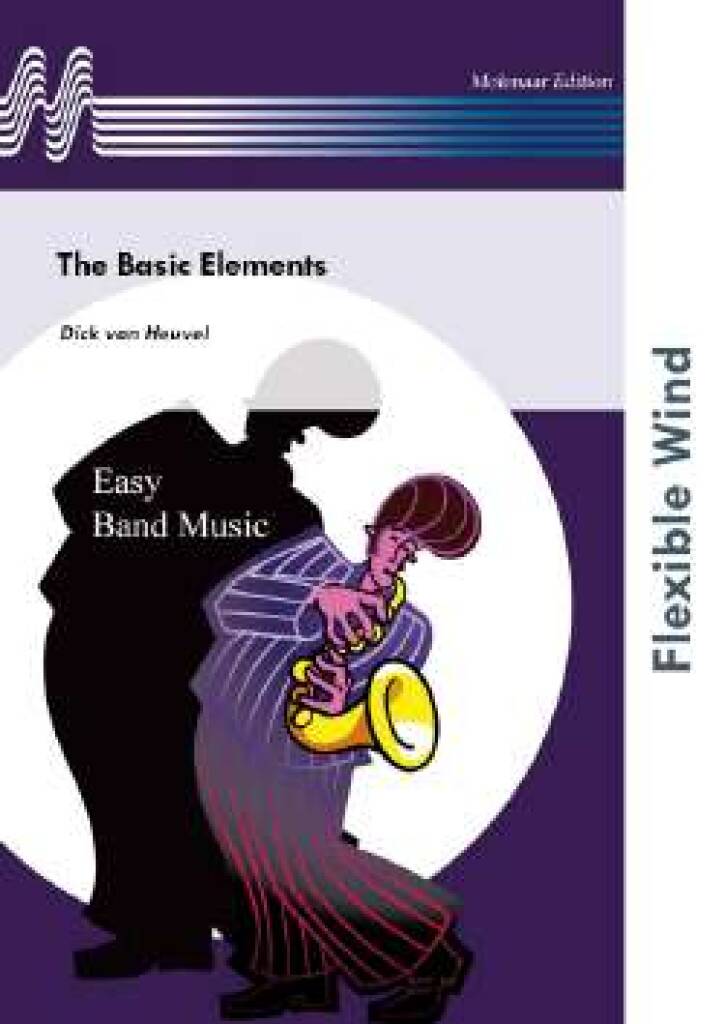 £63.40
The Basic Elements - Dick van Heuvel
In this rather simple but extremely well sounding suite in four parts, the Dutch composer Dick van Heuvel has made a musical evocation of the four basic elements of nature, namely earth, air, water and fire. The composition is written for five parts plus percussion, so here we have another fine composition for flexible instrumentation that can be played already by small bands.
Estimated dispatch 5-14 working days
 View Music