
Results
-
 £24.95
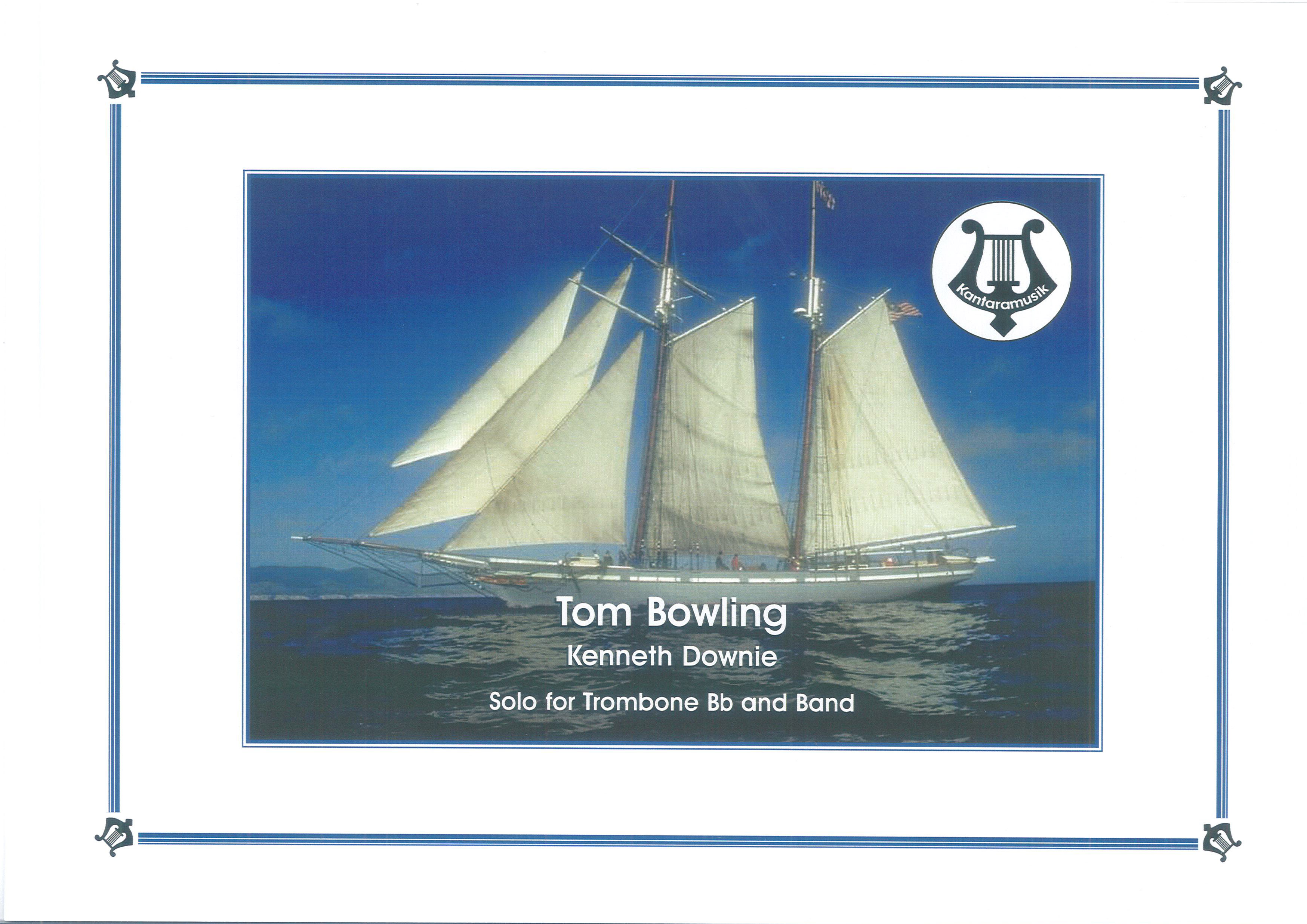
Tom Bowling - Trombone Solo (Brass Band - Score and Parts)
This wonderful song is invariably featured in the last night of the BBC Promenade Concert series as it is included in Henry Wood's Fantasia on British Sea Songs. It is played as a cello solo and always provides one of the most sensitive, melancholic moments of the evening. It the trombone soloist rises to the challenge, there will not be a dry eye in the concert hall!
Estimated dispatch 7-14 working days
-
 £39.95
Sing with the Band Medley No.2
Includes: Part 1: The Miller of The Dee; Some folks Do; All Through the Night; John Peel. Part 2: Early One Morning; My Bonnie Lies Over the Ocean; Cock Robin; Auld Lang Syne. Word Sheet included
Estimated dispatch 7-14 working days
-
 £34.95
SLOW RIDE IN A STATIC MACHINE, A (Brass Band) - Lawrence, Phil
A Slow Ride in a Static Machine was inspired some time ago when my (late) Father came to visit me "down in London" as he put it. It was based not on one of his circular mishaps, but on several! He was always directed carefully, but refused to carry a map in the car! At one time when I lived in North London I would meet him outside the capital, and he would then follow be back to my place, but after I moved to East London I made him bite the navigational bullet and transverse the 'M25 Orbital'. His main problem seemed to be getting off this mesmerising circular cark park. He would often phone (in a weary tone) from the Dartford Tunnel (which is 5 junctions past the one he needed to get off at), asking me to, "bring him in" so to speak. I would always refuse. And then, he would do the opposite (especially when travelling at night), he would phone me up from near Cambridge (he'd gone the wrong way up the M11 away from London by 45 miles), and would ask where he was!The title is obviously a play on John Adams' composition, A Short Ride In A Fast Machine. This quirky tone poem starts as a wind-up by using those unwanted intervals of augmented 4th's and minor 9th's & 7th's in the main tune, before hearing the road works, the juggernauts multi horns, fender-benders, ambulance and police sirens! This then all works to a back beat on kit. The wind-up start gets to an almost Go-Go 1960's Disco middle section (the nostalgic hay-days of the open road), where our wind-up tune falls into place and we all relax as we can now drive at 42.1 mph! We DC, and then get into a right car mess in the Coda!Phil Lawrence.Duration:4:00
Estimated dispatch 7-14 working days
-
 £75.00
Scottish Suite (Brass Band - Score and Parts) - Skinner, Colin
A? four movement Gaelic suite for brass band. Includes: Simmer Dim (The night-long twilight in Orkney and Shetland in midsummer, when dusk runs more or less directly into dawn and it is never truly dark); Dance o' the Tattie-Bogles (Another name for scarecrows. We imagine them in the fields, one by one coming to life and joining in an extraordinary and chaotic dance); Sweetheart Abbey (Inspired by the ruined abbey near Dumfries founded by Dervorguilla of Galloway, in memory of her husband. After his death, she kept his embalmed heart with her for the rest of her life and it was buried alongside her when she died); Clanjamfrie (A drunken rabble meet in a remote Highland pub and proceed to talk nonsense and dance the night away). Duration: 11.15
Estimated dispatch 7-14 working days
-
 £29.95
Lead, Kindly Light (Brass Band - Score and Parts) - Broughton, Bruce
This beautiful hymn is one of trust and faith, building in confidence 'till the night is gone.' This arrangement follows that line of confidence. The melody begins unaccompanied, which is to say 'alone', and the eventual accompanying voices enter sombrely. Instead of a traditional final cadence, the 'leading of the light' continues, using the first four notes of the hymn as a motif that leads to a second, more positive statement of the melody, underscored by a walking motion. The positivity grows and lasts through a final grand statement of the hymn. A short meditative coda follows, and the arrangement ends with a solo note of reflection.
Estimated dispatch 7-14 working days
-
 £40.00
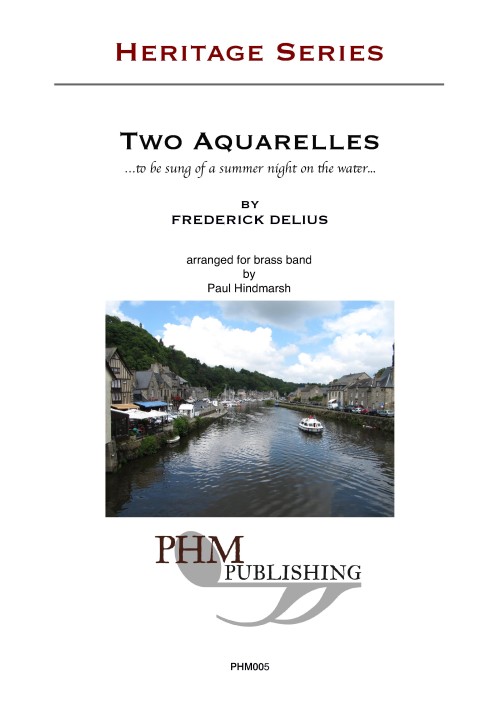
Two Aquarelles (Euphonium Feature with Brass Band - Score and Parts) - Delius, Frederick - Hindmarsh, Paul
In the late spring of 1917, the Bradford born composer, Frederick Delius (1856 - 1934) composed two short part-songs at his home in Grez-sur-Loing. The river ran along the bottom of his garden and he called the two miniatures To be sung of a summer night on the water. The First World War was at its height, but one would never guess that from the languid and serene quality of these richly textured nocturnes. The songs were first heard in London on 28 June, sung by the Oriana Madrigal Society, conducted by Charles Kennedy Scott. In 1932 Delius's amanuensis, Eric Fenby, arranged them for string orchestra as Two Aquarelles. While I have taken Fenby's title, my arrangement is a note-for-note transcription of the choral original. It was prepared in early in 1993 for Besses o' th' Barn Band, of which I was Musical Director at the time. In the second song, the prominent tenor solo has been given to the solo euphonium, who should stand apart from the band in performance.- Paul HindmarshDuration: 5.00
Estimated dispatch 7-14 working days
-
£69.95
Starmaker (Brass Band - Score and Parts) - Steadman-Allen, Ray
Described by the composer as one of his more ambitious works for brass band, this work is in three movements. Although each movement is capable of standing alone, the composer's own concept is totality with the three movements forming a composite whole. Starmaker presents in music the concept of God's creation of the universe. The frantic and sometimes harsh music of the first movement portrays the chaos from which the immortal and invisible wisdom of God created the order and structure of the heavens, with the stars and planets in their ordered places. An exquisite second movement, based on the benediction 'Now the day is over', brings a calm and ordered peace to the universe, also reminding listeners of the night sky, when God's amazing work is best viewed in all its awesome wonder. The final movement is celebratory in nature, with fragments of melodies like 'Praise to the Lord, the Almighty, the King of creation' appearing in various guises.
Estimated dispatch 7-14 working days
-
£34.95
Starmaker (Brass Band - Score only) - Steadman-Allen, Ray
Described by the composer as one of his more ambitious works for brass band, this work is in three movements. Although each movement is capable of standing alone, the composer's own concept is totality with the three movements forming a composite whole. Starmaker presents in music the concept of God's creation of the universe. The frantic and sometimes harsh music of the first movement portrays the chaos from which the immortal and invisible wisdom of God created the order and structure of the heavens, with the stars and planets in their ordered places. An exquisite second movement, based on the benediction 'Now the day is over', brings a calm and ordered peace to the universe, also reminding listeners of the night sky, when God's amazing work is best viewed in all its awesome wonder. The final movement is celebratory in nature, with fragments of melodies like 'Praise to the Lord, the Almighty, the King of creation' appearing in various guises.
Estimated dispatch 7-14 working days
-
 £74.99
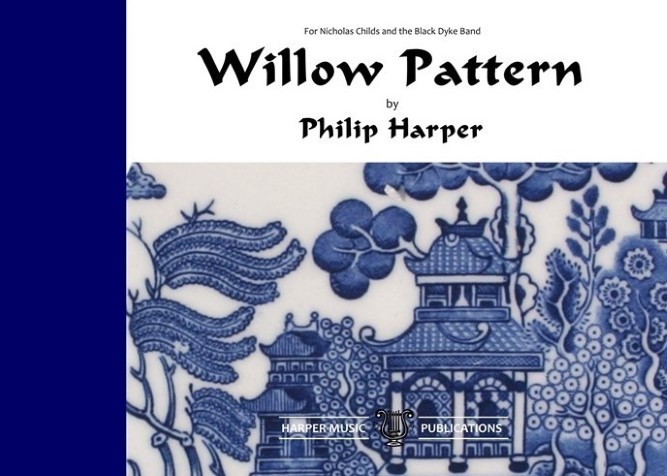
Willow Pattern (Brass Band - Score and Parts) - Harper, Philip
Composed in 2009 for Nicholas Childs and the Black Dyke BandThis piece tells the Willow Pattern legend through music. Several leitmotifs are used both for the different characters and also for some of the important emotions in the tale. Additionally, Knoon-se's part is mainly played by the flugel horn, Chang by the euphonium, the Mandarin by the Eb Bass and the Duke Ta-jin by the trombone.The Willow Pattern Legend:Once, in ancient China, there lived a wealthy and powerful Mandarin who had a beautiful daughter, Knoon-se. She had fallen in love with Chang, a humble accountant, which angered her father who imprisoned her in the Pavilion by the river with only the exotic birds for company. She learnt that the Mandarin planned to marry her to the pompous Duke Ta-jin and that the wedding would take place on the day the blossom fell from the willow tree, so she sent Chang a message: "Gather thy blossom, ere it be stolen". The Duke arrived by sea amid great fanfare when the tree was heavy with bud, and nights of magnificent banquets followed. After one such occasion when the Mandarin slept, Chang crept over the crooked fence and tiptoed into the Pavilion to rescue Knoon-se, but as they escaped the alarm was raised. They fled over the bridge with the Mandarin close on their heels brandishing his whip. They managed to escape by boat to a secluded island where they lived happily for a time. Meanwhile, the Mandarin learned of their refuge and, intent on revenge, he ordered his soldiers to kill them. As Knoon-se and Chang slept at night, the men set fire to the pagoda in which they lived and the lovers perished in the flames. However, the Gods, moved by the lovers' plight, transformed their souls into two turtle-doves which rose from the charred remains, soaring above the Earth, symbolising eternal happiness.Willow Pattern is dedicated to the memory of Jean Harper who passed away as I was completing the piece and who was a great collector of porcelain and china-ware.Duration: 12:00
Estimated dispatch 7-14 working days
-
 £24.95
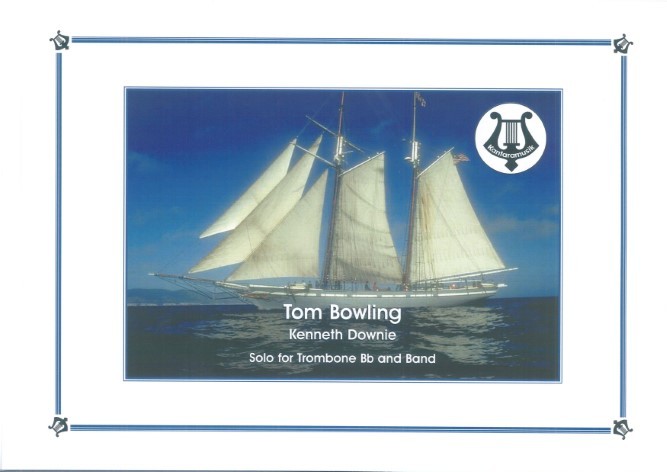
Tom Bowling - Trombone Solo (Brass Band - Score and Parts) - Downie, Kenneth
This wonderful song is invariably featured in the last night of the BBC Promenade Concert series as it is included in Henry Wood's Fantasia on British Sea Songs. It is played as a cello solo and always provides one of the most sensitive, melancholic moments of the evening. It the trombone soloist rises to the challenge, there will not be a dry eye in the concert hall!
Estimated dispatch 7-14 working days
 View Music