
Results
-
 £22.50
A Pastoral Symphony (Brass Band - Score only) - Redhead, Robert
This symphony for brass band seeks to explore the thought that 'the greatest need of any congregation is its pastor's personal holiness'. The first movement challenges the pastor 'to serve the present age', the tunes 'Majesty' and 'Lathbury' are used. The second movement expresses a priority to 'Seek...first the Kingdom of God'. The short third movement presents the question 'Except I am moved with compassion, how dwellest they Spirit in me?' before the triumphant finale reflects the desire of every Christian that his life and work will always be for the glory of God with the presentation of 'In my life Lord, be glorified'.
Estimated dispatch 7-14 working days
-
£59.95
Festivity (Brass Band - Score and Parts) - Condon, Leslie
This is a celebrational and witty composition that has all the hallmarks of Condon's innovative style. Originally written for brass quintet and first performed by chosen soloists in 1972, it was scored for brass band a few years later. Acrobatic energy, dignity and solemnity are all aspects of this work. The majestic hymn tune 'Gopsal' is the theme with which the words 'Rejoice, the Lord is King' are associated.
Estimated dispatch 7-14 working days
-
£29.95
Festivity (Brass Band - Score only) - Condon, Leslie
This is a celebrational and witty composition that has all the hallmarks of Condon's innovative style. Originally written for brass quintet and first performed by chosen soloists in 1972, it was scored for brass band a few years later. Acrobatic energy, dignity and solemnity are all aspects of this work. The majestic hymn tune 'Gopsal' is the theme with which the words 'Rejoice, the Lord is King' are associated.
Estimated dispatch 7-14 working days
-
£29.95
Wade In The Water (Brass Band - Score and Parts) - Ballantine, Leonard
Wade in the Water is a Negro Spiritual made popular in 1962 by the Ramsey Lewis Trio. Further versions followed in 1968 by Big Mama Thornton and in 1997 by Eva Cassidy. The song is thought to be a coded message for slaves escaping to freedom and tells the fugitive to walk in the water, instead of on the land, where tracking dogs cannot follow human scent. This version for brass band is in swing style.
Estimated dispatch 7-14 working days
-
£14.95
Wade In The Water (Brass Band - Score only) - Ballantine, Leonard
Wade in the Water is a Negro Spiritual made popular in 1962 by the Ramsey Lewis Trio. Further versions followed in 1968 by Big Mama Thornton and in 1997 by Eva Cassidy. The song is thought to be a coded message for slaves escaping to freedom and tells the fugitive to walk in the water, instead of on the land, where tracking dogs cannot follow human scent. This version for brass band is in swing style.
Estimated dispatch 7-14 working days
-
 £64.95
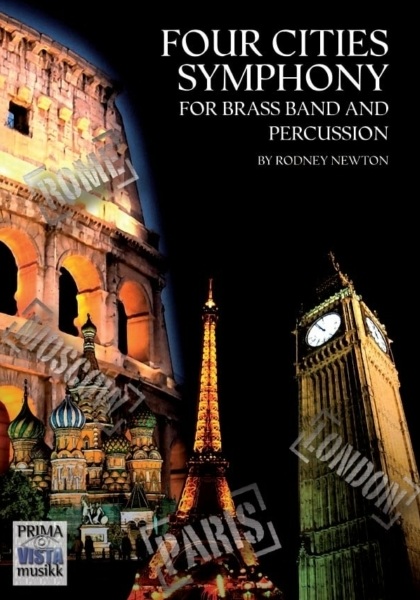
Four Cities Symphony (Brass Band - Score and Parts) - Newton, Rodney
This piece was commissioned by the National Contesting Council as the 4th section test piece for the 2008 Regional Brass Band Championships of Great Britain.This symphony (the composer's 12th) has four movements played without a break. The first centres on two aspects of the city of London: its history and pageantry and its role as a busy modern metropolis.The second movement depicts Paris, its street cafes and boulevards and riverside walks, in the form of a romantic waltz.The third movement is constructed around the Gregorian chants of the Lord's Prayer (Pater noster, qui es in caelis) and the Creed (Credo in unum Deum) in an evocation of the city of Rome. After a powerful climax, mysterious tramping footsteps are heard as the ghosts or a Roman legion march through the city by night. The vision fades and the pater noster is heard once again before the movement is brought to a close with the ancient Ambrosian chant, Christus Vincit, Christus Regnet, Christus Imperat.The final movement is an evocation of the city of Moscow, with its great historic buildings, its turbulent history and its fiery traditional music. At the outset a rather dour folk-like melody is heard which is transformed into a lively Cossack dance.This work is dedicated to Howard Wilson, former principal euphonium of City of Coventry Band who, in 1972, introduced the composer to top section brass band contesting.Duration: 11.00
Estimated dispatch 7-14 working days
-
 £59.99
David of the White Rock (Brass Band - Score and Parts) - Sparke, Philip
This is an ancient Welsh air that was first published in Relics of the Welsh Bards in 1794. Dafydd (David) Owain was a famous Welsh bard who lived on a farm called Gareg Wen (The White Rock) in Eifionydd, Carnarnvonshire, North Wales. Tradition has it that on his deathbed he called for his harp and composed this lovely melody, requesting that it be played at his funeral. Accordingly, it was later played at the parish church of Ynys-Cynhaiarn. Lyrics were later added by Ceiriog Hughes, which describe the melody's inspiration. This version for brass band retains all the beauty and simplicity of the original.Duration: 2:45
Estimated dispatch 7-14 working days
-
 £59.99
MacArthur Park (Brass Band - Score and Parts) - Webb, Jimmy - Sparke, Philip
Over a period of four decades Jimmy Webb (b. 1946) has written hits for a number of singers including Glen Campbell, Art Garfunkel, Frank Sinatra, Willie Nelson, Johnny Cash and Linda Ronstadt. His songs are often epic in character and include By the Time I Get to Phoenix; Up, Up and Away; Didn't We; Wichita Lineman and Galveston. MacArthur Park (1968) was unlike anything that had gone before it. Running at over 7 minutes, it is 2 or 3 times the length of most pop songs and has an extended orchestral interlude. Richard Harris' seminal recording topped the music charts in Europe, while peaking at number two on the U.S. charts. Philip Sparke has made this excellent arrangement for brass band, which is sure to become a regular feature on your concert programme.Duration: 07:30
Estimated dispatch 7-14 working days
-
 £128.00
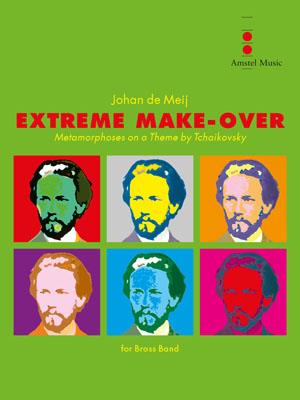
Extreme Make-Over (Brass Band - Score and Parts) - De Meij, Johan
The work, set as the test-piece for the 2005 European Brass Band Championships was inspired by a theme from the second movement of Tchaikovsky's String Quartet No.1 (Andante Cantabile). It consists of a number of musical metamorphoses on the theme and includes several excerpts from Tchaikovsky's Fourth and Sixth Symphonies and Romeo and Juliet. The most unconventional element of the work is instrumentation for ten tuned bottles to be played by members of the cornet section. This gives the piece an Indonesian Gamelan effect. Why not give your players something to get their teeth into with this impressive major work.Duration: 16:45
Estimated dispatch 7-14 working days
-
 £79.99
Variants on an English Hymn Tune (Euphonium Solo with Brass Band - Score and Parts) - Sparke, Philip
This set of variations on the well-known hymn tune Holy, holy, holy! will make a most satisfying addition to the solo repertoire for euphonuim and brass band. It is in the traditional air varie form with an introduction, theme and 3 variations. The original melody (known as Nicaea) was composed by John Bacchus Dykes' especially for Reginald Heber's renowned hymn of praise and became universally popular when it was included in Hymns Ancient and Modern in 1861. A beautiful solo that will test the soloists ability to show true emotion.Duration: 7:15
Estimated dispatch 7-14 working days
 View Music