
Results
-
 £29.95
In The Firing Line (Brass Band - Score and Parts) - Coles, Bramwell
Bramwell Coles wrote over 50 marches and so has been dubbed The Salvation Army's 'march king'! First published in 1925, this march has stood the test of time and remains a favourite.
Estimated dispatch 7-14 working days
-
£14.95
In The Firing Line (Brass Band - Score only) - Coles, Bramwell
Bramwell Coles wrote over 50 marches and so has been dubbed The Salvation Army's 'march king'! First published in 1925, this march has stood the test of time and remains a favourite.
Estimated dispatch 7-14 working days
-
 £55.00
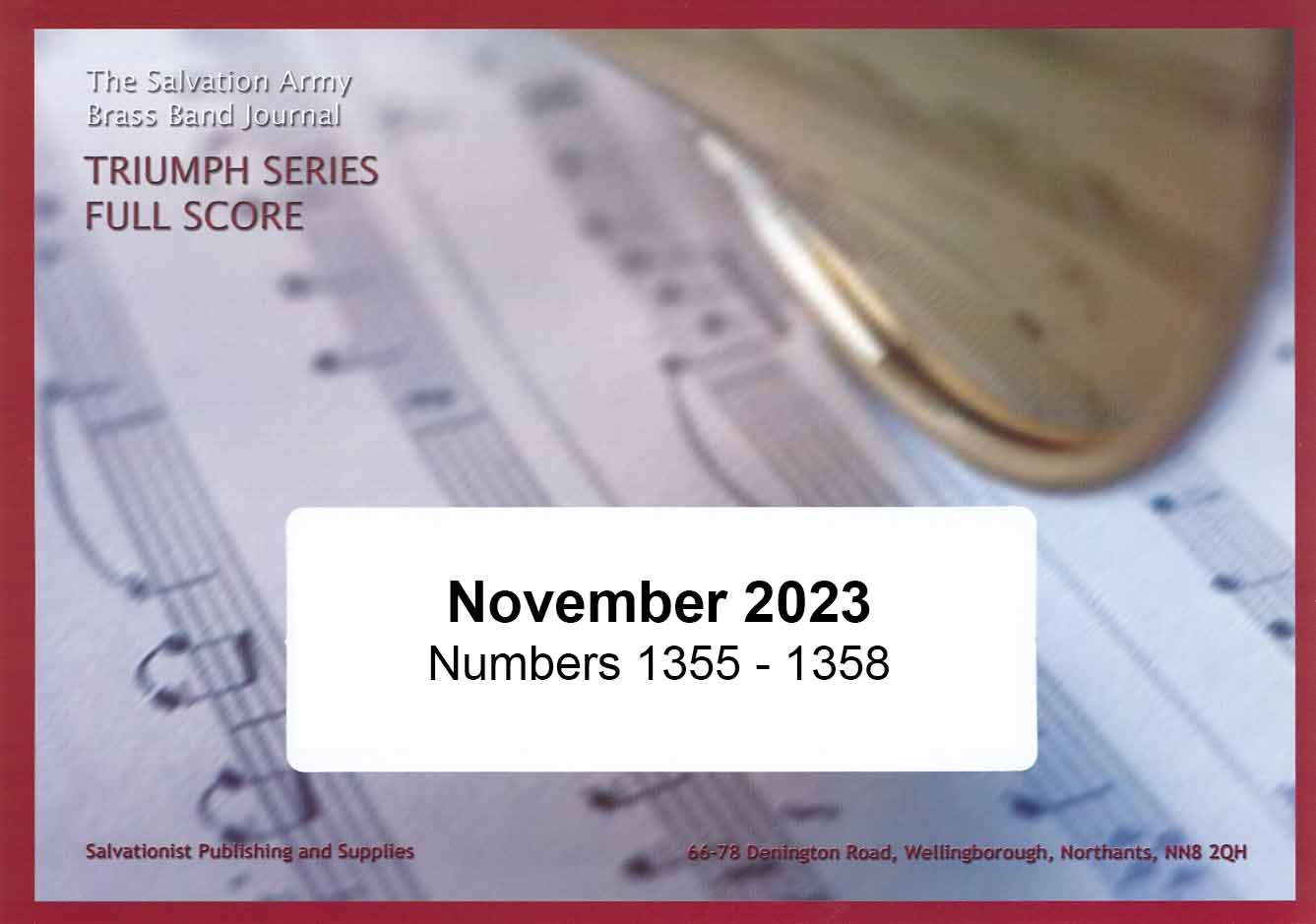
Triumph Series Brass Band Journal, Numbers 1355 - 1358, November 2023
1355: March Medley - Pardoned Forever (Keith Manners)This collection of Easter-themed melodies should be played with enthusiasm and vigour. Featuring the songs He lives (S.A.S.B. 229), Chris is alive! Let Christians sing (S.A.S.B. 217) and No more! No more! He remembers sins no more (S.A.S.B. 460), the positive message of Easter Sunday is reflected in this bright march style.1356: Selection - I love the sweetest name (Noel Jones)This devotional selection includes three songs that feature the name of Jesus and derives its title from the following lines of those songs; 'How sweet the name of Jesus sounds' (S.A.S.B. 78), 'O, how I love the Saviour's name! The sweetest name on earth' (S.A.S.B. 94) and 'Sweetest name on mortal tongue' (S.A.S.B. 93).1357: Renewal (Harold Burgmayer)Will J. Brand penned the song Renewal (S.A.S.B. 634), with music by Bramwell Coles, for 'Day of Renewal' meetings conducted by General Albert Orsborn in October 1949. It was published in that form in The Musical Salvationist in 1951. Over time these meaningful words of consecration became wedded to an alternative tune, a lovely melody by Oscar Ahnfelt known as Trust in God (T.B. 903). This setting for band is based on a male-voice arrangement, conceived for a time of renewed consecration, sung by massed bands at the Canadian Staff Band's 50th Anniversary Festival in 2019.1358: Groove Hosanna! (Munashe Chikwezvero)This is a funk setting of three well-known melodies associated with Jesus' triumphal entry into Jerusalem. Today, such celebratory processions, and indeed most large gatherings, usually feature rich forms of music-making. Music provides atmosphere and generates excitement, and it is hoped that a funk inspired arrangement of these songs will inspire listeners to 'move to the groove'. The first two songs, Children of Jerusalem (S.A.S.B. 356) and Give me joy in my heart, keep me praising (S.A.S.B. 362) encourage us to sing 'Loud hosannas to our King!'. The words of the third song, When his salvation bringing, remind us that he "smiled to hear their song".
Estimated dispatch 7-14 working days
-
 £45.00
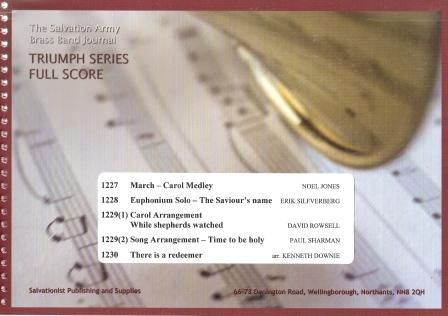
Triumph Series Band Journal July 2012 Numbers 1227 - 1230
No. 1227 March - Carol Medley (Noel Jones)This march features three carols, 'God rest ye merry, gentlemen', Hark! The herald angels sing' and 'Deck the Hall' together with brief references to others in a medley form. A couple of these references are somewhat camoflaged which provides further interest.No. 1228 Euphonium Solo - The Saviour's Name (Erik Silfverberg)A setting of Jane Clarke's lovely melody set to familiar words, 'There is a name I love to hear'.No. 1229 (1) Carol Arrangement - While shepherds watched (David Rowsell)A four-verse setting of the 16th Century tune, 'Winchester Old' commonly associated with the carol, 'While shepherds watched their flocks by night'.No. 1229 (2) Song Arrangement - Time to be holy (Paul Sharman)This arrangement of George Cole Stebbins' tune was originally made for the 2010 World Youth Convention in Sweden, the theme of which was 'Time to be holy'.No. 1230 There is a redeemer (Kenneth Downie)Melody Green-Sievright's popular song, 'There is a redeemer' was first published in 1982, 30 years before the appearance of this new setting.
Estimated dispatch 7-14 working days
-
 £38.95
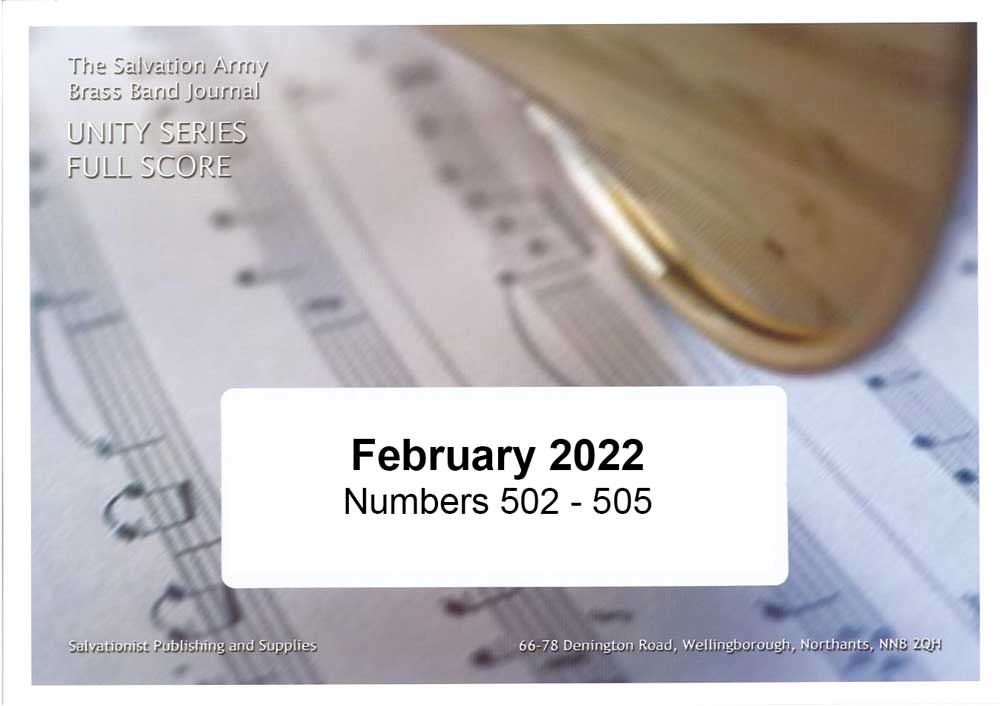
Unity Series Band Journal - Numbers 502 - 505, February 2022
502: See, what a morning (Gary Rose)This music is based on the popular Easter song of the same title (also known as Resurrection Hymn) by Keith Getty and Stuart Townsend (S.B.S. Volume VII).503: Light Force (Stephen Gibson)Originally written for a Young People's Band play-day, this exciting work brings together original themes as well as references to Jesus bids us shine (S.A.S.B. 870) and Shine, Jesus, shine (S.A.S.B. 261).504: Cornet Solo - Into your holiness (Jrgen Ijsendorn)Written for Martin Oosterbeek, who served in the military and undertook a tour of duty in Afghanistan, this work uses When I look into your holiness (T.B. 927), a song that provided solace during his time away.505: March - Turn to the Lord (Charles Craig)A tradition-style march perfect for groups with little rehearsal time.
Estimated dispatch 7-14 working days
-
 £34.95
The Southern Cross (Brass Band - Score and Parts)
The Southern Cross is one of several excellent marches by Brian Bowen in which he carried on the more sophisticated pattern of British marches by Wilfred Heaton, Leslie Condon and Ray Steadman-Allen. It was written for the Box Hill (Australia) Corps jubilee celebrations in 1970 and formed part of the band's repertoire when it toured Great Britain in the same year. The first half of the march features part of the song, 'March on!' by Klaus Ostby, an early pioneer of Salvation Army music in Scandinavia. The contrapuntal layering of melodies in the trio, especially in the finale where 'March on!' sounds one more triumphant time, is notable, as is the shift to a slower, more stately tempo. The harmonic and rhythmic style also represents the more modern sounds of Salvation Army brass band music in the late 1960s and early 1970s. Right from the opening gestures, listeners at early performances knew that a page had turned in the evolution of the Salvation Army march.
Estimated dispatch 7-14 working days
-
 £39.95
When Thunder Calls (Brass Band - Score and Parts)
When Thunder Calls was commissioned by Dr Nicholas Childs and the Black Dyke Band for their performance at the Gala Concert of the Swiss Open Championships in September 2011. When composing this piece, I decided to focus on both the music and the stage presentation. The way the piece has been composed and designed makes it a very effective way of starting a concert or a second half of a concert.At the start of the piece, the percussion enter the stage and take their positions in their usual place behind the band. They begin playing the piece without a conductor. They keep repeating the opening section while the Basses, Horns, Baritones and Euphoniums march onto the stage.This group of musicians take their seats with the Horns, Baritones and Euphoniums sitting where they usually sit in the band but the Basses sit where the solo cornets usually sit, forming an inner semi-circle of lower brass. When seated and when the music gets to the end of bar 4 the piece continues onto section A. All performers keep repeating this next 4-bar phrase until the trombones march onto stage and stand at the front of the stage with the Bass Trombone standing in between the other two trombones.All performers then play from figure B to C with the trombones taking the lead at the front. When the performers get to rehearsal figure C they repeat this section (the same as section A) while the trombones move from the front of the stage and take their positions where the Basses would normally sit (between the horns and the percussion) and remain standing. Meanwhile, the flugel enters the stage and stands at the front of the stage (standing where the trombones did). When in position the flugel soloist picks up into rehearsal figure D.When the flugel soloist finishes playing, just before rehearsal figure F they then move to their normal seat in the band. At figure F the cornets march onto the stage from either side, they turn and stand side by side each other facing outward towards the audience forming two 'fanfare' lines either side of the lower brass. The conductor follows the cornets on stage and on cue they lift their instruments at the same time and perform when the piece gets to figure G.There is no more moving around from this point on other than the solo cornet to move forward with the solo euphonium and perform their duet at letter H. Also the horns are required to stand and play at letter I and then sit just before J.When performed with all the choreography, this piece makes for an exciting addition to any concert repertoire both for the performer and the audience.Suitable for 3rd Section Bands and Above
Estimated dispatch 7-14 working days
-
 £29.95
Judd: Minneapolis IV
This march was the outcome of a request from Minneapolis IV Corps to write a march to celebrate its 60th anniversary. It is said that the composer received $25 for his efforts! At the time of its writing, Soderstrom had become a leading arranger for NBC Radio in Chicago and had mastered many contemporary American styles. His lush harmonies remind one of Gershwin, Porter, Berlin and Rodgers while even the scoring suggests an American big-band of the swing era! These and other novel touches make the march interesting to listen to, as well as to play, over 60 years on.
Estimated dispatch 7-14 working days
-
£29.95
Rhapsody in Brass (Score Only)
Rhapsody in Brass is in three movements and was written for the British Open Championships in 1949, held at Belle Vue in Manchester. The contest winners were Fairey Aviation Works Band under the baton of Harry Mortimer. Eric Ball came second with Ransome & Marles and Stanley Boddington 3rd with Munn and Felton Band. Rhapsody in Brass had the unusual distinction of being written as a test piece by a Salvation Army composer. Eric Ball's Resurgam was the only other piece to achieve that dual personality in that era.Dean Goffin was born in 1916 in Wellington, New Zealand, son of Henry Goffin, a Salvation Army officer and composer. At 19 he was appointed Bandmaster of the Wellington South Band and when World War II started, he enlisted in the New Zealand Armed Forces where he became Bandmaster of the 20th Infantry Battalion and later the 4th Brigade Band. During the time he served with them in the Middle East and Europe, he composed and arranged numerous pieces among which Rhapsody in Brass and the march Bel Hamid, later adapted for Salvation Army use and renamed Anthem of the Free.After the war, Dean kept on composing and his work was featured by the Wellington South Band. Later he transferred to Timaru for another job and became Bandmaster there. He was studying music at the time and as he wanted to take part in a competition for devotional selections for Salvation Army use, he sent some of his compositions to the International Headquarters. When Rhapsody for Brass was chosen as the test-piece for the British Open Championships, people at the Salvation Army started asking questions about the lack of publications of his work. It was discovered that the pieces submitted for the competition didn't meet the exact criteria. Among these pieces was one of his most appealing works The Light of the World which was published a year later, in 1950, the same year as he completed his Bachelor of Music studies at Otagu University.After entering the Salvation Army Training College in Wellington with his wife, Marjorie, Dean was in 1956 appointed National Bandmaster in the British Territory. Later he became National Secretary for Bands and Songster Brigades and in this period he organised the yearly festival in the Royal Albert Hall and was responsible for the national music schools in the UK. Dean returned to his home country in 1966 and to mark the centenary of the Salvation Army in New Zealand he was knighted by the Queen in 1983. Sir Dean Goffin died on 23 January 1984.
Estimated dispatch 7-14 working days
-
 £29.95
Cairo Red Shield (Brass Band - Score and Parts)
During World War Two, Salvation Army servicemen serving in Cairo formed a 'Red Shield Club', of which one of the elements was a band. Albert Raikes (more often known affectionately by his middle name, Stan) was for some time in charge of this band and wrote this march in memory of this wartime combination and the enthusiasts who were, at one time or another, members of it.
Estimated dispatch 7-14 working days