
Results
-
 £44.95
Powerhouse (Brass Band - Score and Parts) - Downie, Kenneth
Spirit divine, come as of old. So begins the song by Brindley Boon, and that phrase becomes the message of this piece, and an important motif in the music. It appears at the very beginning of the work and recurs at important points during the piece. The theme of the need for spiritual power is further underlined by the use of the hymns Show your power, Wonder-working power and the very old chorus Send a new touch of power on my soul, Lord.The composer first heard Boon's song Spirit Divine when it was sung by Parkhead Songsters in the Sunday morning meeting at his home Corps of Greenock Citadel. They were visiting for the weekend from Glasgow, and were conducted by Songster Leader Walter Chalmers, himself a beautiful lyric tenor soloist. They sang it in a moving fashion, unaccompanied, and such was the impact that, at the conclusion, many people went to the mercy seat. It made a huge impression on the young composer. It was the first time that Downie discovered the enormous power of music in worship. It also serves as a reminder to us all that young people of a tender age are very capable of grasping deeply significant events happening around them. This music was written for the 2020 UK Territorial Youth Band course.
Estimated dispatch 7-14 working days
-
 £40.00
Great Gate of Kiev, The (from Pictures at an Exhibition) (Brass Band - Score and Parts) - Mussorgsky, Modest - Littlemore, Phillip
Modest Mussorgsky was a close friend of the young artist and architect Victor Hartmann, and his death in 1873 plunged Mossorgsky into a deep depression. The following year a memorial exhibition in St. Petersburg displayed Hartmann's paintings, costumes, architectural designs and sketches. Mussorgsky's visit to it, combined with his desire to write a piece in his friend's memory, inspired him to compose his?Pictures At An Exhibition?for piano. A suite of ten movements, with a recurring Promenade theme, it is one of the composer's most famous works and regarded as a showpiece for virtuoso pianists. It is perhaps the orchestral transcription made by Maurice Ravel in 1922 that is now the most famous version of it. This arrangement opens with a brief excerpt from?The Hut on Fowl's Legs, which was based on a painting of an elaborately carved clock depicting Baba Yaga, a horrible tiny witch that feasts on human bones. The tenth, and final picture in Mussorgsky's masterpiece is commonly referred to as?The Great Gate of Kiev, although it's literal translation is The Bogatyr Gates -- a Bogatyr being a hero figure in medieval East Slavic legend. It features a grand main theme that is interspersed with a more solemn hymn-like secondary theme. The work closes with a grand final rendition of the Promenade theme that almost grinds to a halt at what must be the foot of what were to be magnificent ceremonial gates (although they were never actually built!). Duration: 6:00
Estimated dispatch 7-14 working days
-
 £35.00
I Vow to Thee, My Country (Brass Band - Score and Parts) - Holst, Gustav - Littlemore, Phillip
!!I Vow to Thee My Country. Originally for unison voices with orchestra, Holst adapted it as a hymn tune and called it Thaxted , named after the village where he lived for many years. Because of the sentiment in the words it has now become a staple of Remembrance services.The American Composer, Geoff Knorr, incorporated Holst's music into his score for the strategy-based video game Civilisation, where it is used to depict the England of Elizabeth I. It is from this music that the transcription is made. Duration: 5.40
Estimated dispatch 7-14 working days
-
 £65.00
Royal Fireworks, Music from the (Brass Band - Score and Parts) - Handel, George Frideric - Blakeson, Don
Handel's Music For The Royal Fireworks was composed in 1749 to celebrate the signing of the Treaty of Aix-la-Chapelle and the end of the War of the Austrian Succession. The site chosen was the fashionable upper part of St. James Park, which was becoming known at that time as Green Park. The Green Park 'Machine', which housed the pyrotechnics was an elaborate affair adorned with "statues and other figures, festoons of flowers, and other lustres". It was announced that there would be some 10,000 rockets and other devices to be let off, all culminating in a grand, burning sun with 'Vivat Rex' at its centre. There were also rumours that the event was to be accompanied by an impressively large band of military music and mention was made of "40 trumpets, 20 french horns, 16 hautboys (oboes), 16 bassoons, 8 pairs of kettle drums, 12 side drums, a proper number of flutes and fifes; with 100 cannon to go off singly at intervals". It is unlikely that Handel had ever conceived such forces and it was merely the promoter's hyberbole, not least because it was unlikely that there were sufficient numbers of extra military musicians available that could read music, as most played from memory. It is also likely that Handel, and his publisher, were conscious that future performances would be hindered by such forces. The autographed score lists the instrumentation as 9 trumpets, 9 french horns, 24 hautboys, 12 bassoons, 3 pairs of kettle drums and up to 4 side drums. The work is in five movements, although Handel's original score did not indicate in which order they should be played. However, in this score they are arranged to be played as follows: Overture; Bour?e; La Paix; Minuets; La R?jouissance. Duration: 19:00
Estimated dispatch 7-14 working days
-
 £95.00
King Lear (Brass Band - Score and Parts) - Bantock, Granville - Hindmarsh, Paul
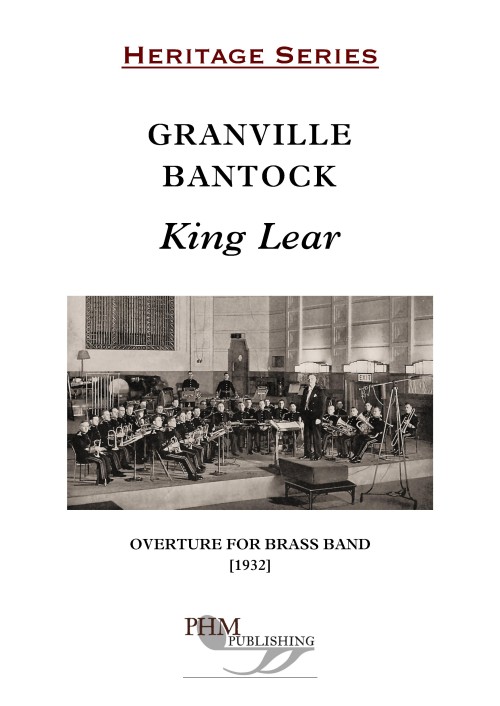
Sir Granville Bantock (1868 - 1946) composed the second of his five major brass band work for Callender's Cableworks Band, completing the commission on 30 November 1932. Based in the Thames-side district of Belvedere near Erith, the band was active between 1898 and 1961. The works band of the Callender Cable & Construction Co. Ltd, it was at the peak of its popularity during the 1930s and was a frequent broadcaster on the radio. The band employed an in-house arranger and played saxophones in its lighter material. King Lear was one of the band's major commissions and was not published in Bantock's lifetime. The manuscript score and parts were thought to be lost for decades, but were found in the library of the Haydock Band (Lancashire), which had inherited part of Callender's library of manuscripts material and bespoke arrangements after it has been transferred to nearby Prescott Cables Band after Callender's Cable Works closed.King Lear is a substantial work, in essence a dramatic tone poem in the romantic Tchaikovskian manner, presenting a series of character portraits of the foolish old king and his three daughters, Goneril, Regan and Cordelia. The music is dramatic and lyrical by turns, with the most generous lyrical episode revealing perhaps the warm-hearted Cordelia. An expansive melody that flows from this is brought back towards the end as the main climax of the work.In 2001, Bantock's score was recorded by the University of Salford Brass Band, conducted by Dr. Roy Newsome. The original is serviceable, but in comparison with the orchestral version he made in 1936 (part of which was recorded on a Paxton 78 rpm) and later brass band scores, performing editions of which were prepared by others, it lacks colour and range typical of Bantock's orchestral work. Above all it lacks percussion, which can be heard on the recorded extract. With the kind permission of the Bantock Estate, I have prepared a performing edition for publication that incorporates percussion, derived from the orchestral recording and added editorially in similar manner elsewhere. I have revoiced some of the low- lying instrumental parts to present the material in more comfortable ranges. Editorial interventions more elaborate than revoicing the original text have been identified as cue notes.- Paul HindmarshDuration: 15.00
Estimated dispatch 7-14 working days
-
£40.00
King Lear (Brass Band - Score only) - Bantock, Granville - Hindmarsh, Paul
Sir Granville Bantock (1868 - 1946) composed the second of his five major brass band work for Callender's Cableworks Band, completing the commission on 30 November 1932. Based in the Thames-side district of Belvedere near Erith, the band was active between 1898 and 1961. The works band of the Callender Cable & Construction Co. Ltd, it was at the peak of its popularity during the 1930s and was a frequent broadcaster on the radio. The band employed an in-house arranger and played saxophones in its lighter material. King Lear was one of the band's major commissions and was not published in Bantock's lifetime. The manuscript score and parts were thought to be lost for decades, but were found in the library of the Haydock Band (Lancashire), which had inherited part of Callender's library of manuscripts material and bespoke arrangements after it has been transferred to nearby Prescott Cables Band after Callender's Cable Works closed.King Lear is a substantial work, in essence a dramatic tone poem in the romantic Tchaikovskian manner, presenting a series of character portraits of the foolish old king and his three daughters, Goneril, Regan and Cordelia. The music is dramatic and lyrical by turns, with the most generous lyrical episode revealing perhaps the warm-hearted Cordelia. An expansive melody that flows from this is brought back towards the end as the main climax of the work.In 2001, Bantock's score was recorded by the University of Salford Brass Band, conducted by Dr. Roy Newsome. The original is serviceable, but in comparison with the orchestral version he made in 1936 (part of which was recorded on a Paxton 78 rpm) and later brass band scores, performing editions of which were prepared by others, it lacks colour and range typical of Bantock's orchestral work. Above all it lacks percussion, which can be heard on the recorded extract. With the kind permission of the Bantock Estate, I have prepared a performing edition for publication that incorporates percussion, derived from the orchestral recording and added editorially in similar manner elsewhere. I have revoiced some of the low- lying instrumental parts to present the material in more comfortable ranges. Editorial interventions more elaborate than revoicing the original text have been identified as cue notes.- Paul HindmarshDuration: 15.00
Estimated dispatch 7-14 working days
-
 £66.00
S.O.S. (Brass Band - Score and Parts) - Kjaernes, Bjorn Morten
When the publisher asked me to make an arrangement of an ABBA tune, S.O.S. was the first song I thought of. Its introduction and melody are well suited to play for band. Admittedly, the key had to be shifted to make it sound good for this instrumentation. To me, this is nostalgia, while for others, the Mamma Mia movie/show will be what they associate with this wonderful song. Apart from a few medleys, few of ABBA's songs are available for band. So, it was very fun to work on this classic.The arrangement is made quite simply to fit many sizes of bands. Technically, it is also relatively simple both in range and rhythm. As you can see, there are many ways to adjust this arrangement to your own ensemble. Bring out melody lines and the bassline, and a lot is done. If needed, simplify to make it sound nice.Get creative and have fun!- Bjorn Morten KjaernesDuration: 3.30
Estimated dispatch 7-14 working days
-
 £164.99
Diamond Concerto (Euphonium Concerto No.3) (Euphonium Solo with Brass Band - Score and Parts) - Sparke, Philip
Diamond Concerto was commissioned by Musikverein Morschied from Germany - Dr. Eric Grandjean, conductor - for a special concert featuring Steven Mead as guest soloist. Together they gave the world premiere on 28th April 2012 in the town theatre of Idar-Oberstein. The commission is a highlight in the 30-year friendship between composer and soloist, which has included many mutual CD projects and concerts and, now, a concerto. Sparke had Steven Mead's special euphonium sound in his head throughout the composition process and made free use of the variety of styles which the world-renowned virtuoso has made his own during his highly successful solo career.The village of Morschied lies to the west of Frankfurt am Main in the area known as the German Road of Precious Stones, which is famous for its thriving gem industry. Because of this it was decided to give the commission a local connection by choosing the title, Diamond Concerto. Each of the three movements is named after a famous diamond:Earth Star is rather stern in mood, opening with a free fantasy for the soloist over a static chord from the band. This leads to an Allegro Moderato in minor mode where small motives are gradually repeated and developed by both band and soloist.Ocean Dream uses a varied quote from the composer's Music for Battle Creek, including a melting slow melody that was originally written with Steven Mead in mind.Blue Heart was written, at Steven Mead's suggestion, in bebop style and takes the form of a jazz waltz. The quasi-improvisatory central section features a call-and-response passage for the soloist and upper woodwinds.Duration: 16:45
Estimated dispatch 7-14 working days
-
 £85.00
The Alchymist's Journal (Brass Band - Score and Parts) - Hesketh, Kenneth
The Alchymist's Journal (Variants for Brass Band) was commissioned by Faber Music Band Consultant Paul Hindmarsh in 2001, with the support of the Brass Band Heritage Trust, as a substantial concert/contest challenge that would be within the compass of the country's most able youth and first section bands. It received its first performance in January 2002, by Black Dyke Band under Nicholas Childs, as part of the Royal Northern College of Music Festival of Brass.Since its original publication, composer Kenneth Hesketh has made a number of revisions to the work. Most of these were included in the recording made by Foden's Band conducted by Bramwell Tovey. This definitive new edition, including all the composer's revisions, has been specially prepared for the 2015 National Brass Band Championships of Great Britain and is the text that all bands performing were required to use.Suitable for 1st Section Bands and aboveDuration: 12 minutes
Estimated dispatch 7-14 working days
-
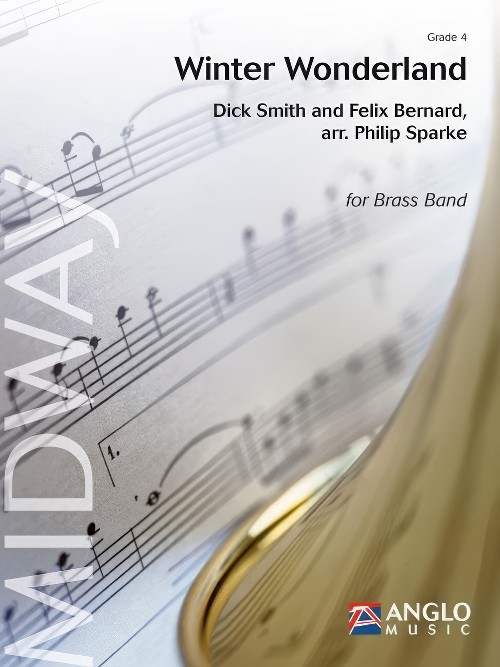 £59.99
Winter Wonderland (Brass Band - Score and Parts) - Bernard & Smith - Sparke, Philip
This enduringly popular seasonal song has long been a Christmas favourite, even though the lyrics don't mention 'Christmas' at all. The words were by Dick Smith (1901-1935) and the music by Felix Bernard (1897-1944). The inspiration was reportedly a visit by Smith to Honesdale's (his hometown) Central Park when it was covered in snow. The first recording was made by Richard Himber's Ritz-Carlton Orchestra in 1934. The same year Guy Lombardo and his band, The Royal Canadians, took the song to number 2 in the US Billboard Chart, where it stayed for 9 weeks. It has since been recorded by over 150 artists, the most successful versions being by Perry Como and the Andrews Sisters, both released in 1946.Duration: 4.00
Estimated dispatch 7-14 working days
 View Music