
Results
-
 £124.95
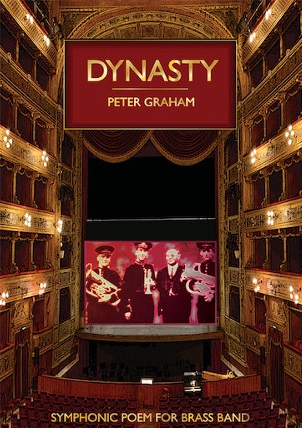
Dynasty (Brass Band - Score and Parts) - Graham, Peter
Dynasty takes the form of a Symphonic Poem, a musical form first introduced to a contest audience at the Crystal Palace in 1913 by Percy Fletcher in his work Labour and Love.Using key passages from the autobiography of Harry Mortimer, On Brass, as the source for the narrative, the work opens with a four-note leitmotif (Harry's theme, "as if descending from the heavens"), and the timeline unfolds as follows:Harry - One's destiny decided at birth "I'll make him the best cornet player in England"War - Why do the nations so furiously rage together? Fred volunteers for military serviceTheatre - And suddenly "I dashed to the rescue like a hero in the silent movies I was about to get to know so well"Journey - Comfort Ye A new life and new challengesTogether - Come unto me "A golden age"Farewell - For behold, darkness "Fred's death surely marked the passing of an era"Amen - The Trumpet shall soundListeners familiar with brass band repertoire will recognise a few pertinent quotes within the piece.In my imagination Harry is joined by Fred on cornet and the euphoniums of Alex and Rex for the quartet cadenza from Sovereign Heritage by Jack Beaver in Together.The Amen section from Handel's Messiah provides the basis for a contrapuntal flight of fancy as the work moves towards a conclusion. Other less overt fragments contribute to the story.Dynasty was co-commissioned by the British Open Brass Band Championships for the September 2019 contest, and the Brass Band Committee VLAMO for the Belgian Brass Band Championships 2019.- Peter GrahamDuration: 17.00
Estimated dispatch 7-14 working days
-
 £88.00
Bass Trombone Concerto (Bass Trombone Solo with Brass Band - Score and Parts) - Brubeck, Christopher
"As a bass trombonist, I spent many years of my adolescence playing in youth orchestras, engaging in musical daydreams. I would visualize myself jumping up from the back of the orchestra to unleash improvisations much to the conductor's horror. The resultant three-movement, thirteen-minute work has enjoyed a robust life with performances by notable orchestras all around the world. Happily, the concerto works well as a recital piece, with many accomplished college players having won concerto competitions performing it. Jazz elements were inescapable, and realizing my old nightmare/dream, quite a bit of the trombone solo is meant to be improvised. I made a recording of the concerto with the London Symphony Orchestra, which was included on a CD called Bach to Brubeck released on Koch International Classics. Having already become popular as a bass trombone work with orchestra accompaniment, renowned British Bass Trombonist and publisher Roger Argente suggested he release a special Brass Band arrangement of my concerto. Roger knew the piece well because years ago he played the European premiere of the concerto with the Royal Philharmonic Orchestra at the Royal Albert Hall." - Chris Brubeck. Duration: 13.00. Suitable for 1st Section Bands and above.
Estimated dispatch 7-14 working days
-
 £44.95
Reflections (Flugel and Tenor Horn Duet with Brass Band - Score and Parts) - Graham, Peter
Duet for Flugel and Tenor Horn or Two Bb Cornets from War of the Worlds SuiteEach movement of War of the Worlds is available separately allowing for a variety of "mini-suite" combinations eg: Movements 1,2 and 5 or 3,4 and 5 etc. For movements 1, 4 and 5 see the BB Concert Music tab. Complete suite also available.Reflections is the second movement of the suite War of the Worlds which was commissioned by the Senzoku Gakuen College of Music Saxophone Orchestra and first performed by them in the Maeda Hall, Japan on June 29 2012, the composer conducting. The music is dedicated to Professor Shin-ichi Iwamoto. The transcription for brass band was first performed by the Brighouse & Rastrick Band, conductor David King, in the Bridgewater Hall Manchester on September 8 2012.The suite takes inspiration from the 1953 film script adaptation of the famous HG Wells novel and key scenes from the film are set as individual movements: Reflections - here mankind contemplates a life forever changed as the invaders progress their colonisation of Planet Earth.
Estimated dispatch 7-14 working days
-
 £40.00
A Song for Bram (Brass Band - Score and Parts) - Gregson, Edward
A Song for Bram is a short work, originally composed piano and brass band, and is dedicated to the memory of Bramwell Tovey, a close friend and colleague of the composer, and a conductor, composer, pianist and musician of huge talent, who sadly passed away before his time in the summer of 2022. In this short piece the composer has tried to imagine what kind of tune Bram would have improvised at the piano, something he frequently engaged in. No doubt it would have been a mixture of bluesy jazz, hymn tune, and love song, and this is how the solo piano takes off. In the middle section of a what is a simple tertiary structure, introduced are quotes from two hymn tunes Bram particularly loved, never having forgotten his Salvation Army roots. Bram's 'Song' returns, this time on a plaintive flugelhorn horn, and which reaches a climax with the full band before receding, literally, into the distance.....(to a new life beyond?).Duration: 6.00
Estimated dispatch 7-14 working days
-
£14.00
A Song for Bram (Brass Band - Score only) - Gregson, Edward
A Song for Bram is a short work, originally composed piano and brass band, and is dedicated to the memory of Bramwell Tovey, a close friend and colleague of the composer, and a conductor, composer, pianist and musician of huge talent, who sadly passed away before his time in the summer of 2022. In this short piece the composer has tried to imagine what kind of tune Bram would have improvised at the piano, something he frequently engaged in. No doubt it would have been a mixture of bluesy jazz, hymn tune, and love song, and this is how the solo piano takes off. In the middle section of a what is a simple tertiary structure, introduced are quotes from two hymn tunes Bram particularly loved, never having forgotten his Salvation Army roots. Bram's 'Song' returns, this time on a plaintive flugelhorn horn, and which reaches a climax with the full band before receding, literally, into the distance.....(to a new life beyond?).Duration: 6.00
Estimated dispatch 7-14 working days
-
 £69.99
Sarabande and Polka (from Solitaire) (Brass Band - Score and Parts) - Arnold, Malcolm - Sparke, Philip
In 1956 Sir Kenneth MacMillan created a one-act ballet for the Sadler's Wells Theatre Ballet, London. He selected the music from the two sets of English Dances which Sir Malcolm Arnold had written in 1950 and 1951 to great acclaim. The composer wrote two new dances, a Sarabande and a Polka, especially for the ballet, which was premiered at Sadler's Wells Theatre in June 1956. The two new dances have taken on a life of their own in the concert hall and are typical Arnold: the Sarabande contains one of his most memorable melodies and the Polka shows him at his quirky, tongue-in-cheek best. Duration: 5.30
Estimated dispatch 7-14 working days
-
 £45.00
A Song for Bram (Piano Solo with Brass Band - Score and Parts) - Gregson, Edward
A Song for Bram is a short work, originally composed piano and brass band, and is dedicated to the memory of Bramwell Tovey, a close friend and colleague of the composer, and a conductor, composer, pianist and musician of huge talent, who sadly passed away before his time in the summer of 2022. In this short piece the composer has tried to imagine what kind of tune Bram would have improvised at the piano, something he frequently engaged in. No doubt it would have been a mixture of bluesy jazz, hymn tune, and love song, and this is how the solo piano takes off. In the middle section of a what is a simple tertiary structure, introduced are quotes from two hymn tunes Bram particularly loved, never having forgotten his Salvation Army roots. Bram's 'Song' returns, this time on a plaintive flugelhorn horn, and which reaches a climax with the full band before receding, literally, into the distance.....(to a new life beyond?).Duration: 6.00
Estimated dispatch 7-14 working days
-
£15.00
A Song for Bram (Piano Solo with Brass Band - Score only) - Gregson, Edward
A Song for Bram is a short work, originally composed piano and brass band, and is dedicated to the memory of Bramwell Tovey, a close friend and colleague of the composer, and a conductor, composer, pianist and musician of huge talent, who sadly passed away before his time in the summer of 2022. In this short piece the composer has tried to imagine what kind of tune Bram would have improvised at the piano, something he frequently engaged in. No doubt it would have been a mixture of bluesy jazz, hymn tune, and love song, and this is how the solo piano takes off. In the middle section of a what is a simple tertiary structure, introduced are quotes from two hymn tunes Bram particularly loved, never having forgotten his Salvation Army roots. Bram's 'Song' returns, this time on a plaintive flugelhorn horn, and which reaches a climax with the full band before receding, literally, into the distance.....(to a new life beyond?).Duration: 6.00
Estimated dispatch 7-14 working days
-
 £35.00
We Three Gypsy Kings (Brass Band - Score and Parts) - McKenzie, Jock
The arranger had a dream..... The three wise men were looking for the baby Jesus to give him their gifts. This was done somewhat in the manner of the scene of Monty Python's 'Life of Brian'. The search was not successful - Sir Alan Sugar ('The 'Apprentice') made an appearance ordering the three wise men to "get off my land". Meanwhile, the baby Jesus slept peacefully on, unaware of the nearby disturbance. Bizarrely, this dream sequence was played out at high speed, as in the closing scene from each episode of 'The Benny Hill Show' of the 1970s. This arrangement attempts to portray this comical caper. Duration: 4.00
Estimated dispatch 7-14 working days
-
 £50.00
Greetings to a City (Brass Band - Score and Parts) - Bliss, Arthur - Hindmarsh, Paul
Sir Arthur Bliss (1891 - 1975) was a significant composer and pillar of the British musical establishment. Although Born in London, his father was from the United States and both countries were important in his life and career. A pupil of Stanford at the Royal College of Music, Bliss travelled to the United States with his father in 1923, taking a prominent part in Elizabeth Sprague Coolidge's Pittsfield Music Festival, as well as undertaking some teaching and conducting. In 1925 he married Trudy Hoffman and they returned to the UK early in 1926. Bliss's most influential scores were his ballets and film scores. In 1953 Sir Arthur was appointed Master of the Queen's Music, after which he added a steady stream of fanfares and ceremonial works to his list of works. In 1960 he was commissioned by the American Wind Symphony of Pittsburgh, which requested for festive work to feature on an extensive European tour, including a performance in London.Bliss scored Greetings to a City for antiphonal brass, a choir each of 2 trumpets, 2 horns and three trombones, with tuba and percussion. This adaptation for brass band instruments retains an element of antiphony, emphasing the contrast between the fanfare instruments (cornets and trombones) and the horns and tubas. Greetings to a City is cast in three connected sections, with extended fanfare episodes separated by a short lyrical interlude.- Paul HindmarshDuration: 6.00
Estimated dispatch 7-14 working days
 View Music