
Results
-
 £41.09
Verklarte Nacht (Brass Band) Arnold Schoenberg arr. Rob Bushnell
Composed in just three weeks in 1899, Verklarte Nacht (Transfigured Night) is a string sextet in one movement by Arnold Schoenberg. Whilst known better for tone rows, his dodecaphonic music and the Second Viennese School, Schoenberg was a master of harmony (writing a number of books on the subject) and, in his early life, was inspired by the music of Brahms and Wagner. This is his best-known tonal work. Its description as a tone poem is not surprising given it takes its inspiration from Richard Dehmel's poem of the same name, as well as Schoenberg's strong feelings towards his future wife, Mathilde Zemlinsky, sister of his teacher, Alexander von Zemlinsky. The work is said to have five sections, one for each of the stanzas in the poem. The poem, from 1896, describes a man and woman walking through a dark forest on a moonlit night. The woman shares a secret with him, that she is pregnant but not with his child. The man reflects upon this before warmly accepting (and forgiving) the news. The work premiered on 18 March 1902 in the Vienna Musikverein by the Rose Quartet. As was normal at the time, Schoenberg produced a string orchestra version that was premiered on 29 November 1916 in Prague, conducted by Zemlinsky, which was later revised in 1943 to better support the soloists, also adding more articulation and tempo markings. Whilst the piece was controversial at the time, both musically and due to the poem's "inappropriate" subject matter, Richard Dehmel himself was impressed, writing "I had intended to follow the motives of my text in your composition, but soon forgot to do so, I was so enthralled by the music." This arrangement is for the British-style brass band, with alternative parts for horns in F and bass-clef lower brass. To view a recording of the original composition please visit www.youtube.com/watch?v=vqODySSxYpc. Difficulty Level: 2nd Section + Duration: approx. 6.40 minutes Sheet music available from www.brassband.co.uk Instrumentation: Soprano Cornet Eb Solo Cornet Bb Repiano Cornet Bb 2nd Cornet Bb 3rd Cornet Bb Flugel Horn Bb Solo Horn Eb 1st Horn Eb 2nd Horn Eb 1st Baritone Bb 2nd Baritone Bb 1st Trombone Bb 2nd Trombone Bb Bass Trombone Euphonium Bb Bass Eb Bass BbTimpani Percussion 1-3
In Stock: Estimated dispatch 1-3 working days
-
 £37.35
World War III (Brass Band) Joe Galuszka
This descriptive work for brass band by Joe Galuszka depicts the horrors of war. War is all around us. Every day, another life is lost. Myanmar, Sudan, Ethiopia, Ukraine, Colombia, Afghanistan, Somalia, Syria and Yemen. As time goes on, more and more countries are brought to the end of what is a diplomatic struggle - in where war seems to be the only option. 'War! Terror! Panic! captures the tumultuous and relentless nature of war. With driving rhythms, aggressive brass fanfares, and thundering percussion, the listener is immersed in the chaos of battle. Dissonance and clashing harmonies depict the discord that pervades war and takes us on a journey through the terror and panic that comes with the brutality of conflict. Remembrance (For Those That We Have Lost) provides a poignant and reflective interlude, allowing the audience to contemplate the human cost of war. Mournful melodies and expressive solos for trombone, euphonium and glockenspiel, convey the depth of sorrow and loss, serving as a powerful reminder of the toll war takes on individuals and communities. The final movement, Hymn for Peace and Hope is a testament to the enduring human spirit and the yearning for harmony - dissonance and conflict gradually give way to consonance and resolution. We celebrate the human capacity for unity and the triumph of peace over strife, as we imagine a world at piece. To listen to an audio demo of the work please visit https://on.soundcloud.com/Udt1AWRThgwuWnQv5 Duration: Approx. 5.00 mins Difficulty Level: 2nd Section + PDF download includes parts and score. Sheet music available from www.brassband.co.uk (UK) or https://satradecentral.org (USA) Instrumentation: Soprano Cornet Eb Solo Cornet Bb Repiano Cornet Bb 2nd Cornet Bb 3rd Cornet Bb Flugel Horn Bb Solo Horn Eb 1st Horn Eb 2nd Horn Eb 1st Baritone Bb 2nd Baritone Bb 1st Trombone Bb 2nd Trombone Bb Bass Trombone Euphonium Bb Bass Eb Bass Bb Timpani Percussion 1-3
In Stock: Estimated dispatch 1-3 working days
-
£55.00
The Brigand's Orgy - Berlioz, H - Harper, P
In his memoirs the composer wrote: 'I long to go to the mountains and put myself in the service of a brigand chief. That's the life I crave: volcanoes, rocks, rich piles of plunder in mountain caves, a concert of shrieks accompanied by an orchestra of pistols and carbines, blood and wine, a bed of lava rocked by subterranean tremors: voil la vie!'Championship SectionDuration 7 minsListen to Cory BandCourtesy of World of Brass
In Stock: Estimated dispatch 1-3 working days
-
 £45.00
Believe (From 'The Polar Express')
ABOUT THIS PIECE: Capture the magic and wonder of Christmas with this beautiful arrangement of Believe, from the beloved film The Polar Express. Composed by the award-winning songwriter Glen Ballard and legendary film composer Alan Silvestri, Believe is a heartwarming ballad that celebrates the themes of faith, hope, and the spirit of Christmas. Originally performed by Josh Groban, the song earned an Academy Award nomination and has become a seasonal favourite around the world. This arrangement brings the enchanting melody and emotional depth of the original to life, making it a perfect choice for Christmas concerts. Believe offers a wonderful opportunity for your band to connect with audiences and celebrate the magic of the holiday season. ENSEMBLE: Standard British Brass Band WHEN YOU BUY THIS PRODUCT, YOU GET: High-quality printed score and parts LEVEL: 1 LISTEN: DURATION: 4-minutes 40-seconds EXAMPLE SCORE: Click here LEVEL GUIDE: Level 1- Accessible to all Level 2 - c. UK third section and higher Level 3 - c. UK second section and higher Level 4 - c. UK first section and higher Level 5 - c. UK championship section level
Estimated dispatch 5-7 working days
-
£80.00
From the Sea - Geert Jan Kroon
From the Sea is a three-part work with the theme of land reclamation. The first part (The New Land) expresses the feelings of expectation and tension that come with the brand-new land. The second part (The Old Sea) is a nostalgic look back at the (old) sea. A sea that was sometimes turbulent, but also a source of life. The third part (The Future Land) captures the joy of living on the new land up to the present day. The work was commissioned by the joint music associations of the Noordoostpolder.
-
 £34.95
By Water and the Word - Jonathan Bates
DURATION: 4'00". DIFFICULTY: 4th+. 'By Water and the Word' was composed for 2020 Brass Band Summer School in memory of it's long-standing course administrator Philip Biggs, who passed away in 2019. Aside from his work with BBSS, Philip was also the renowned administrator for the National Youth Brass Band of Great Britain where my first opportunities as a writer of brass music were presented. It's a certainty to say that without Philip's work at the head of this organisation, there's zero chance I would be able to do what I do today as a musician, and for that it was a huge honour to write this short work in his memory. Under Maestro Bramwell Tovey, each course would conclude with an encore of The Day Thou Gavest (St. Clements) and one of the most used hymn tunes throughout the week was The Church's One Foundation (Aurelia). Since then, these two tunes have become synonymous with the NYBBGB and in turn Philip's life & work, so I felt it fitting to combine these two wonderful sacred melodies into a new work paying homage to those memories. .
In Stock: Estimated dispatch 1-3 working days
-
 £74.95
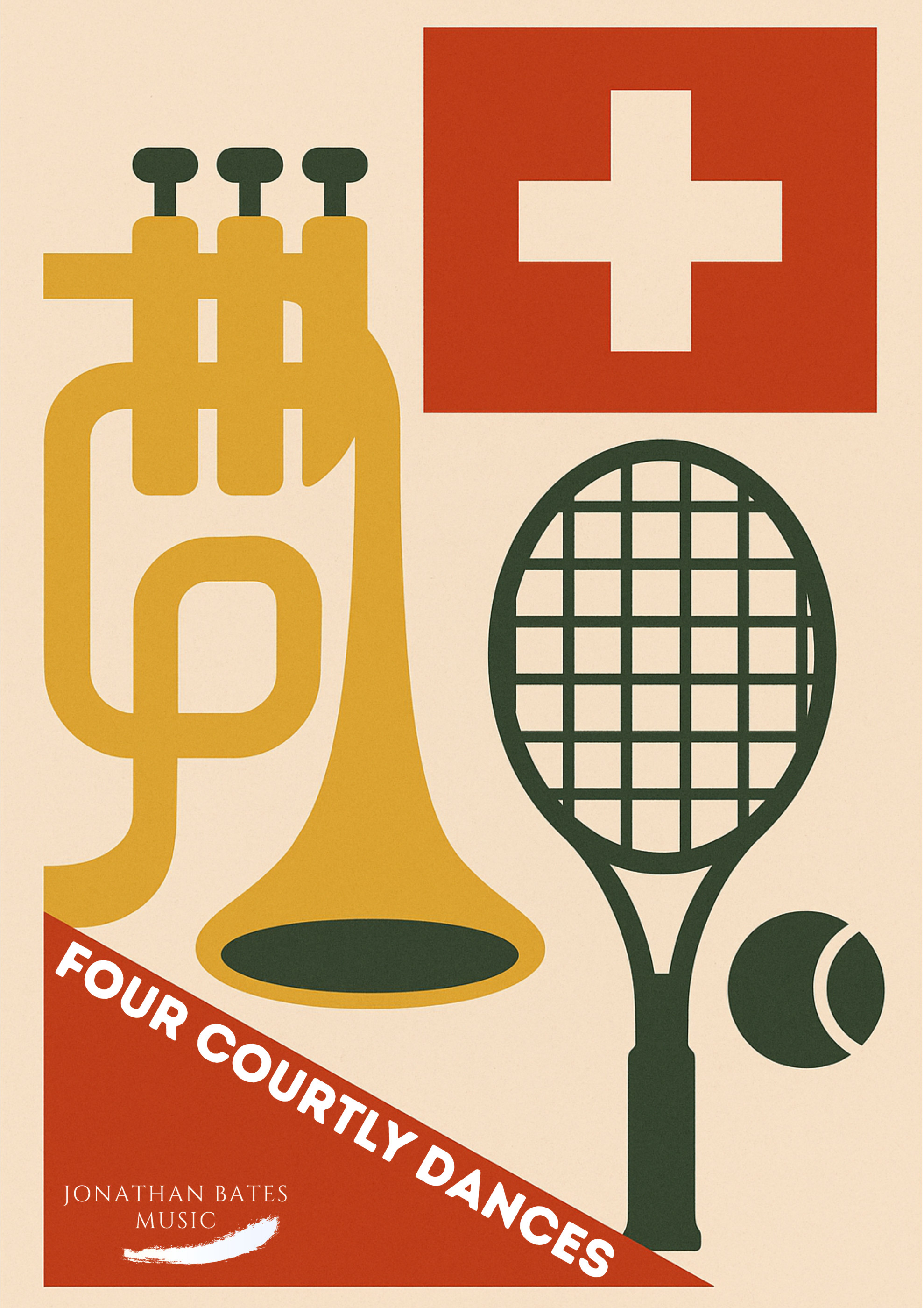
Four Courtly Dances - Jonathan Bates
DURATION: 12'00". DIFFICULTY: 1st+. 'Four Courtly Dances' was composed for Brass Band Burgermusik Luzern in 2025 for their Brass & Sport Gala Concert in the KKL Luzern. The work is a tribute to career of Swiss Tennis great Roger Federer with each movement giving a musical 'nod' to the story of his life and career. Each movement is inspired by a traditional 'courtly' (not in a tennis sense, but that was the idea!) dance:. 1. Inspiration (Almain) . The opening movement is subtitled 'Elegance on Court', backed by a deep-rooted sense of Swiss nationlism, featuring a prelude based upon the traditional Swiss song 'Guggisberglied'. . 2. Success & Failure (Galliard) . A movement centred around the trials and tribulations of an elite sportsperson, with antiphonal cornet & tambourine groups playing avirtuosic musical tennis match across the band. . 3. Rivalry (Sarabande & Canario) . An upbeat movement fused with Spanish and Balkan influences, inspired by Federer's long-running rivalries with Rafael Nadal and Novak Djokovic. . 4. Legacy (Pavane) . A final reflective and uplifting homage to the legacy leftby one of the greatest sportspeople of all time, culminating in a coda whichbrings together all the previous 'ingredients' which made Federer the icon he is. . .
In Stock: Estimated dispatch 1-3 working days
-
 £34.95
Maybury Hill Lullaby - Jonathan Bates
DURATION: 4 minutes. DIFFICULTY: 2nd+. 'Maybury Hill Lullaby' was composed for the City of Bradford Brass Band as part of a programme of music based around both the original H.G Wells novel and 1978 adaption by Jeff Wayne of The War of the Worlds. . During the previous day, the first of the missiles from Mars had crashed into Earth and the creature within had gone about invoking chaos and destruction upon all human life nearby. 'The Narrator' (an unnamed character throughout) escapes the scene to his home on Maybury Hill, Woking and falls into a deep, haunted sleep, recalling the horrors he had witnessed before his eyes.
In Stock: Estimated dispatch 1-3 working days
-
 £34.95
Real Northern Powerhouse, The - Jonathan Bates
DURATION: 4'00". DIFFICULTY: Championship. Commissioned by the NASUWT Riverside Band for their 2019 appearance at the Brass in Concert Championships, held at The Sage in Gateshead, 'The Real Northern Powerhouse' is a musical representation of the huge impact various forms of industrial life had on the history, and indeed future of the North East of England. Defined into 3 clear sections - By Sea, By Land, and By Rail, the music paints a picture of the various scenes in the dockyards, coalfields and rail stations as the industrial revolution boomed. .
In Stock: Estimated dispatch 1-3 working days
-
 £34.95
Lament for the Pride Lands - Jonathan Bates
DURATION: 4'00". DIFFICULTY: 3rd+. 'Lament for the Pride Lands' was composed for Skelmanthorpe Band's programme of music celebrating the 30th anniversary of Walt Disney's 'The Lion King' at the 2024 Red Admiral Entertainment Championships. At this point of the story, Simba stares up into the night sky and the stars appear to form the face of his late father Mufasa who remind him of his place in the great Circle of Life and encourages him to return to the Pride Lands from which he fled as a young cub.
In Stock: Estimated dispatch 1-3 working days
 View Music