
Results
-
 £37.35
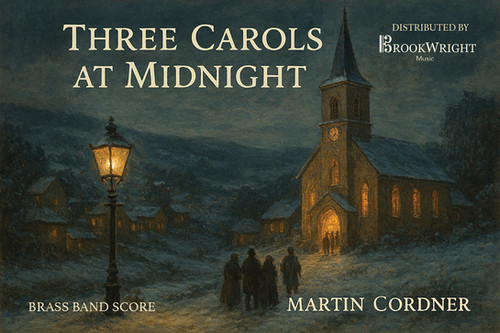
Three Carols at Midnight (Brass Band) Martin Cordner
Rooted in the sacred stillness of a French village on Christmas Eve, this suite by Martin Cordner draws upon traditional carols that have echoed through centuries of candlelit chapels and midnight vigils. Each movement offers a window into the Nativity story: I. Mystery: Noel Nouvelet (Christmas Comes Anew) opens with modal wonder, evoking the anticipation of Christ's coming and the quiet awe of Advent. II. Cradle: Entre le boeuf et l'ane gris (Between the Ox and the Grey Donkey) rests in pastoral tenderness, where the newborn Savior lies between humble beasts, watched over by angels and the Virgin. III. Joy: Il est ne, le divin enfant (He is born, the Divine Infant) bursts forth in celebration, proclaiming the divine birth with rustic dance and jubilant praise. Together, these carols form a musical triptych - moving from mystery to intimacy to exultation. Three Carols at Midnight invites listeners to step into the hush of a French Noel, where the sacred story is told not only in word, but in melody, memory, and light. All proceeds support the mission and ministry of The Salvation Army Delaware Command, USA. To view a rolling score video of the work please visit www.youtube.com/watch?v=fUcCluBS18Q Difficulty level: 4th Section + Duration: approx. 5.00 minutes This PDF download includes parts and score. Sheet music available at www.brassband.co.uk or www.durhammusicshop.co.uk (UK) or https://satradecentral.org (USA) Instrumentation: Soprano Cornet Eb 1st Cornet Bb 2nd Cornet Bb 1st Horn Eb 2nd Horn Eb 1st Baritone Bb 2nd Baritone Bb 1st Trombone Bb 2nd Trombone Bb Bass Trombone Euphonium Bb Bass Eb Bass Bb Percussion 1-2 Glockenspiel
In Stock: Estimated dispatch 1-3 working days
-
 £37.35
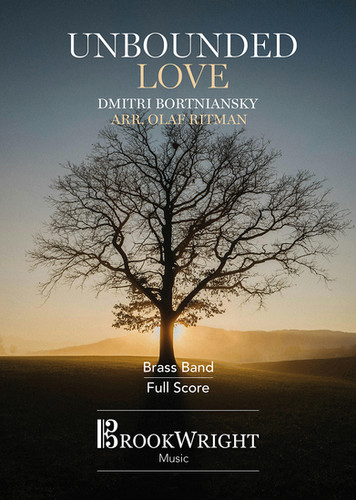
Unbounded Love (Brass Band) Bortniansky arr. Olaf Ritman
Unbounded Love is a deeply moving work that bridges the gap between sacred tradition and personal tribute. Drawing inspiration from the beloved 18th-century hymn Ich bete an die Macht der Liebe (I Pray to the Power of Love), this arrangement transforms a timeless spiritual message into a profound musical experience. The foundation of this work lies in the 1822 melody by Dmitri Bortniansky. Originally set to the poetry of Gerhard Tersteegen, this dignified and contemplative theme has served as a cornerstone of ceremonial music for centuries, symbolising solace, reverence, and the liberating power of divine love. Unbounded Love is an intimate memorial dedicated to Hein Voskamp, a cherished soprano player and close friend of the composer. Born from a simple final request - to hear this hymn one last time - the piece became the composer's way of navigating grief and expressing gratitude when words were no longer enough. To view a video of the Amsterdam Staff Band performing the work please visit https://youtu.be/Ug6tZwX7MiQ Duration: Approx. 5.45 minutes Difficulty Level: 4th Section + This PDF download includes the full score and parts. Sheet music available at www.brassband.co.uk (UK) or https://satradecentral.org (USA) Instrumentation: Soprano Cornet Eb Solo Cornet Bb Repiano Cornet Bb 2nd Cornet Bb 3rd Cornet Bb Flugel Horn Bb Solo Horn Eb 1st Horn Eb 2nd Horn Eb 1st Baritone Bb 2nd Baritone Bb 1st Trombone Bb 2nd Trombone Bb Bass Trombone Euphonium Bb Bass Eb Bass Bb Timpani Glockenspiel Percussion
In Stock: Estimated dispatch 1-3 working days
-
 £37.35
World War III (Brass Band) Joe Galuszka
This descriptive work for brass band by Joe Galuszka depicts the horrors of war. War is all around us. Every day, another life is lost. Myanmar, Sudan, Ethiopia, Ukraine, Colombia, Afghanistan, Somalia, Syria and Yemen. As time goes on, more and more countries are brought to the end of what is a diplomatic struggle - in where war seems to be the only option. 'War! Terror! Panic! captures the tumultuous and relentless nature of war. With driving rhythms, aggressive brass fanfares, and thundering percussion, the listener is immersed in the chaos of battle. Dissonance and clashing harmonies depict the discord that pervades war and takes us on a journey through the terror and panic that comes with the brutality of conflict. Remembrance (For Those That We Have Lost) provides a poignant and reflective interlude, allowing the audience to contemplate the human cost of war. Mournful melodies and expressive solos for trombone, euphonium and glockenspiel, convey the depth of sorrow and loss, serving as a powerful reminder of the toll war takes on individuals and communities. The final movement, Hymn for Peace and Hope is a testament to the enduring human spirit and the yearning for harmony - dissonance and conflict gradually give way to consonance and resolution. We celebrate the human capacity for unity and the triumph of peace over strife, as we imagine a world at piece. To listen to an audio demo of the work please visit https://on.soundcloud.com/Udt1AWRThgwuWnQv5 Duration: Approx. 5.00 mins Difficulty Level: 2nd Section + PDF download includes parts and score. Sheet music available from www.brassband.co.uk (UK) or https://satradecentral.org (USA) Instrumentation: Soprano Cornet Eb Solo Cornet Bb Repiano Cornet Bb 2nd Cornet Bb 3rd Cornet Bb Flugel Horn Bb Solo Horn Eb 1st Horn Eb 2nd Horn Eb 1st Baritone Bb 2nd Baritone Bb 1st Trombone Bb 2nd Trombone Bb Bass Trombone Euphonium Bb Bass Eb Bass Bb Timpani Percussion 1-3
In Stock: Estimated dispatch 1-3 working days
-
 £79.95
Amundsen - Jonathan Bates
DURATION: 14'00". DIFFICULTY: 1st+. 'Amundsen' was commissioned by rskog Brass, Norway for their winning performance at the 2020 Norwegian National Championships held at the Grieghallen in Bergen. In December 1911, Norwegian Roald Amundsen gained global fame by becoming the first explorer to lead a team to the geographic South Pole. Amundsen and 4 other members of his team arrived 5 weeks ahead of a rival team from the UK led by Robert Falcon Scott, all of which perished on their attempted return from the pole. Initially when Amundsen's team set out in 1910, they were under the impression that they would be making the far shorter journey to the arctic drift to attempt to reach the North Pole, but Amundsen had received news that American explorers Peary and Cook had beaten them to this goal, and so Amundsen's focus changed southward. 'Fram, Forward' - 'Fram' (translating to English as "forward") was the name of the ship Amundsen used for this particular polar expedition. Amundsen had only informed 2 people of his real intentions of conquering the South Pole when the ship first left port in Kristiansand before heading south to the Portuguese island of Madeira in the Atlantic Ocean. After weeks at sea - causing the uninformed members of the crew to raise a number of questions and produce a general feel of uncertainty and low spirits - it was here that Amundsen announced his true plans to the rest of his crew. They were asked whether they wished to continue with their expedition, to which all - some begrudgingly - agreed to sail on to the South Pole, through the great Ice Barrier before docking in the Bay of Whales on the Ross Ice Shelf. 'Ross Ice Shelf' - Upon Amundsen's arrival in the Bay of Whales, the team were greeted by the sight of the enormous ice plateau's and glaciers, towering into the Antarctic sky. In 1907, Ernest Shackleton had attempted - and failed - to reach the South Pole, but his route and mapping was by now well documented. Scott and the UK team were to follow this route, whereas Amundsen and his men forged their own way to the pole through unchartered territory and deadly terrain littered with deep crevasses and canyons. The music here though, is a picture of tranquility. The eerie silence of total emptiness with only the heavy snow falling around Amundsen as Fram and the Bay of Whales disappears into the distance, faced by the maginute of the expedition ahead. 'Advance to Polheim' - The first new challenge Amundsen discovered on this route was a rough, sharp and extremely steep glacier (which was later named the Axel heiberg Glacier after the Norwegian monarch who funded much of the expedition), which would take his team up from sea level to an altitude of over 9,000ft in just 20 miles, with most of this over just 7 miles. Once scaled, only the vast Antarctic Plateau stood between Amundsen and the pole. Here the race began, with only one aim - victory for himself, his team, and for the whole of Norway. .
In Stock: Estimated dispatch 1-3 working days
-
£39.00
Kort samba og kort mambo - Svein Fjermestad
This is two short pieces at grade level 1,5 written in samba- and mambo style as the titles indicates.The percussion parts are ad lib and are intended to be customized to the number of players and instruments available.
Estimated dispatch 7-14 working days
-
 £64.95
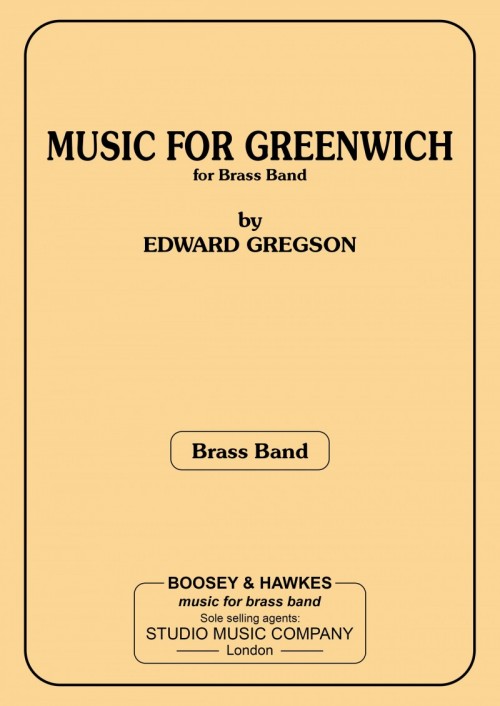
Music for Greenwich (Brass Band - Score and Parts) - Gregson, Edward
Music for Greenwich was commissioned in 1980 by the Greenwich Theatre, London, for a new production of Peter Buckman's play 'All Together Now'.In this play, about a down-at-heels brass band in the North of England brought to a new level of self-confidence and achievement by an incoming conductor, the whole cast performed a test piece on stage every night (i.e. Music for Greenwich), in readiness for a competition which they have entered and, of course, win. Although the play is as much a social commentary as anything to do with music-making, every member of the cast had to be able to play a brass instrument to a greater or lesser extent (a difficult challenge for the casting Director!).For obvious reasons, the music is not technically difficult. The work is structured as follows: a brief fanfare-like opening is followed by an allegro section, rhythmic and playful; a slow lyrical section is then introduced (a suitably nostalgic melody featuring solos for cornet and trombone), before a return to the fast music, a hint of the fanfare, and finally a climactic flourish to round things off. This is music to be enjoyed, as hopefully it was every night by the audience and actors alike.Duration: 5.00
Estimated dispatch 7-14 working days
-
£24.95
Music for Greenwich (Brass Band - Score only) - Gregson, Edward
Music for Greenwich was commissioned in 1980 by the Greenwich Theatre, London, for a new production of Peter Buckman's play 'All Together Now'.In this play, about a down-at-heels brass band in the North of England brought to a new level of self-confidence and achievement by an incoming conductor, the whole cast performed a test piece on stage every night (i.e. Music for Greenwich), in readiness for a competition which they have entered and, of course, win. Although the play is as much a social commentary as anything to do with music-making, every member of the cast had to be able to play a brass instrument to a greater or lesser extent (a difficult challenge for the casting Director!).For obvious reasons, the music is not technically difficult. The work is structured as follows: a brief fanfare-like opening is followed by an allegro section, rhythmic and playful; a slow lyrical section is then introduced (a suitably nostalgic melody featuring solos for cornet and trombone), before a return to the fast music, a hint of the fanfare, and finally a climactic flourish to round things off. This is music to be enjoyed, as hopefully it was every night by the audience and actors alike.Duration: 5.00
Estimated dispatch 7-14 working days
 View Music