Results
-
 £45.00
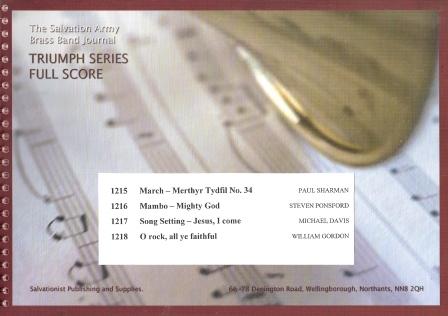
Triumph Series Band Journal July 2011 Numbers 1215 - 1218
No. 1215 March - Merthyr Tydfil No.34 (Paul Sharman)This march was written at the request of Bandmaster Howard Roberts to celebrate the 125th anniversary of Merthyr Tydfil Corps, corps number 34 in The Salvation Army. The tunes used have obvious Welsh connections wit 'Cwm Rhonnda' and 'Aberystwyth' being featured. 'Aberystwyth' was written by Joseph Parry who lived in Merthyr Tydfil for a while.No. 1216 Mambo - Mighty God (Steven Ponsford)Based on words from Isaiah 9, 'Mighty God' is a song of worship and assurance by Chris Bowater and helen and Mark Johnson. This arrangement will afford bands the opportunity to engage the audience into a lively segment of praise.No. 1217 Song Setting - Jesus, I come (Michael Davis)A setting of George C Stebbins' beautiful melody 'Out of my bondage'.No. 1218 O rock, all ye faithful (William Gordon)The Christmas carol 'O come, all ye faithful' is arranged here in a 'rock' style and includes references to other well known Christmas carols.
Estimated dispatch 7-14 working days
-
 £86.00
The Journal of Phileas Fogg - Graham Peter - Vertommen Luc
Estimated dispatch 7-14 working days
-
 £69.95
THE JOURNAL OF PHILEAS FOGG - Peter Graham
Additional Score: �29.95
Published Closed for Holidays. Est dispatch 13th Nov
-
 £19.95
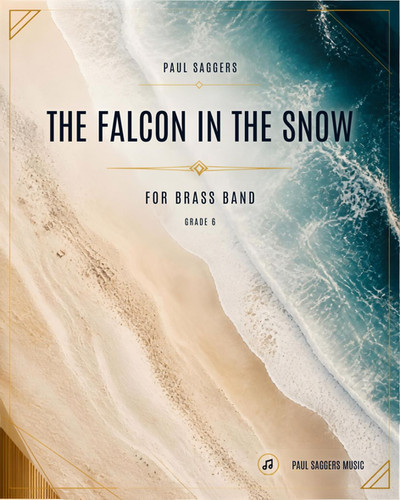
The Falcon in the Snow for Brass Band - Paul Saggers
The Falcon in the Snow is a musical depiction of British explorer Robert Falcon Scott's expedition to reach the South Pole, the work is divided into five sections, using quotes from Falcon Scott's own journal:Saturday November 26, 1910 - "We advertised our start at 3.P.M., and at three minutes to that hour the Terra Nova pushed off from the jetty".Robert Falcon Scott led the British Antarctic Expedition from 1910 to 1913, aiming to be the first to reach the South Pole. Leaving from Cardiff, Wales, in June 1910, the expedition arrived at the Ross Ice Shelf in January 1911. Scott's team established base camp at Cape Evans on Ross Island and began preparations for the push to the Pole.Thursday February 2, 1911 - "The Blizzard, Nature's protest-the crevasse, Nature's pitfall".The expedition faced numerous challenges, including harsh weather, difficult terrain, and the logistics of transporting supplies and equipment over long distances. Scott divided his men into different teams for the Pole attempt, with one led by himself and the other by Ernest Shackleton, who was eventually sent home due to illness.Tuesday January 16, 1912 - "The Norwegians have forestalled us and are first at the pole. It is a terrible disappointment, and I am very sorry for my loyal companions".Scott's team set out for the South Pole, enduring extreme conditions and struggling with low food supplies. They reached the Pole on January 17, 1912, only to discover that the Norwegian explorer Roald Amundsen had beaten them to it by 34 days.Thursday January 18, 1912 - "We have turned our back now on the goal of our ambition and must face our 800 miles of solid dragging".Disheartened, the team began the long and arduous journey back to base camp. Tragically, Scott and his companions-Edward Wilson, Henry Bowers, Lawrence Oates, and Edgar Evans-perished during their return journey. They were slowed by extreme weather and suffering from exhaustion and malnutrition.Thursday March 29, 1912 - "For God's sake look after our people".Their final camp, found in November 1912, became their tomb. Scott's journal, recovered with his body, provides a poignant record of their struggles.Despite the tragic outcome, Scott's expedition contributed significantly to the understanding of the Antarctic region. The scientific research and specimens collected during the journey provided valuable insights into the continent's natural history and biology. Additionally, the expedition stimulated public interest in polar exploration and science, leaving a legacy in the chronicles of exploration.
-
 £55.00
Escape the Kraken!
This evocative music portrays an underwater escape from the clutches of the legendary, multi-tentacled sea creature, the Kraken. From the mysteriousness of the seabed, the awakening of the beast, an exciting chase ensues as you evade capture. The work is full of excitement and energy, balancing myth alongside a cinematic sound world. Originally composed in 2017 for Jaren Hornmusikkforenig , Escape the Kraken! was the finale of the concept programme Twenty-Thousand Leagues Beneath the Sea . The work is published here in its 2019 revision, as performed at the Brass In Concert championships by the Flowers Band in their award-winning programme Captain Nemo's Forgotten Journal. Duration: 00:04:45 Grade: 5 / 5.5
Estimated dispatch 5-7 working days
-
 £59.95
Judd: Quest
'Quest' was originally written for the Territorial Youth Band (UK) in 2012. It is a major work in three movements, Movement 1: Making a difference, Movement 2: Making time and Movement 3: Making progress. The music essentially charts the journey of the Christians life. The music commences with Ray Steadman-Allen's choral work and testimony 'So this is it! My day for living!' and has references and then a presentation to the tune 'Southport' associated with the words 'To serve the present age my calling to fufil'. The music displays the struggle of the Christian in maintaining a witness within this world. The second movement is a reflective and prayerful setting of the song 'This day' found in the Sing to the Lord journal. The imposing third movement features the tune 'Trust in God' with the associated words 'As the weary way of life we journey'. The piece has been recorded by the International Staff Band under the same title (SPS330)
Estimated dispatch 7-14 working days
-
 £29.95
Judd: Dalaro
This was Edward Gregson's first composition to be included in The Salvation Army Band Journal. The Dalaro in the title refers to a town in Sweden where a Salvation Army students conference took place in 1964 for which this march was written.
Estimated dispatch 7-14 working days
-
 £29.95
Judd: Emblem Of The Army
This march was originally written in 1934 and published as 'The Hussar' in the composer's own Regal Band Journal. The march was re-published by The Salvation Army in 1967, with the addition of the tune 'Lift up the Army banner', under the new title of 'Emblem of the Army' and has remained a firm favourite ever since
Estimated dispatch 7-14 working days
-
£55.00
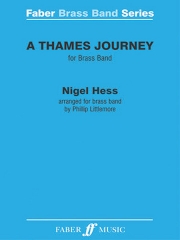
Thames Journey - Nigel Hess
Thames Journey is a 10-minute musical journey that follows the river Thames from its origins, as a few drops of water in Wiltshire, to the point where it meets the open sea at Greenwich. Along the way, Hess draws upon many musical links along the Thames, such as an old Wiltshire melody, morris dancing in Oxfordshire, boating songs from Berkshire and street songs in London. With such rich and diverse sources of music across several counties and centuries, this has quite understandably become one of Hess's most popular works to date.Brass Band Grade 4: Advanced Youth and 3rd SectionDuration: 10 minutes.This brass band arrangement, by Phillip Littlemore, has been recorded by the Leyland Band, conducted by Michael Fowles on the CD The Alchymist's Journal.
In Stock: Estimated dispatch 1-3 working days
-
£29.95
EMBLEM OF THE ARMY (Brass Band Set) - Arthur Gullidge
This march was originally written in 1934 and published as 'The Hussar' in the composer's own Regal Band Journal. The march was re-published by The Salvation Army in 1967, with the addition of the tune 'Lift up the Army banner', under the new title of 'Emblem of the Army' and has remained a firm favourite ever since.
Estimated dispatch 7-14 working days
 View Music
 Watch video