
Results
-
 £115.60
Occurence - Haakon Esplo
Occurrence was written as a commissioned work for Randesund School Band in 2014. The symphonic work gives challenges for all instruments and is well suited to work with rhythm, intonation, sound and musicality. Percussion has a central rolein the piece with solo performances, and the beautiful middle part gives the band opportunity to demonstrate its ability to interpretation and musical understanding. Occurence is therefore well suited for competitions as well as concerts.
Estimated dispatch 5-14 working days
-
 £115.60
Every Breath You Take - Gordon Matthew Sumner - Idar Torskangerpoll
The great hit from 1983 by English band Police has moods and colours that is immediately recognized. In the band arrangement it is much the same, but with the added timbres and carpets of sound typical for wind players. Please pay attention to balance throughout the piece. You may also use this piece to improve the sound, balance and intonation in your band.
Estimated dispatch 5-14 working days
-
 £107.80
Myrsnipa - Vocal or Instrumental Solo - Jan Eggum - David Hveem
Jan Eggum released "Myrsnipa" on the album "Hjerteknuser", which was released in 2007. The text is a variant of the folk tale with the moral "everyone likes their own children best and has for many years been one of Eggum's regular encores at concerts.The arrangement is attempted to stay true to Eggum's version and has retained its somewhat delicate character in order to support the text as much as possible. Although the arrangement is written for vocal soloist, it also works great with a solo instrument instead, and you can also choose whether you want a guitar or not, to keep it even more true to the original recording.The arrangement requires good balance and intonation, but will be a nice part of the concert repertoire the audience is guaranteed to recognize.
Estimated dispatch 5-14 working days
-
 £115.60
Tenn Lys - Eyvind Skeie - Reid Gilje
"Candles in Advent" is a beautiful melody with great lyrics. It was originally written for an Norwegian Advent TV-series in 1985.In this arrangement, the flugelhorn has some solo lines. I Have tried to vary the instrumentation without going beyond the beautiful Christmas mood.The harmonization is simple and functional. Let the soloists "speak" with good phrasing and focus also on harmony in the unison melody lines. Good balance and intonation in the accompaniment can make the performance a little gem on the Christmas concert.- Reid Gilje -
Estimated dispatch 5-14 working days
-
 £67.50
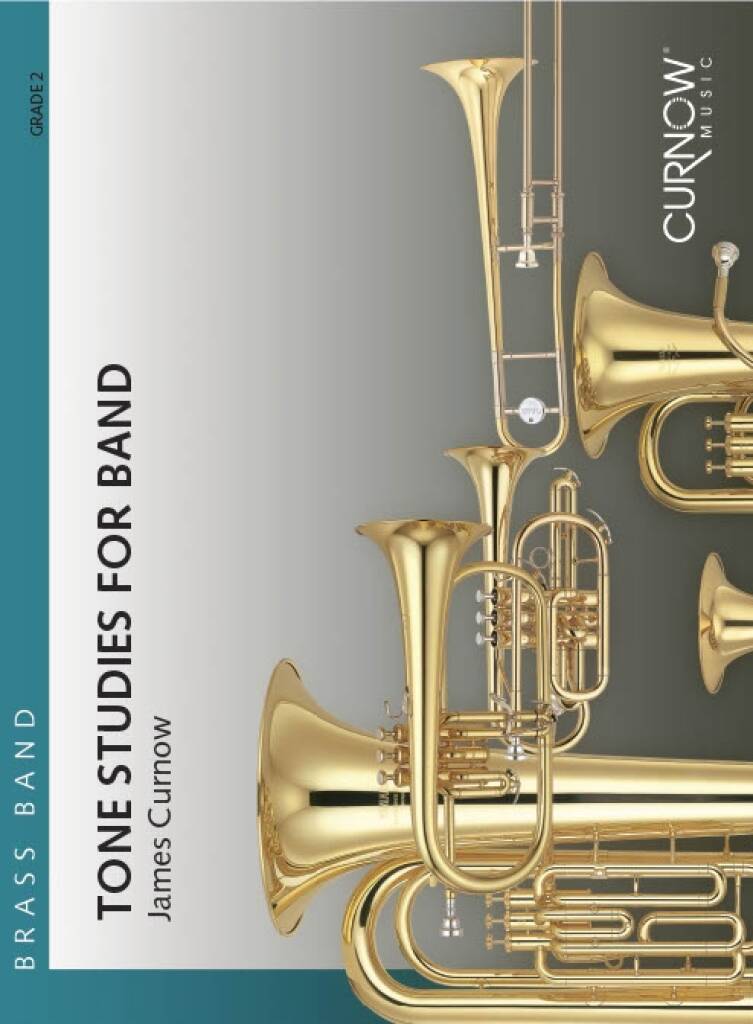
Tone Studies for Band - James Curnow
Tone Studies for brass band consists of nine studies designed to aid the development of good individual and ensemble tone production and intonation. Add Tone Studies to your library and you will find it quickly becomes an indispensible part of your band's rehearsal routine.
Estimated dispatch 5-14 working days
-
 £37.06
Nicaea - Band Warm-up (Brass Band) John Bacchus Dykes arr. Steve Kellner
This warm-up is designed to help players and conductors hear and improve section, group, and full band intonation, rhythmic precision, and balance in an efficient and musically satisfying way. The tune Nicaea was selected because of its easy-to-hear triads and intervals, and the harmonisation used throughout is purposely simple and consistent, so that the players can become very familiar with potential intonation trouble spots. Likewise, discrepancies in precision and balance will easily be heard. Keys have been carefully selected to expose specific intonation problems within the sections and groups, like the overlap between Eb and Bb instruments in the horns/baritones and later in euphoniums/basses, and 5th position tuning in the trombones. The format in sections 2 through 5 is consistent, beginning with a single section of the band playing in unison, then expanding into two-part and four-part harmony. After eight bars that section is joined by another section or sections to form a common multi-section group used in brass band scoring, such as the 'mellow choir', 'low brass', 'tuba-euphonium choir', and 'bright choir'. Section 6 features the two largest groupings, the 'all but cornets' and 'high brass'. Section 7 brings the whole band together for a majestic and powerful finish. To view a rolling score video please visit https://www.youtube.com/watch?v=RR3zQhsNTuc Duration: Approx. 5.10 minutes Difficulty Level: 4th Section + Sheet music available from www.brassband.co.uk Instrumentation: Soprano Cornet Eb Solo Cornet Bb Repiano Cornet Bb 2nd Cornet Bb 3rd Cornet Bb Flugel Horn Bb Solo Horn Eb 1st Horn Eb 2nd Horn Eb 1st Baritone Bb 2nd Baritone Bb 1st Trombone Bb 2nd Trombone Bb Bass Trombone Euphonium Bb Bass Eb Bass Bb Percussion 1-2
In Stock: Estimated dispatch 1-3 working days
-
£79.00
Every Breath You Take - Gordon Matthew Sumner - Idar Torskangerpoll
The great hit from 1983 by English band Police has moods and colours that is immediately recognized. In the band arrangement it is much the same, but with the added timbres and carpets of sound typical for wind players. Please pay attention to balance throughout the piece. You may also use this piece To improve the sound, balance and intonation in your band.
Publisher Closed for Holidays. Est Delivery 13-14th Aug
-
 £30.00
Brass Band Warm Up - Chris Houlding
I believe the practice of using a choral or hymn tune to develop fundamental playing basics in order to 'warm up' a brass ensemble is universally supported. However, this imaginative little exercise combines the virtues of choral playing with additional challenges addressing ensemble, phrasing, balance, dynamics (inc. crescendos and diminuendos), intonation (inc. unison passages) and varied articulations. For the discerning band in search of quality, not quite as easy as it looks !
-
 £30.00
Homage to Bach - Chris Houlding
Inspired by the master of counterpoint, Homage to Bach was written by Chris as an exercise in simplicity itself, designed to not only test the musicians playing skills and sense of style, but to encourage them to develop their "ensemble radar" through carefully listening, fine tuning, subtle dynamics and variation in articulation. The brass band has a long tradition of using chorales and hymns as a training exercise. As an alternative to existing hymn tunes, I have composed this simple chorale melody in three verses with a short introduction and links to specifically develop a quality 'tutti' band sound. Certain parts are doubled allowing performances by incomplete bands while presenting full outfits with an intonation and stylistic challenge. The printed phrasing is to be adhered to at all times regarding breaths, thus producing a seamless counterpoint. Simple yet satisfying for a quieter and atmospheric concert interlude.
-
 £39.95
Song of India - Rimsky-Korsakov arr. Eric Wilson
'Song of India' (or more accurately the 'Song of the Hindu') from Rimsky-Korsakov's 'opera-bilina' Sadko provides a technical challenge as well as a musical one, requiring a great degree of control and accurate intonation as the subtly varied chromatic phrases weave their way over a gently undulating, almost hypnotic accompaniment. Also available with piano accompaniment (Order Code: 0317)
Estimated dispatch 7-9 working days
 View Music