
Results
-
 £49.44
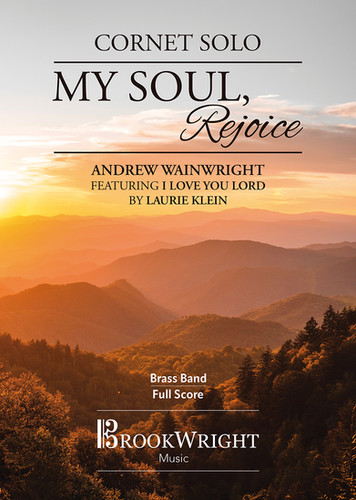
My soul, rejoice (Cornet Solo with Brass Band) Andrew Wainwright
My soul, rejoice (Andrew Wainwright) was commissioned in 2022 by Elizabeth Malovance, principal cornet of the Chicago Staff Band. A spirited and celebratory work, it is designed to showcase the dual nature of the cornet: its sparkling technical agility and its rich, vocal lyricism. The music begins in meditative fashion before transitioning into a joyful caprice featuring playful syncopations which are handed around the band. This is followed by a reflective section based on the much-loved worship song I love you Lord by Laurie Klein.The work concludes with a reprise of the original theme, building in momentum and intensity. Through a series of brilliant runs and virtuosic flourishes, the soloist leads the charge toward a majestic and triumphant finale, bringing the work to a ringing, glorious close.The solo was recorded by Richard Marshall on the 2026 CD Gothique Fantasy - The Music of Andrew Wainwright, which was his last solo recording of his 20-year tenure as principal cornet of Black Dyke Band.Technical Requirements & Electroacoustic IntegrationThis work features an optional digital delay effect for the soloist, indicated in the score by "pedal on" and "pedal off" markings. If the required equipment is unavailable, the piece can be performed entirely acoustically.To listen to Beth Malovance performing the work with the Chicago Staff Band please visit https://on.soundcloud.com/c8IoU3CF3srTD4z0wXDuration: approx. 8 minutesDifficulty Level (Band): 2nd Section +Soloist: AdvancedThis PDF download includes the full score and parts.Sheet music available at www.brassband.co.uk (UK) or https://satradecentral.org (USA)Instrumentation:Soprano Cornet EbSolo Cornet Bb1st Cornet Bb2nd Cornet BbFlugel Horn BbSolo Horn Eb1st Horn Eb2nd Horn Eb1st Baritone Bb2nd Baritone Bb1st Trombone Bb2nd Trombone BbBass TromboneEuphonium BbBass EbBass BbTimpani & Bass DrumPercussion 1-3
In Stock: Estimated dispatch 1-3 working days
-
£34.95
COVENANTERS, The (Brass Band Set) - Kenneth Downie
In 1638, many members of the Presbyterian Church of Scotland signed a document called the National Covenant. By doing so, they were declaring that they acknowledged only Jesus Christ as the spiritual head of their church, and not any king or queen. This had become necessary because the Stuart kings believed in the Divine Right of Monarchs and saw themselves as head of the church. In the previous year, Charles I had forcibly introduced the Book of Common Prayer, invoking the wrath of the common people who faced the threat of torture, transportation or execution if they did not use the new liturgy and worship at their local church. The net result of this was that many met illegally in the countryside or in barns and large houses. These meetings became known as 'conventides' and many took place in the south-west of the country. Anyone caught attending was at risk of execution by the muskets of the dragoons who were employed in the area for that specific purpose. This music was written to honour the bravery and loyalty of these Christians to their faith, in the face of extreme danger, in the hope that it will inspire us also to be faithful. There are overtones of military threat, secrecy and solidarity. An old pentatonic tune is used, which the composer heard as a boy being sung to the words The Lord's My Shepherd.
Estimated dispatch 7-14 working days
-
 £127.95
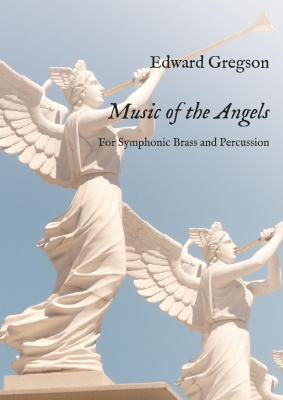
Music of the Angels (Symphonic Brass Ensemble - Score and Parts)
In 1998 Gregson was commissioned by conductor Martyn Brabbins to write a short concert opener with choir to mark his debut as Music Director of the Huddersfield Choral Society. Entitled ...and the seven trumpets... this ten minute flourish is founded on a verse from Chapter 8 of the Revelation To John (The Apocalypse), the last book in the Bible: 'and I saw the seven Angels which stood before God: and to them were given seven trumpets'. The performance employed the full power of the Huddersfield Town Hall organ and the brass section of the BBC Philharmonic, including seven trumpets and four horns placed strategically around hall.The following year, when Gregson received a commission from the Cheshire-based Foden's Brass Band (conducted at that time by Nicholas Childs) for a work to mark its centenary in 2000, he turned to the first portion of ...and the seven trumpets... as the basis for an ambitious celebratory work entitled The Trumpets of the Angels. "The opportunity to create an extended work which would break out of the brass band mould was an important milestone for me," the composer says. In 2015 he was asked by Nicholas Childs to create a new performing edition without organ for the Black Dyke Band. This received its first performance in April 2016 at the European Brass Band Festival in Lille. In 2018, Gregson revisited the music for a third time, returning the opening fanfares to orchestral brass and transforming substantial portions of the 'Black Dyke' version to create Music of the Angels, a dramatic canvas for symphonic brass and percussion.An array of bells and gongs offer an unmistakable key to the source of Gregson's inspiration. Inscribed In tribute to Olivier Messiaen, the work's principal material and its sound world, but crucially not the underlying musical processes, are influenced by Messiaen's masterpiece for wind and percussion, Et exspecto ressurectionem mortuorum (1964). Music of the Angels begins with braying of horns suggestive of the start of an ancient ritual. Six 'angel' trumpeters, set behind the ensemble, answer in sequence, with the evocative sound of tam-tams creating the Messiaen-like aura. Once the horns have reached the performing space, four of the trumpeters deliver highly contrasting fanfare cadenzas. At the climax of this episode, the individual fanfares are presented together, as if, perhaps, to reflect the Biblical writer's apocalyptic visions of hail, fire, seas of blood and the cataclysmic destruction of man and beast.This powerful vision of death and destruction gives way to a prayerful lament, re-imagining a sung Kyrie Eleison from the 'Black Dyke' edition, with flugel horn and euphonium obligati. The hushed atmosphere is broken by tenor and side drums, and trumpets five and six, which gallop away like the Horsemen of the Apocalypse. In the biblical account their steeds had 'heads like lions with fire and smoke and sulphur issuing from their mouths'.As the reverberation of a dramatic climax dies we hear the entry of the seventh trumpet, from 'on high', blazing forth with a version of the main that extends across the entire compass of the instrument - almost three octaves. Supported by a 'holy trinity' of gongs, an 'epic' final cadenza introduces new material which is further developed in a frenetic final section. This is announced by two sets of timpani, to the left and right. Braying brass (euphoniums and horns) once more adds an air of foreboding. As the music builds towards a magisterial conclusion, the Messiaen-inspired tritones of the principal motif are smoothed out into perfect 5ths and combined with the earlier material in a full-voiced chorale, over which the seventh trumpet blazes in triumph.- Programme note by Paul HindmarshScored for1 Trumpet in E flat (Trumpet 5)6 Trumpets in B flat (Trumpet 4 doubling Flugel Horn)4 Horns in F3 Tenor Trombones1 Bass TromboneEuphonium2 Tubas2 Timpani (Percussion 3 doubles Timpani 2)Percussion (3 players): 3 Tam-tams, 3 Suspended Cymbals, Bass Drum, Tenor Drum, Snare Drum, Tubular Bells.Duration: 16.00
Estimated dispatch 7-14 working days
-
 £34.95
Judd: The Covenanters
In 1638, many members of the Presbyterian Church of Scotland signed a document called the National Covenant. By doing so, they were declaring that they acknowledged only Jesus Christ as the spiritual head of their church, and not any king or queen. This had become necessary because the Stuart kings believed in the Divine Right of Monarchs and saw themselves as head of the church. In the previous year, Charles I had forcibly introduced the Book of Common Prayer, invoking the wrath of the common people who faced the threat of torture, transportation or execution if they did not use the new liturgy and worship at their local church. The net result of this was that many met illegally in the countryside or in barns and large houses. These meetings became known as 'conventides' and many took place in the south-west of the country. Anyone caught attending was at risk of execution by the muskets of the dragoons who were employed in the area for that specific purpose. This music was written to honour the bravery and loyalty of these Christians to their faith, in the face of extreme danger, in the hope that it will inspire us also to be faithful. There are overtones of military threat, secrecy and solidarity. An old pentatonic tune is used, which the composer heard as a boy being sung to the words The Lord's My Shepherd.
Estimated dispatch 7-14 working days
-
 £34.22
La Chica sin nombre (Trombone Solo with Brass Band) Rob Wiffin
A vibrant, rhythmic solo for trombone and band.La Chica sin Nombre was written in March 2020 at the request of Brett Baker. He wanted something in Latin style so I chose to go for a Mambo-type dance piece. In obtaining the right percussion sound I would always ask for Conga drums and Mambo Bell/Timbales rather than drum kit. The piece needs to be played with an appropriate feel for Latin music.It should sound light and easy to play but has a few tricky moments - especially the cadenza-like sections from F to H. The virtuosic section at letter G can be cut if required.Duration: Approx. 4.20 minutesDifficulty Level: Band: Medium / Soloist: AdvancedThis PDF download includes the full score and parts.Sheet music available at www.brassband.co.uk (UK) or https://satradecentral.org (USA)
In Stock: Estimated dispatch 1-3 working days
-
 £36.30
Will You Love Me Tomorrow
This haunting song from the early 1960's was sung by The Shirrelles, and is better remembered as "Will you still love me tomorrow".Tim Paton writes:This arrangement features the Tenor Horns and Baritones, although there is still plenty to do for the rest of the band. Also, I have made sure that, if your band were unfortunately missing a 2nd Horn or/and 2nd Baritone, I have cued any important parts elsewhere so that they are covered.
In Stock: Estimated dispatch 3-5 working days
-
 £64.65
Temperamental (Brass Band) Fendall Hill
This work by Fendall Hill was the set test for the 2021 National Brass Band Championships of New Zealand, B Grade.The composer writes: 'J.S. Bach (1685-1750) is deemed by many to be the 'Ulimate Composer'. He added an incredible proportion to the DNA of western music, and his influence is heard in the music of today. Like many artists, he was not overly recognised as a composer during his lifetime, and it took an 1829 performance of the St Matthew Passion by Mendelssohn to ignite a recognition of his place in the music world, a place he has maintained ever since.This piece starts with a similar spark of rediscovery of the music of Bach. It contains arrangements of various works, interspersed with composition based on Bach's chord structures, sections in the style of Bach, and original sections inspired by the moods created along the way.The first section explores the Toccata, and great organ works. This leads into an exploration of his choral works, and a finale based on the Preludes. The word 'Tempered' has different meanings, and all seem to apply to the music of Bach, and these appeal to the musical, engineering and spiritual aspects of my personal life.His music reaches to the humanity and divinity, it has strength, structure and order that creates frameworks in which incredible complexity reigns; and the complexity leads to a wildness, a kind of craziness that represents a range of human moods, and can change without warning. The same piece of music affects people in very different ways.I don't know if it's Bach's music, or us, but it can seem out of control and under control at the same time - the combination is highly temperamental.To view a follow-the-score video of the work please visit: https://youtu.be/zpNxITUqXZUSheet music available from:UK - www.brassband.co.ukUSA - www.solidbrassmusic.comDifficulty Level: 1st Section +Instrumentation:Soprano Cornet EbSolo Cornet 1&2 BbSolo Cornet 3&4 Bb2nd Cornet Bb3rd Cornet BbFlugel Horn BbSolo Horn Eb1st Horn Eb2nd Horn Eb1st Baritone Bb2nd Baritone Bb1st Trombone Bb2nd Trombone BbBass TromboneEuphonium BbBass EbBass BbTimpaniPercussion 1-4
In Stock: Estimated dispatch 1-3 working days
-
 £30.00
Bandamonium 2024 (Neil Lock) - Brass Band Sheet Music Full Score & Parts - LM541
COMPOSER: Neil LockThis march was submitted to the march composers' competition for "Bandamonium 3"in Hatherleigh, Devon in July 2024. The winning march was played by massed bands at the conclusion of the celebrations on Saturday 27th July 2024. Unfortunately, this march took second place in the competition, behind the march of Paul Pennicotte-Henrie, conductor of Okehampton Silver Band.The march can be played with or without the singing. (Even at the Whit Friday marches, begad!) I suggest that it should be introduced by 3-beat rolls.When played with singing, the "Bandamonium" lyrics (bars 10-13 and 56-57) are to be sung by all players, keeping to their own parts, with appropriate octave adjustment for their individual singing voices. Conductor and percussionists should sing with the main theme (Db and C at bars 10-13, F at 56-57). Listen to the 3rd cornet players!There is an additional part for Singers, in which the trio melody (bars 58 onwards) can be sung by Soprano and Tenor singers at a moderate choir standard. An octave-down option is also provided in the higher bars. This part can be given to "spare" singers within the band, or to singers external to the band if opportunity permits. The lyrics are:We are in Devon,We're in Hatherleigh,Whit Friday heaven,But we're marching free!Now it's past seven,Time to party,At BandamoniumIn Hatherleigh!LM541 - ISMN : 9790570005413
In Stock: Estimated dispatch 3-5 working days
-
 £42.35
Oubliette - Lucy Pankhurst
Lucy Pankhurst has created a highly immersive solo for Tuba/Eb Bass with brass band accompaniment, aiming and succeeding in showing the lyrical and technical diversity of the tuba, demanding virtuoso brilliance and clarity in performance.Dedicated to tuba player Edd Leech, Oubliette raises the bar for tuba repertoire.Set includes score, brass band parts and solo parts for Eb Bass (TC) and Tuba (BC). Solo with piano accompaniment available separately.Programme notes from the composer, Lucy Pankhurst:From the French word oublier, meaning 'to forget', an oubliette was a form of dungeon used in the 14th century. A small, windowless room where someone is locked away to be forgotten and left to go mad.I initially chose this title for the piece as the Tuba is often forgotten as a solo instrument, when its versatility in performance should be celebrated. Oubliette showsThe work begins with desolate and sparse accompaniment with lamenting solo lines. The soloist has already been cast into the oubliette at this point and is beginning to wake from a somnolent state. Reality is blurred through the darkness of the chamber - the only entrance is a hatch in the ceiling, far out of reach.Memories are confused by countless hours of solitude - hallucinations and paranoia tainting reality. Gradually, the soloist remembers images from the past and gains confidence and strength. Long forgotten by the captors, or presumed dead in the chamber, the entrance hatch suddenly opens to allow another prisoner inside. The soloist seizes the opportunity for escape and a short battle ensues. Sword and fist fighting, perilous leaps over the entrances to more dungeons and fierce battle cries are futile, as the soloist suddenly realises they are alone in the oubliette once more and the skirmish was nothing but another dream.The piece concludes with unaccompanied soloist in the low register, sinking deeper into the shadows of the windowless prison; are they accepting their fate, or merely lying in wait for another chance of escape, if one will ever come . . .
In Stock: Estimated dispatch 3-5 working days
-
£30.00
Three Pieces from Czechoslovakia - Leos Janacek
This is the music of Leos Janacek (1854-1928) - exciting, powerful, emotive, impassioned, unpredictable, and many other definitions all rolled into one! Janacek was little known in Britain until the 1960's, when the conductor Charles Macherras introduced his unique music and opera to the western audience. His orchestral Sinfonietta was an instant hit. Janacek has since been one of the featured composers in the 'Proms'.The three pieces which I have arranged for brass band are INTRODUCTION, ORGAN SOLO and INTRADA from Janacek's Glagolitic Mass. They work equally well together or on their own, as they each have their own identity. They can be purchased together or separately.1. INTRODUCTIONA great 'starter' for the first or second half of a concert. 2. ORGAN SOLOThis is a 'must' if you want to impress your audience - every section of the band is incredibly busy, (although they can be assured that they do have time to breath)! 3. INTRADAThis piece, (and no.1 "Introduction"), both contain that 'fanfare' like quality which Janacek is famous for in his Sinfonietta.
In Stock: Estimated dispatch 3-5 working days
 View Music
