
Results
-
 £33.62
Have Yourself a Merry Little Christmas (Vocal or Flugel/Cornet Solo with Band)
This attractive Bossa Nova-style arrangement for vocal or flugel/cornet soloist with brass band has been made by Australian composer Sam Creamer. The key is suitable for male or female vocalists, or in the absence of a vocal soloist a part has been supplied for flugel horn or cornet soloist. A piano accompaniment that matches this band arrangement is also available here and may be used as an alternate accompaniment in the absence of a full band, or can be used simultaneously by a rhythm section alongside the brass band. Have Yourself a Merry Little Christmas has been a Christmas favourite to many since its first release, extensively featuring in Christmas movies, broadcasts and programming. It has also been recorded numerous times by artists including Judy Garland, Frank Sinatra, Tori Amos, Michael Buble, Christina Aguilera, and Chicago. To view a rolling score video of this piece please visit www.youtube.com/watch?v=sSZHxzsJheg Duration: Approx. 3.00 minutes Difficulty Level: Medium Easy PDF download includes parts and score. Sheet music available from www.brassband.co.uk or www.durhammusicshop.co.uk (UK) or https://satradecentral.org (US) Instrumentation: Vocal Soloist Cornet/Flugel Horn Soloist Bb Soprano Cornet Eb Solo Cornet Bb Repiano Cornet Bb 2nd Cornet Bb 3rd Cornet Bb Flugel Horn Bb Solo Horn Eb 1st Horn Eb 2nd Horn Eb 1st Baritone Bb 2nd Baritone Bb 1st Trombone Bb 2nd Trombone Bb Bass Trombone Euphonium Bb Bass Eb Bass BbPercussion I (Timpani, Vibraphone, Glockenspiel) Percussion II (Bongos, Shaker, Triangle) Percussion III(Drum Set)
In Stock: Estimated dispatch 1-3 working days
-
 £82.19
'Odyssey' Variations (Brass Band) Kevin Norbury
'Odyssey' Variations was composed as a result of a commission in May 2020 from Five Lakes Silver Band and its musical director, Christopher Ward. This music is based on an original theme that I first used in an earlier composition, Odyssey, which was the test piece for the European Brass Band Championships, held at Munich, Germany, in April 1999. I distinctly remember getting into my hotel room and turning on the television to be greeted by news coverage of the Columbine High School shooting, so that piece has always held some significance for me, though because of a very sad coincidence. The melody was originally a cornet solo in the central slow section of Odyssey and pitched deliberately to test the soloist. I have, more recently attempted a straightforward choral setting of the melody, and the harmonies I use in the three chorale-style settings at the start of these variations are loosely based on that setting. The melody is a setting of the familiar words of Be Thou My Vision, an old Irish hymn, translated by Mary E. Byrne, and versified by Eleanor H. Hull. The form of the work is as follows: Theme - three presentations Variation 1 - Allegro Variation 2 - Moderato (featuring the horns, baritones, euphoniums and basses) Variation 3 - Maestoso (featuring the cornets, flugel horn, and trombones) Variation 4 - Adagio Variation 5 - Allegretto Variation 6 - Largo - Moderato Variation 7 - Allegro molto Theme - Maestoso e sostenuto Finale - Allegro vivace - Adagio e allargando To view a video of Five Lakes Silver Band performing the work please visit: www.youtube.com/watch?v=vfLnld3bCw8 Sheet music available from: UK - www.brassband.co.uk USA - www.solidbrassmusic.com Difficulty Level: 1st Section + Instrumentation: Soprano Cornet Eb Solo Cornet Bb Repiano Cornet Bb 2nd Cornet Bb 3rd Cornet Bb Flugel Horn Bb Solo Horn Eb 1st Horn Eb 2nd Horn Eb 1st Baritone Bb 2nd Baritone Bb 1st Trombone Bb 2nd Trombone Bb Bass Trombone Euphonium Bb Bass Eb Bass Bb Timpani Percussion 1-3
In Stock: Estimated dispatch 1-3 working days
-
 £33.62
Both Sides, Now (Brass Band) Joni Mitchell arr. Andrew Wainwright
Joni Mitchell's Both Sides, Now is a timeless reflection on the shifting landscapes of life, love, and self-understanding. First released in 1969, this iconic song has become a signature of Mitchell's extraordinary songwriting, capturing the delicate interplay between youthful innocence and hard-earned wisdom. With its poignant lyrics and haunting melody, Both Sides, Now continues to resonate across generations. This evocative brass band arrangement by Andrew Wainwright was commissioned by the Fountain City Brass Band for its 2023 tour of England, including a performance at the prestigious Brass in Concert Championships. Featuring prominent solos for baritone and flugel horn, the arrangement makes full use of their lyrical warmth and tonal richness. BrookWright is delighted to be able to now make this arrangement available to brass bands. To view an excerpt of Fountain City Brass Band performing the work please visit www.youtube.com/watch?v=OYaoF_b9wHo Duration: approx. 3.30 minutes Difficulty Level: 4th Section + This PDF download includes parts and score. Sheet music available at www.brassband.co.uk (UK) or https://satradecentral.org (USA) Instrumentation: Soprano Cornet Eb Solo Cornet Bb Repiano Cornet Bb 2nd Cornet Bb 3rd Cornet Bb Flugel Horn Bb Solo Horn Eb 1st Horn Eb 2nd Horn Eb 1st Baritone Bb 2nd Baritone Bb 1st Trombone Bb 2nd Trombone Bb Bass Trombone Euphonium Bb Bass Eb Bass Bb Timpani Percussion 1-3
In Stock: Estimated dispatch 1-3 working days
-
 £33.62
Classical Concert! (Brass Band) Various arr. Alex Scaife McGee
Classical Concert! by Alex Scaife McGee is a high-energy concert medley that celebrates the enduring appeal of the classical canon while paying tribute to the legendary Harold Walters, whose Instant Concert and Hootenanny set the standard for this exciting style of programming. Drawing on some of the most recognisable themes in classical music, this arrangement weaves familiar melodies into a fast-paced, audience-pleasing showcase. The journey begins with the unmistakable excitement of Rossini's William Tell Overture, flowing seamlessly into Bizet's Carmen Overture. The intensity builds with Grieg's In the Hall of the Mountain King before lifting into the brightness of Vivaldi's Spring. Momentum continues through a thrilling sequence featuring Beethoven's Ode to Joy from Symphony No. 9, the dramatic fate theme from Tchaikovsky's Symphony No. 5, and the majestic power of Saint-Saens's Organ Symphony. A triumphant statement from Handel's Hallelujah Chorus sets the stage for rapid-fire appearances by Mozart's Horn Concerto No. 3 and Tchaikovsky's Swan Lake. The medley concludes with two crowd-favorite finales: Rossini's The Barber of Seville and the rousing, cannon-ready excitement of Tchaikovsky's 1812 Overture. Ideal for concerts, entertainment contests, and audience outreach, Classical Concert! delivers non-stop excitement, instant recognition, and a joyful celebration of classical music at its most entertaining. To view a rolling score video please visit www.youtube.com/watch?v=gIqvoA1Rh40 Duration: Approx. 4.00 minutes Difficulty Level: 2nd Section + This PDF download includes the full score and parts. Sheet music available at www.brassband.co.uk (UK) or https://satradecentral.org (USA) Instrumentation: Soprano Cornet Eb Solo Cornet Bb Repiano Cornet Bb 2nd Cornet Bb 3rd Cornet Bb Flugel Horn Bb Solo Horn Eb 1st Horn Eb 2nd Horn Eb 1st Baritone Bb 2nd Baritone Bb 1st Trombone Bb 2nd Trombone Bb Bass Trombone Euphonium Bb Bass Eb Bass Bb Timpani Drum Kit Percussion
In Stock: Estimated dispatch 1-3 working days
-
 £44.83
Illuminate - Brass Band (Andrew Wainwright)
Written for the Chicago Staff Band's tour of England in 2015, this exhilaratingwork was premiered at The Salvation Army's Boundless International Congress at London's O2 Arena to an audience of 20,000 people. The piece is structured as a through-composed triptych, weaving together the popularcontemporary worship songs Shine on Us (Michael W. Smith) and Speak, O Lord (Keith and Kristin Getty) with the historic Salvationist anthem The World for God (Evangeline Booth) to explore themes of light, guidance, and mission. The work opens with energy and rhythmic drive, centering on Shine on Us. A stark contrast follows in the meditative middle section. Here, the music explores the contemplative depths of Speak, O Lord, featuring the solo horn. The final section introduces a nostalgic and stirring reference to General Evangeline Booth's classic hymn, The World for God. The finale juxtaposes all three themes. As the disparate melodies intertwine and layer upon one another, the music builds to a triumphant climax - a representation of 'illumination' that celebrates a shared faith across generations. To view The International Staff Band performing the piece, please visit: www.youtube.com/watch?v=T5gVsBrdvio Duration: approx. 7 minutes Includes score and full set of parts. Sheet music available exclusively from World of Brass - www.worldofbrass.com Difficulty Level: 2nd Section + Instrumentation: Soprano Cornet Eb Solo Cornet Bb 1st Cornet Bb 2nd Cornet Bb Flugel Horn Bb Solo Horn Eb 1st Horn Eb 2nd Horn Eb 1st Baritone Bb 2nd Baritone Bb 1st Trombone Bb 2nd Trombone Bb Bass Trombone Euphonium Bb Bass Eb Bass Bb Timpani Percussion 1-2
In Stock: Estimated dispatch 1-3 working days
-
 £33.62
O Holy Night (Flugel Solo with Brass Band) arr. Kevin Larsson
VIEW SCORE PDF O Holy Night, also known as Cantique de Noel, was originally based on a poem by Placide Cappeau before being set to music by Adople Adam. This carol has become a favourite to many, being performed all over the world in various styles and forms. This jazz-style arrangement for flugel horn and brass band was written for John Docter for The Salvation Army's Night of Wonder Carol Service in Los Angeles. To view a performance video please visit: www.youtube.com/watch?v=tMobVKBLmMY Sheet music available from: UK - www.brassband.co.uk USA - www.solidbrassmusic.com Difficulty Level: 3rd Section + Instrumentation: Flugel Horn Soloist Bb Soprano Cornet Eb Solo Cornet Bb 1st Cornet Bb 2nd Cornet Bb Solo Horn Eb 1st Horn Eb 2nd Horn Eb 1st Baritone Bb 2nd Baritone Bb 1st Trombone Bb 2nd Trombone Bb Bass Trombone Euphonium Bb Bass Eb Bass Bb Timpani Drum Kit Percussion Bongos
In Stock: Estimated dispatch 1-3 working days
-
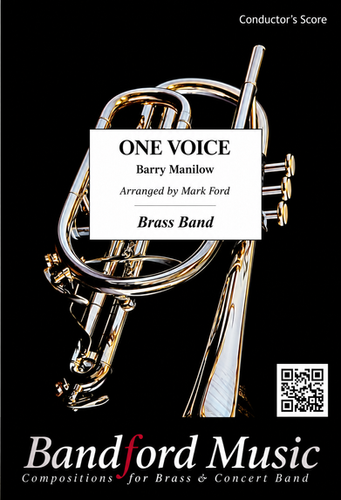 £33.62
One Voice (Brass Band) Barry Manilow arr. Mark Ford
Originally released in 1979 as the title track of Barry Manilow's sixth studio album, One Voice has become an enduring anthem for unity and social courage. It is a stirring ballad that reminds us how a single, brave voice can ignite a chorus of solidarity and lead the way toward positive change. Expertly crafted for brass band by Mark Ford, this setting captures the intimate, soaring spirit of the original while leveraging the unique textures of the brass band. The piece begins with a delicate, lyrical flugel horn solo, representing the 'single voice' of the title. As the arrangement progresses, the rest of the ensemble joins in, building from a gentle accompaniment into a magnificent, wall-of-sound finale that is sure to leave your audience inspired. To view a rolling score video of the work please visit https://youtu.be/RcQ5xbnyNjs Duration: Approx. 3.15 minutes Difficulty Level: 4th Section + This PDF download includes the full score and parts. Sheet music available at www.brassband.co.uk (UK) or https://satradecentral.org (USA) Instrumentation: Soprano Cornet Eb Solo Cornet Bb Repiano Cornet Bb 2nd Cornet Bb 3rd Cornet Bb Flugel Horn Bb Solo Horn Eb 1st Horn Eb 2nd Horn Eb 1st Baritone Bb 2nd Baritone Bb 1st Trombone Bb 2nd Trombone Bb Bass Trombone Euphonium Bb Bass Eb Bass Bb Timpani Glockenspiel Percussion
In Stock: Estimated dispatch 1-3 working days
-
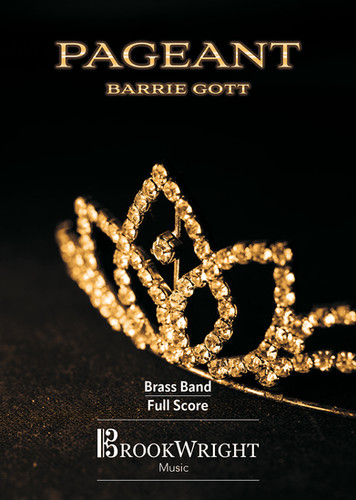 £41.09
Pageant (Brass Band) Barrie Gott
Born during the isolation of the COVID-19 pandemic, Pageant by Australian composer Barrie Gott transforms the simple interval of a fourth into an engaging, multi-faceted set of variations. Written specifically with 4th Section bands in mind, this work delivers rich textural contrast, clear educational rewards, and a crowd-pleasing arc that moves from regal tradition to high-energy rock. The piece opens with a majestic herald, setting a ceremonial tone as a warm, mellow melody dialogues with bright, fanfare-like brass. From there, the music moves through three distinct stylistic worlds: a delicate, nimble variation inspired by the craft of Eric Ball's A Little Suite for Band; a smooth, lyrical ballad featuring the solo cornet and flugel horn; and a high-energy finale grounded in a driving 6/8 rock groove, bringing the work to a dramatic, cinematic finish. To listen to a recording of Toowoomba Municipal Band performing the work please visit: https://on.soundcloud.com/i9X5JsWQedaAbiWzXf Duration: approx. 6.45 mins Difficulty Level: 4th Section + This PDF download includes the full score and parts. Sheet music available at www.brassband.co.uk (UK) or https://satradecentral.org (USA) Instrumentation: Soprano Cornet Eb Solo Cornet Bb Repiano Cornet Bb 2nd Cornet Bb 3rd Cornet Bb Flugel Horn Bb Solo Horn Eb 1st Horn Eb 2nd Horn Eb 1st Baritone Bb 2nd Baritone Bb 1st Trombone Bb 2nd Trombone Bb Bass Trombone Euphonium Bb Bass Eb Bass Bb Timpani Percussion 1-4
In Stock: Estimated dispatch 1-3 working days
-
 £48.56
Peace in Our Time (Brass Band) Andrew Wainwright
Commissioned by Armonico Consort to mark the 85th anniversary of the Coventry Blitz, Peace in Our Time is a profoundly moving reflection on humanity's enduring quest for reconciliation amidst turmoil. Originally scored for choir, orchestra, and organ, this masterful brass band transcription beautifully captures the emotional weight of John Oxenham's evocative poetry and the timeless plea of Psalm 122. The work opens in hushed reverence, where distant muted cornets, a dark bass pedal, and a fragile, militaristic snare drum set a shadowed, contemplative scene. Out of this delicate landscape emerges a poignant cornet solo that yields to the expressive voice of the solo flugel horn, carrying the opening text with quiet conviction before introducing the solemn reminder: "O pray for peace, peace in Jerusalem." As the piece progresses, the setting turns darker and more restless. Harmonic tension builds through rich brass textures to reflect the fears, divisions, and heavy costs of historical and modern conflict. From this emotional turbulence rises a bold, ceremonial fanfare that marks a dramatic turning point, ushering in a glorious, expansive setting of the poem's final verse. Yet rather than ending in simple triumph, the music gently recedes into a serene and tender stillness. The final bars leave performers and audiences alike with a quiet, lingering echo - a persistent hope for peace that resonates just as deeply today as it did 85 years ago. This substantial work is an extraordinary addition to any brass band library, serving as an ideal centerpiece for Remembrance Sunday, historical commemorations, church services or serious concert programming. To view a multimedia presentation of the piece with audio please visit www.youtube.com/watch?v=Y2BKI_GCegw The multimedia presentation is available on request withe purchase of this work - please email [email protected] to receive a link to download it. To view a video performance of the original work for choir, orchestra and organ please visit www.youtube.com/watch?v=m6o6PJJVKCo Duration: approx. 8.45 minutes Difficulty Level: 2nd Section + This PDF download includes the full score and parts. Sheet music available at www.brassband.co.uk (UK) or https://satradecentral.org (USA) Instrumentation: Soprano Cornet Eb Solo Cornet Bb Repiano Cornet Bb 2nd Cornet Bb 3rd Cornet Bb Flugel Horn Bb Solo Horn Eb 1st Horn Eb 2nd Horn Eb 1st Baritone Bb 2nd Baritone Bb 1st Trombone Bb 2nd Trombone Bb Bass Trombone Euphonium Bb Bass Eb Bass Bb Timpani Percussion 1-2
In Stock: Estimated dispatch 1-3 working days
-
 £33.62
Rockingham (Brass Band) Edward Miller arr. Karl Whelan
This sublime arrangement of the much loved hymn tune Rockingham ('When I survey the wondrous cross'), was arranged by Karl Whelan in memory of Frank Naylor. Frank was a faithful member of North Ashton Band based in Wigan (UK), a renowned tenor horn player and an inspiration to his many pupils over the years. In reference to Frank's slow melody piece of choice, there is also a reference in the trombones to Star of Bethlehem by Stephen Adams, leading into the final verse. Sheet music available from: UK - www.brassband.co.uk USA - www.solidbrassmusic.com Difficulty Level: 4th Section + Instrumentation: Soprano Cornet Eb Solo Cornet Bb Repiano Cornet Bb 2nd Cornet Bb 3rd Cornet Bb Flugel Horn Bb Solo Horn Eb 1st Horn Eb 2nd Horn Eb 1st Baritone Bb 2nd Baritone Bb 1st Trombone Bb 2nd Trombone Bb Bass Trombone Euphonium Bb Bass Eb Bass Bb Timpani Percussion 1-3
In Stock: Estimated dispatch 1-3 working days
 Watch video