
Results
-
 £84.95
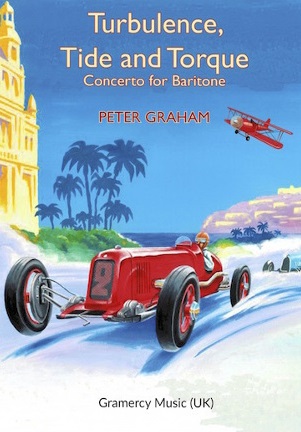
Turbulence, Tide and Torque (Baritone Solo with Brass Band - Score and Parts) - Graham, Peter
Concerto for BaritoneTurbulence, Tide and Torque can be considered to be a companion piece to my 2008 Euphonium Concerto In League with Extraordinary Gentlemen, and indeed can be performed on Euphonium (vintage or medium bore instrument preferred). Whereas the gentlemen in question in the latter work were fictional (e.g. Sherlock Holmes and Phileas Fogg), the former pays tribute to three real life women who were very much true pioneers and heroines of their age.Turbulence: Harriet Quimby (b. 1875) was one of the world's best woman aviators, her significant and historic achievement being the first woman to fly across the English Channel. Sadly, in her lifetime very few people were aware of her 1912 accomplishment; potential press coverage was dominated by the sinking of The Titanic only two days before.Grace Darling (b. 1815) is a name much more familiar to the public today, and in her lifetime she was lauded as a national heroine. A humble lighthouse keeper's daughter from Northumberland, her participation in the rescue of survivors from the wrecked paddle-steamer Forfarshire is well documented (a museum dedicated to her achievements located in Bamburgh, the town of her birth). This movement, Tide, develops a main theme from my large scale work Harrison's Dream, reflecting on the souls lost in the disaster.The final movement Torque, opens with a sudden gear change such as might have been undertaken by Dorothy Levitt (b. 1882), the woman's world land speed record holder, in her Napier racing car. Levitt, who following her 1906 record-breaking achievement was described as the Fastest Girl on Earth, went on to write extensively about her experiences, encouraging females to take up motoring through her articles in The Graphic newpaper.Turbulence, Tide and Torque was commissioned by and is dedicated to Katrina Marzella as part of an Arts Council of England funded residency I was awarded with the Black Dyke Band in 2018.- Peter GrahamDuration: 15.00
Estimated dispatch 7-14 working days
-
 £34.95
Welsh Fantasy for Euphonium & Band (Euphonium Solo with Brass Band - Score and Parts) - Pearce, Ralph
Written for the late Bandmaster Christopher Mallet to play at the Bristol Easton Band's 2000 Spring Festival, the solo is based around the Welsh Lullaby 'Suo G?n’ which is associated with the words of Herbert H. Booth, 'Let me love thee'. There are also subtle references to 'Men of Harlech'. ?As demanding as the solo part is, so too the band parts rise above the level of mere accompaniment.
Estimated dispatch 7-14 working days
-
£17.50
Welsh Fantasy for Euphonium & Band (Euphonium Solo with Brass Band - Score only) - Pearce, Ralph
Written for the late Bandmaster Christopher Mallet to play at the Bristol Easton Band's 2000 Spring Festival, the solo is based around the Welsh Lullaby 'Suo G?n’ which is associated with the words of Herbert H. Booth, 'Let me love thee'. There are also subtle references to 'Men of Harlech'. ?As demanding as the solo part is, so too the band parts rise above the level of mere accompaniment.
Estimated dispatch 7-14 working days
-
 £38.00
Wade in the Water (Euphonium Solo with Brass Band - Score and Parts) - Bassey, Mark
A Euphonium feature, "Wade in the Water" is a Negro Spiritual. The song relates to both the old and new testaments and reflects the Israelites escape out of Egypt, There is a popular belief that Wade in the Water contained explicit instructions to fugitive slaves on how to avoid capture. In this arrangement, Mark Bassey has been influenced by Norman Symmons fine arrangement for the Johnny Griffin orchestra and was recorded by Superbrass on their "Brass Taps" CD with Andy Wood as soloist. Duration: 5.00. Suitable for 2nd Section Bands and above.
Estimated dispatch 7-14 working days
-
£34.95
Rhapsody for Euphonium (Euphonium Solo with Brass Band - Score and Parts) - Sharman, Paul
Following a lively opening in which the band echoes statements by?the soloist, the central section features the melody 'He Leadeth Me'?before returning to the pyrotechnics of the first section.
Estimated dispatch 7-14 working days
-
£17.50
Rhapsody for Euphonium (Euphonium Solo with Brass Band - Score only) - Sharman, Paul
Following a lively opening in which the band echoes statements by?the soloist, the central section features the melody 'He Leadeth Me'?before returning to the pyrotechnics of the first section.
Estimated dispatch 7-14 working days
-
 £40.00
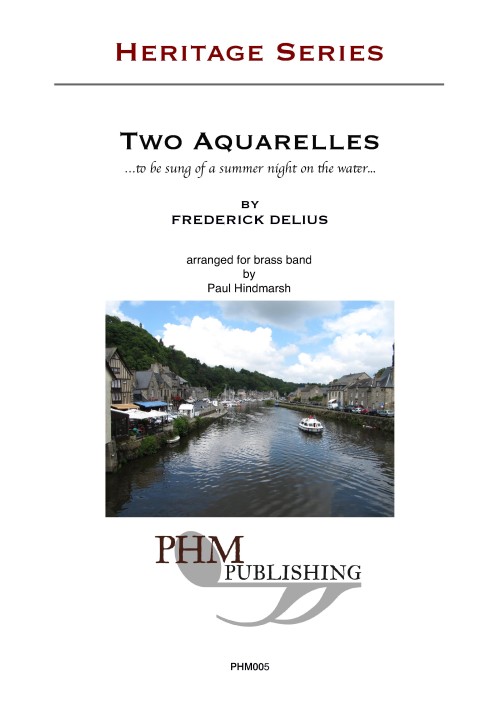
Two Aquarelles (Euphonium Feature with Brass Band - Score and Parts) - Delius, Frederick - Hindmarsh, Paul
In the late spring of 1917, the Bradford born composer, Frederick Delius (1856 - 1934) composed two short part-songs at his home in Grez-sur-Loing. The river ran along the bottom of his garden and he called the two miniatures To be sung of a summer night on the water. The First World War was at its height, but one would never guess that from the languid and serene quality of these richly textured nocturnes. The songs were first heard in London on 28 June, sung by the Oriana Madrigal Society, conducted by Charles Kennedy Scott. In 1932 Delius's amanuensis, Eric Fenby, arranged them for string orchestra as Two Aquarelles. While I have taken Fenby's title, my arrangement is a note-for-note transcription of the choral original. It was prepared in early in 1993 for Besses o' th' Barn Band, of which I was Musical Director at the time. In the second song, the prominent tenor solo has been given to the solo euphonium, who should stand apart from the band in performance.- Paul HindmarshDuration: 5.00
Estimated dispatch 7-14 working days
-
£29.95
A Joy Untold (Euphonium Solo with Brass Band - Score and Parts) - Camsey, Terry
This short, light-hearted solo has been described as The Salvation Army's answer to 'The flight of the bumble bee' and requires facility from the soloist and accurate accompaniment from the band. The solo opens and closes with whimsical references to Erik Leidzen's famous euphonium solo 'The Song of the Brother' and includes the tunes 'A robe of white' and 'I'll serve Thee'.
Estimated dispatch 7-14 working days
-
£14.95
A Joy Untold (Euphonium Solo with Brass Band - Score only) - Camsey, Terry
This short, light-hearted solo has been described as The Salvation Army's answer to 'The flight of the bumble bee' and requires facility from the soloist and accurate accompaniment from the band. The solo opens and closes with whimsical references to Erik Leidzen's famous euphonium solo 'The Song of the Brother' and includes the tunes 'A robe of white' and 'I'll serve Thee'.
Estimated dispatch 7-14 working days
-
 £22.00
Lullaby (Euphonium Duet with Brass Band - Score and Parts) - Doe, Philip
Lullaby is a beautiful euphonium duet with band accompaniment. The solo and contrapuntal writing, combined with a rich accompaniment from the band, offers peace and serenity. Suitable for Youth/4th Section Bands and above. Duration: 4.00
Estimated dispatch 7-14 working days
 View Music