
Results
-
 £37.35
The First Nowell (Brass Band, opt. Choir & Piano) Traditional arr. Barrie Gott
This charming setting by Australian composer Barrie Gott is of the favourite carol The First Nowell. Although this version is for brass band, choir and piano, it is orchestrated such that it will work for standalone brass band. The arranger writes: 'I have always been fascinated with the words and music of this majestic carol. It was first written for choir and piano and then orchestrated for the Brisbane Lord Mayor's Carols with the Queensland Pops Orchestra. A further arrangement for brass band was prepared for a Salvation Army event. The setting is for four verses (1,2,5 and 6) and tells the Gospel story in a nutshell. It starts very simply and builds to a spectacular climax.' To view a rolling score video of this work please visit www.youtube.com/watch?v=2KH6u0MUiaY Duration: 4.45 minutes approx. Difficulty Level: 3rd Section + PDF download includes parts and score. Sheet music available from www.brassband.co.uk or www.durhammusicshop.co.uk (UK) or https://satradecentral.org (US) Instrumentation: Soprano Cornet Eb Solo Cornet Repiano Cornet Bb 2nd Cornet Bb 3rd Cornet Bb Flugel Horn Bb Solo Horn Eb 1st Horn Eb 2nd Horn Eb 1st Baritone Bb 2nd Baritone Bb 1st Trombone Bb 2nd Trombone Bb Bass Trombone Euphonium Bb Bass Eb Bass BbTimpani Percussion 1-2 SATB Choir (optional) Piano (optional)
In Stock: Estimated dispatch 1-3 working days
-
 £33.62
The Music of Living - Brass Band (Dan Forrest arr. Andrew Wainwright)
The Music of Living is an exhilarating brass band arrangement by Andrew Wainwright of Dan Forrest's renowned choral masterpiece. Teeming with vibrant joy and an unshakeable optimism for life, this adaptation seamlessly translates the radiant energy and lush textures of the original vocal work into the rich, powerful sonic palette of the brass band. Characterized by driving rhythmic momentum, soaring melodic lines, and brilliant fanfare-like flourishes, this high-energy work serves as a spectacular showcase for every section of the ensemble. To view a rolling score video please visit https://youtu.be/6CCVRUJwhUA This PDF download includes score and full set of parts. Difficulty Level: 1st Section + Sheet music available exclusively from World of Brass - www.worldofbrass.com Instrumentation: Soprano Cornet Eb Solo Cornet Bb Repiano Cornet Bb 2nd Cornet Bb 3rd Cornet Bb Flugel Horn Bb Solo Horn Eb 1st Horn Eb 2nd Horn Eb 1st Baritone Bb 2nd Baritone Bb 1st Trombone Bb 2nd Trombone Bb Bass Trombone Euphonium Bb Bass Eb Bass Bb Timpani Percussion 1-2
In Stock: Estimated dispatch 1-3 working days
-
 £48.56
The Nutcracker Suite - Brass Band (Tchaikovsky arr. Keith Wilkinson)
VIEW SCORE PDF Step into the enchanting world of Tchaikovsky's beloved The Nutcracker with this exciting brass band arrangement which features March, Trepak and Waltz of the Flowers. Expertly adapted for brass band by Keith M. Wilkinson, this suite captures the festive spirit and magical charm of the original score, while showcasing the full power and brilliance of brass and percussion. To view a rolling score video featuring the Amsterdam Staff Band performing Trepak please visit www.youtube.com/watch?v=ur8p2d8nZ3A To view the other movements please click on the videos attached to this product. PDF download includes score and full set of parts. Sheet music available from: UK - www.brassband.co.uk USA - www.solidbrassmusic.com To purchase individual movements, please visit: March - click here Trepak - click here Waltz of the Flowers - click here Difficulty Level: 2nd Section + Instrumentation: Soprano Cornet Eb Solo Cornet Bb Repiano Cornet Bb 2nd Cornet Bb 3rd Cornet Bb Flugel Horn Bb Solo Horn Eb 1st Horn Eb 2nd Horn Eb 1st Baritone Bb 2nd Baritone Bb 1st Trombone Bb 2nd Trombone Bb Bass Trombone Euphonium 1-2 Bb Bass Eb Bass Bb Timpani Percussion 1-2
In Stock: Estimated dispatch 1-3 working days
-
 £29.88
The Sussex Mummers' Christmas Carol - Brass Band (Grainger arr. Wainwright)
An evocative arrangement for brass band by Andrew Wainwright of Percy Grainger's beautiful carol, commissioned in 2016 by The Illinois Brass Band. To view a video of The Illinois Brass Band performing the work please visit www.youtube.com/watch?v=2kd_yvTVVGo PDF download includes score and full set of parts. Sheet music available from: UK - www.brassband.co.uk USA - www.solidbrassmusic.com Difficulty Level: 4th Section + Instrumentation: Soprano Cornet Eb Solo Cornet Bb Repiano Cornet Bb 2nd Cornet Bb 3rd Cornet Bb Flugel Horn Bb Solo Horn Eb 1st Horn Eb 2nd Horn Eb 1st Baritone Bb 2nd Baritone Bb 1st Trombone Bb 2nd Trombone Bb Bass Trombone Euphonium Bb Bass Eb Bass Bb Timpani Percussion
In Stock: Estimated dispatch 1-3 working days
-
 £33.62
The Twelve Days of Christmas - Brass Band (Trad. arr. Andrew Wainwright)
This innovative arrangement by Andrew Wainwright of 'The Twelve Days of Christmas' features all 12 verses and will work well either as a standalone brass band piece, or with audience participation. To view a video of The Illinois Brass Band performing the work please visit www.youtube.com/watch?v=VPhk60_6E0U Includes score and full set of parts. Difficulty Level: 2nd Section + Length: 4.45 minutes Sheet music available from World of Brass - www.worldofbrass.com Instrumentation: Soprano Cornet Eb Solo Cornet Bb Repiano Cornet Bb 2nd Cornet Bb 3rd Cornet Bb Flugel Horn Bb Solo Horn Eb 1st Horn Eb 2nd Horn Eb 1st Baritone Bb 2nd Baritone Bb 1st Trombone Bb 2nd Trombone Bb Bass Trombone Euphonium Bb Bass Eb Bass Bb Timpani Percussion 1-2
In Stock: Estimated dispatch 1-3 working days
-
 £26.15
Trepak from The Nutcracker Suite - Brass Band (arr. Keith M. Wilkinson)
VIEW SCORE PDF Step into the enchanting world of Tchaikovsky's beloved The Nutcracker with this exciting brass band arrangement of Trepak from The Nutcracker Suite.. Expertly adapted for brass band by Keith M. Wilkinson, this suite captures the festive spirit and magical charm of the original score, while showcasing the full power and brilliance of brass and percussion. The second of three movements, The Nutcracker Suite includes March, Trepak and Waltz of the Flowers. To purchase the full suite, please visit www.brookwrightmusic.com/product-page/the-nutcracker-suite-brass-band-tchaikovsky-arr-keith-wilkinson To view a rolling score video featuring the Amsterdam Staff Band performing Trepak please visit www.youtube.com/watch?v=ur8p2d8nZ3A PDF download includes score and full set of parts. Sheet music available from: UK - www.brassband.co.uk USA - www.solidbrassmusic.com Difficulty Level: 2nd Section + Instrumentation: Soprano Cornet Eb Solo Cornet Bb Repiano Cornet Bb 2nd Cornet Bb 3rd Cornet Bb Flugel Horn Bb Solo Horn Eb 1st Horn Eb 2nd Horn Eb 1st Baritone Bb 2nd Baritone Bb 1st Trombone Bb 2nd Trombone Bb Bass Trombone Euphonium 1-2 Bb Bass Eb Bass Bb Timpani Percussion 1-2
In Stock: Estimated dispatch 1-3 working days
-
 £33.62
With the heart (Brass Band) Andrew Batterham
With the heart is a fanfare full of energy and celebration. The title references a quote from the book The Little Prince by Antoine de Saint-Exupery: "it is only with the heart that one can see rightly, what is essential is invisible to the eye". This aesthetic links the passion of music to the giving ethos of the Rotary organisation, whose District 9800 commissioned the work for their 2024 District Conference. With the Heart was premiered by the Victorian Youth State Brass Band directed by Phillipa Edwards in Bendigo in April 2024. To listen to a performance by Victorian State Youth Brass Band please click here. Duration: Approx. 3.15 minutes Difficulty Level: 4th Section + PDF download includes parts and score. Sheet music available from www.brassband.co.uk Instrumentation: Soprano Cornet Eb Solo Cornet Bb Repiano Cornet Bb 2nd Cornet Bb 3rd Cornet Bb Flugel Horn Bb Solo Horn Eb 1st Horn Eb 2nd Horn Eb 1st Baritone Bb 2nd Baritone Bb 1st Trombone Bb 2nd Trombone Bb Bass Trombone Euphonium Bb Bass Eb Bass Bb Percussion 1-3
In Stock: Estimated dispatch 1-3 working days
-
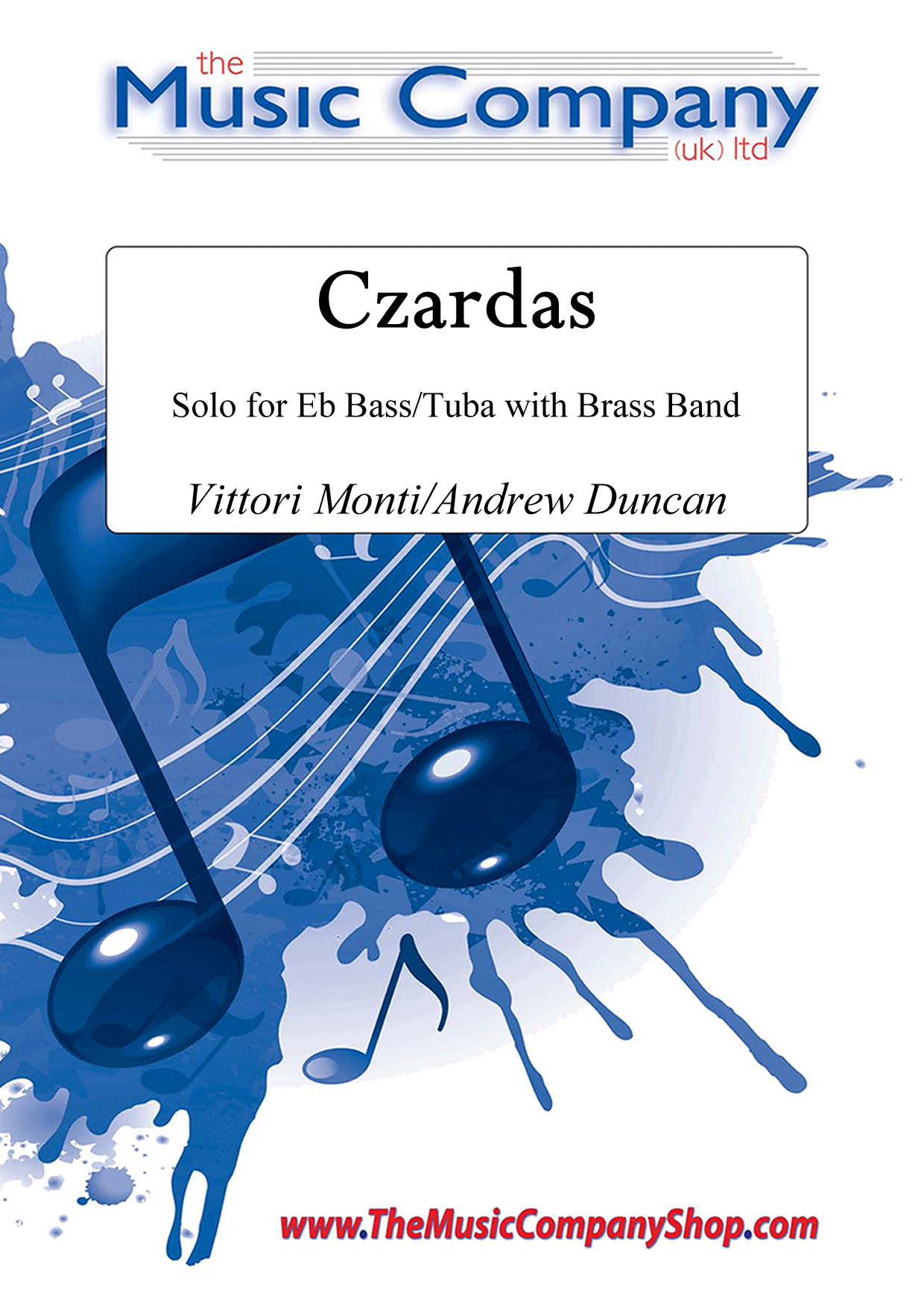 £30.00
Czardas (Eb solo with brass band) - Vittori Monti
Andrew Duncan has arranged this witty version of Vittori Monti's famous gypsy violin feature as a solo for Eb Bass/Tuba with brass band accompaniment, including a challenging (but optional!) showcase cadenza.Suitable for aspiring or advanced players, this piece is provided in print as a full score and band parts (solo parts are provided in both treble and bass clef).Also available as Eb Bass/Tuba solo with piano accompaniment; Bb Bass/Euphonium solo with piano accompaniment; and Eb Bass/tuba solo with quintet.Discography:Quintet version recorded by Halle Brass (Furioso)
In Stock: Estimated dispatch 3-5 working days
-
 £82.19
'Odyssey' Variations (Brass Band) Kevin Norbury
'Odyssey' Variations was composed as a result of a commission in May 2020 from Five Lakes Silver Band and its musical director, Christopher Ward. This music is based on an original theme that I first used in an earlier composition, Odyssey, which was the test piece for the European Brass Band Championships, held at Munich, Germany, in April 1999. I distinctly remember getting into my hotel room and turning on the television to be greeted by news coverage of the Columbine High School shooting, so that piece has always held some significance for me, though because of a very sad coincidence. The melody was originally a cornet solo in the central slow section of Odyssey and pitched deliberately to test the soloist. I have, more recently attempted a straightforward choral setting of the melody, and the harmonies I use in the three chorale-style settings at the start of these variations are loosely based on that setting. The melody is a setting of the familiar words of Be Thou My Vision, an old Irish hymn, translated by Mary E. Byrne, and versified by Eleanor H. Hull. The form of the work is as follows: Theme - three presentations Variation 1 - Allegro Variation 2 - Moderato (featuring the horns, baritones, euphoniums and basses) Variation 3 - Maestoso (featuring the cornets, flugel horn, and trombones) Variation 4 - Adagio Variation 5 - Allegretto Variation 6 - Largo - Moderato Variation 7 - Allegro molto Theme - Maestoso e sostenuto Finale - Allegro vivace - Adagio e allargando To view a video of Five Lakes Silver Band performing the work please visit: www.youtube.com/watch?v=vfLnld3bCw8 Sheet music available from: UK - www.brassband.co.uk USA - www.solidbrassmusic.com Difficulty Level: 1st Section + Instrumentation: Soprano Cornet Eb Solo Cornet Bb Repiano Cornet Bb 2nd Cornet Bb 3rd Cornet Bb Flugel Horn Bb Solo Horn Eb 1st Horn Eb 2nd Horn Eb 1st Baritone Bb 2nd Baritone Bb 1st Trombone Bb 2nd Trombone Bb Bass Trombone Euphonium Bb Bass Eb Bass Bb Timpani Percussion 1-3
In Stock: Estimated dispatch 1-3 working days
-
 £33.62
'Sanctus' from Faure's 'Requiem' - Brass Band (Faure arr. Andrew Wainwright)
Faure's Requiem stands as one of the most cherished choral works in the classical repertoire. Unlike many of his contemporaries who focused on the dramatic aspects of death and judgment, Faure's Requiem is characterised by its serene and comforting nature. The Sanctus, a pivotal movement within this larger work, encapsulates a sense of peace and transcendence that resonates deeply with audiences. This brass band setting by Andrew Wainwright of the Sanctus remains faithful to the essence of Faure's original orchestration, although is scored down a tone from the original. To view a rolling score video of the work please visit https://www.youtube.com/watch?v=mo55Q6M2H18 Sheet music available from www.brassband.co.uk Difficulty Level: 2nd Section + Instrumentation: Soprano Cornet Eb Solo Cornet Bb Repiano Cornet Bb 2nd Cornet Bb 3rd Cornet Bb Flugel Horn Bb Solo Horn Eb 1st Horn Eb 2nd Horn Eb 1st Baritone Bb 2nd Baritone Bb 1st Trombone Bb 2nd Trombone Bb Bass Trombone Euphonium Bb Bass Eb Bass Bb Timpani Suspended Cymbal Vibraphone (or Glockenspiel)
In Stock: Estimated dispatch 1-3 working days
 Watch video