
Results
-
 £104.99
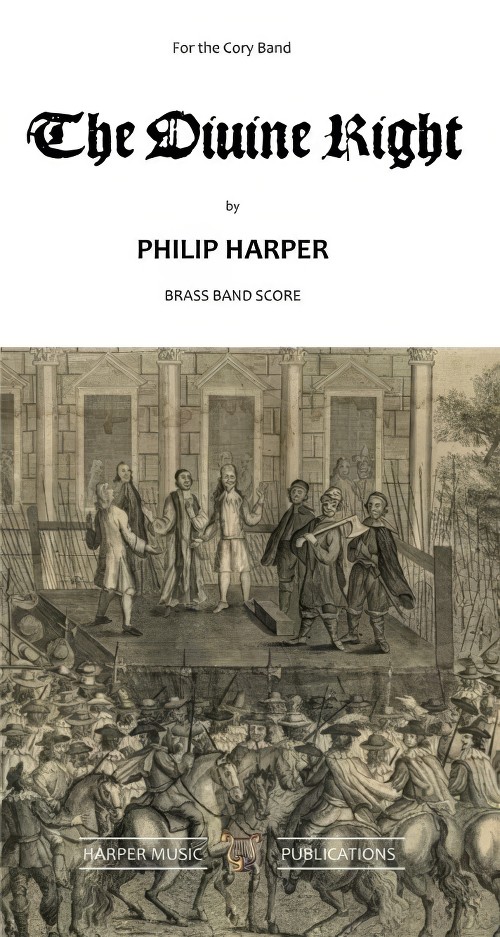
The Divine Right (Brass Band - Score and Parts) - Harper, Philip
At the time of composing this piece, the Arab Spring was sweeping through the Middle East. It seemed that almost every week a new country's people had risen up against the regimes and dictatorships which had prevailed for generations, leaving many nations at a defining crossroads in their history. There were so many possible ways ahead: so many hopes, yet so many uncertainties.This music is a depiction of these revolutionary times, and several musical themes are in turn presented, discussed, considered, fought over, altered, rejected or accepted.Most nations have had, or probably will have, their own Arab Spring, including the United Kingdom. Events of 17th Century Britain provide the context for this piece, particularly those following the execution of the tyrant King Charles I on 30 January 1649. The regicide was in part due to Charless steadfast belief in the Divine Right of Kings, and led to a tumultuous interregnum, where England stood at its own defining crossroads. The music begins turbulently, before King Charles appears and is led to the gallows outside Banqueting House in central London where he is brutally decapitated. From the assembled crowd rose, according to one observer,a moan as I never heard before and desire I may never hear again.The music descends to emptiness.The musical argument which follows is not strictly programmatic, but a number of musical themes are all thrown into the melting pot, representing ideas such as: religion; military force; reasoned Parliamentary debate; and the chattering, irrepressible voice of the people. Additionally, there are some quotations from the music of royalist composer Thomas Tomkins (1572-1656), who was often in tune with the feeling of the times.This defining episode in England's history was brought to a close with the Restoration of the monarchy in 1660, and as the exiled King Charles II rode back into London the diarist John Evelyn wrote:Never was so joyful a day seen in this nation. I stood in the Strand and beheld it, and blessed God.At the end of the piece the bells ring out, and the musical appearance of the King has transformed from turbulent to triumphant.Duration: 17.00
Estimated dispatch 7-14 working days
-
 £75.00
Iceni Autumn (Brass Band - Score and Parts) - Barry, Darrol
The piece is in four movements; SPQR, Cockley Cley, Boudicca - Battles and Requiem and Venta Icenorum.S.P.Q.R. is an initialism of a Latin noun phrase, Senatus Populusque Romanus ("The Senate and the Roman People"). This movement attempts to portray the mood in England under Roman occupation and contains important themes developed throughout the suite.Cockley Cley is a reconstruction of the type of village occupied by the Iceni. For many years it was a popular tourist attraction in Norfolk.Boudicca (also known as Boadicea) was the wife of King Prasutagus of the Iceni, a British tribe that lived in East Anglia during the time of the Roman Emperor Nero. When Prasutagus, an ally of the Romans died, the local Roman government officials decided that they would seize her wealth and lands for themselves. When Boudicca protested, saying she was a Roman ally who was being treated no better than a slave, the Roman soldiers fogged her and raped her daughters. Boudicca called her tribe to arms and revolted against their Roman oppressors; this saw the complete devastation of Colchester, St Albans and London. In the final battle the Romans slaughtered about 80,000 Britons including women, children and old men, repaying atrocities in kind. Boudicca and her two daughters poisoned themselves rather than be captured and taken to Rome as prisoners of war.Venta Icenorum was the capital of the Iceni Tribe, who inhabited the flatlands and marshes of Norfolk and earned immortality for their revolt against Roman rule under their queen Boudicca in the winter of 61 AD. This triumphant march brings various themes together and ends with a final reference.
Estimated dispatch 7-14 working days
-
 £30.00
Iceni Autumn (Brass Band - Score only) - Barry, Darrol
The piece is in four movements; SPQR, Cockley Cley, Boudicca - Battles and Requiem and Venta Icenorum.S.P.Q.R. is an initialism of a Latin noun phrase, Senatus Populusque Romanus ("The Senate and the Roman People"). This movement attempts to portray the mood in England under Roman occupation and contains important themes developed throughout the suite.Cockley Cley is a reconstruction of the type of village occupied by the Iceni. For many years it was a popular tourist attraction in Norfolk.Boudicca (also known as Boadicea) was the wife of King Prasutagus of the Iceni, a British tribe that lived in East Anglia during the time of the Roman Emperor Nero. When Prasutagus, an ally of the Romans died, the local Roman government officials decided that they would seize her wealth and lands for themselves. When Boudicca protested, saying she was a Roman ally who was being treated no better than a slave, the Roman soldiers fogged her and raped her daughters. Boudicca called her tribe to arms and revolted against their Roman oppressors; this saw the complete devastation of Colchester, St Albans and London. In the final battle the Romans slaughtered about 80,000 Britons including women, children and old men, repaying atrocities in kind. Boudicca and her two daughters poisoned themselves rather than be captured and taken to Rome as prisoners of war.Venta Icenorum was the capital of the Iceni Tribe, who inhabited the flatlands and marshes of Norfolk and earned immortality for their revolt against Roman rule under their queen Boudicca in the winter of 61 AD. This triumphant march brings various themes together and ends with a final reference.
Estimated dispatch 7-14 working days
-
 £54.99
Camel Ride (Brass Band - Score and Parts) - De Haan, Jan
In Camel Ride you will experience the magic of a colourful Arabic caravan as it slowly passes by. With this short work for a flexible ten part instrumentation, composer Jan de Haan has brilliantly reflected the atmosphere of the parade and carefully capturing the mysticism of the East. Camel Ride will make a great interlude in your concert performances.Duration: 3:00
Estimated dispatch 7-14 working days
-
 £59.95
On Ratcliff Highway (Brass Band - Score and Parts) - Steadman-Allen, Ray
Written for the centenary of Salvation Army bands in 1978, On Ratcliff Highway was premiered by The International Staff Band (and simultaneously by Melbourne Staff Band in another venue). It was inspired by a sketch on the front page of a copy of The War Cry from 1886 which depicted the Whitechapel Salvation Army band marching through the notorious highway, surrounded by crowds, with the masts of ships seen beyond the East London slums.
Estimated dispatch 7-14 working days
-
£29.95
On Ratcliff Highway (Brass Band - Score only) - Steadman-Allen, Ray
Written for the centenary of Salvation Army bands in 1978, On Ratcliff Highway was premiered by The International Staff Band (and simultaneously by Melbourne Staff Band in another venue). It was inspired by a sketch on the front page of a copy of The War Cry from 1886 which depicted the Whitechapel Salvation Army band marching through the notorious highway, surrounded by crowds, with the masts of ships seen beyond the East London slums.
Estimated dispatch 7-14 working days
-
£76.99
Famous Folksongs (Brass Band - Score and Parts) - Kildevann, Dagmar
In 'Famous Folksongs' we are taken on a musical trip around the world, from France to the USA and from South America to the Middle East. Dagmar Kildevann arranged eight word famous folk songs in very different ways. From traditional (Lolo mi boto) to modern (Le coq est mort) and from swing (Sur le pont) to rock (Michael row the boat). Bon voyage, have a pleasant journey! Oh, and by the way, don't forget your passport!Duration: 10:00
Estimated dispatch 7-14 working days
-
 £40.00
Great Gate of Kiev, The (from Pictures at an Exhibition) (Brass Band - Score and Parts) - Mussorgsky, Modest - Littlemore, Phillip
Modest Mussorgsky was a close friend of the young artist and architect Victor Hartmann, and his death in 1873 plunged Mossorgsky into a deep depression. The following year a memorial exhibition in St. Petersburg displayed Hartmann's paintings, costumes, architectural designs and sketches. Mussorgsky's visit to it, combined with his desire to write a piece in his friend's memory, inspired him to compose his?Pictures At An Exhibition?for piano. A suite of ten movements, with a recurring Promenade theme, it is one of the composer's most famous works and regarded as a showpiece for virtuoso pianists. It is perhaps the orchestral transcription made by Maurice Ravel in 1922 that is now the most famous version of it. This arrangement opens with a brief excerpt from?The Hut on Fowl's Legs, which was based on a painting of an elaborately carved clock depicting Baba Yaga, a horrible tiny witch that feasts on human bones. The tenth, and final picture in Mussorgsky's masterpiece is commonly referred to as?The Great Gate of Kiev, although it's literal translation is The Bogatyr Gates -- a Bogatyr being a hero figure in medieval East Slavic legend. It features a grand main theme that is interspersed with a more solemn hymn-like secondary theme. The work closes with a grand final rendition of the Promenade theme that almost grinds to a halt at what must be the foot of what were to be magnificent ceremonial gates (although they were never actually built!). Duration: 6:00
Estimated dispatch 7-14 working days
-
£34.95
SLOW RIDE IN A STATIC MACHINE, A (Brass Band) - Lawrence, Phil
A Slow Ride in a Static Machine was inspired some time ago when my (late) Father came to visit me "down in London" as he put it. It was based not on one of his circular mishaps, but on several! He was always directed carefully, but refused to carry a map in the car! At one time when I lived in North London I would meet him outside the capital, and he would then follow be back to my place, but after I moved to East London I made him bite the navigational bullet and transverse the 'M25 Orbital'. His main problem seemed to be getting off this mesmerising circular cark park. He would often phone (in a weary tone) from the Dartford Tunnel (which is 5 junctions past the one he needed to get off at), asking me to, "bring him in" so to speak. I would always refuse. And then, he would do the opposite (especially when travelling at night), he would phone me up from near Cambridge (he'd gone the wrong way up the M11 away from London by 45 miles), and would ask where he was!The title is obviously a play on John Adams' composition, A Short Ride In A Fast Machine. This quirky tone poem starts as a wind-up by using those unwanted intervals of augmented 4th's and minor 9th's & 7th's in the main tune, before hearing the road works, the juggernauts multi horns, fender-benders, ambulance and police sirens! This then all works to a back beat on kit. The wind-up start gets to an almost Go-Go 1960's Disco middle section (the nostalgic hay-days of the open road), where our wind-up tune falls into place and we all relax as we can now drive at 42.1 mph! We DC, and then get into a right car mess in the Coda!Phil Lawrence.Duration:4:00
Estimated dispatch 7-14 working days
-
 £35.00
The Water of Tyne (Brass Band - Score and Parts) - Harper, Philip
A delightful setting of a traditional North East melody, arranged in a hauntingly pastorale style with all the skill we have come to expect from Philip Harper. Featuring the euphonium and principal cornet with the melody at first, the piece then builds to a passionate full band rendition which eases back to a tranquil, effective close.A great piece to offer every level of band the opportunity to add some stylish peace to their programme.Duration: 3.45
Estimated dispatch 7-14 working days
 View Music