
Results
-
 £107.95
Cornet Concerto (Brass Band - Score and Parts) - Gregson, Edward
The Cornet Concerto was commissioned by Black Dyke Band for their principal cornet, Richard Marshall, and was premiered at the European Brass Band Festival's Gala Concert in Lille, France, on 30 April 2016 by the same performers, conducted by Nicholas Childs.It is challenging work, both musically and technically, and one that exploits the wide range of the instrument's capabilities. Lasting for some 17 minutes, it is in the usual three movements: Sonata, Intermezzo (subtitled 'Of More Distant Memories') and Rondo.The first movement presents four main ideas:Cadenzas (which recur throughout the movement, and indeed appear at the end of the work); a fast and rhythmically energetic motive; Bugle calls (echoing the ancestor of the cornet), and a lyrical and expressive melody, full of yearning. These four ideas are juxtaposed within the broad shape of a Sonata form structure, although here the word 'Sonata' is used in its original meaning of 'sounding together'.The second movement is music in search of a theme, which eventually comes at the end of the movement. In the middle section there are brief quotations, albeit mostly hidden, from three cornet solos written by the Swedish/American composer Erik Leidzen for the Salvation Army in the 1940s and 50s; these are solos I loved as a teenager, and my use of them is by way of tribute, not imitation - a sort of memory bank, just as the main theme of the movement, when it eventually comes, is reminiscent of the tune from my earlier work for brass band, 'Of Distant Memories'.The final Rondo, the shortest of the three movements, is a lively and 'fleet-of foot' Scherzo, its main theme full of cascading arpeggios, but with a contrasting lyrical second theme intertwined in the structure. There is much interplay between soloist and band in the development of the music, but eventually a brief reprise of the opening cadenzas leads to an exciting and climactic coda.Click here for the piano reduction
Estimated dispatch 7-14 working days
-
 £49.95
Cornet Concerto (Brass Band - Score only) - Gregson, Edward
The Cornet Concerto was commissioned by Black Dyke Band for their principal cornet, Richard Marshall, and was premiered at the European Brass Band Festival's Gala Concert in Lille, France, on 30 April 2016 by the same performers, conducted by Nicholas Childs.It is challenging work, both musically and technically, and one that exploits the wide range of the instrument's capabilities. Lasting for some 17 minutes, it is in the usual three movements: Sonata, Intermezzo (subtitled 'Of More Distant Memories') and Rondo.The first movement presents four main ideas:Cadenzas (which recur throughout the movement, and indeed appear at the end of the work); a fast and rhythmically energetic motive; Bugle calls (echoing the ancestor of the cornet), and a lyrical and expressive melody, full of yearning. These four ideas are juxtaposed within the broad shape of a Sonata form structure, although here the word 'Sonata' is used in its original meaning of 'sounding together'.The second movement is music in search of a theme, which eventually comes at the end of the movement. In the middle section there are brief quotations, albeit mostly hidden, from three cornet solos written by the Swedish/American composer Erik Leidzen for the Salvation Army in the 1940s and 50s; these are solos I loved as a teenager, and my use of them is by way of tribute, not imitation - a sort of memory bank, just as the main theme of the movement, when it eventually comes, is reminiscent of the tune from my earlier work for brass band, 'Of Distant Memories'.The final Rondo, the shortest of the three movements, is a lively and 'fleet-of foot' Scherzo, its main theme full of cascading arpeggios, but with a contrasting lyrical second theme intertwined in the structure. There is much interplay between soloist and band in the development of the music, but eventually a brief reprise of the opening cadenzas leads to an exciting and climactic coda.Duration: 17.00
Estimated dispatch 7-14 working days
-
 £91.99
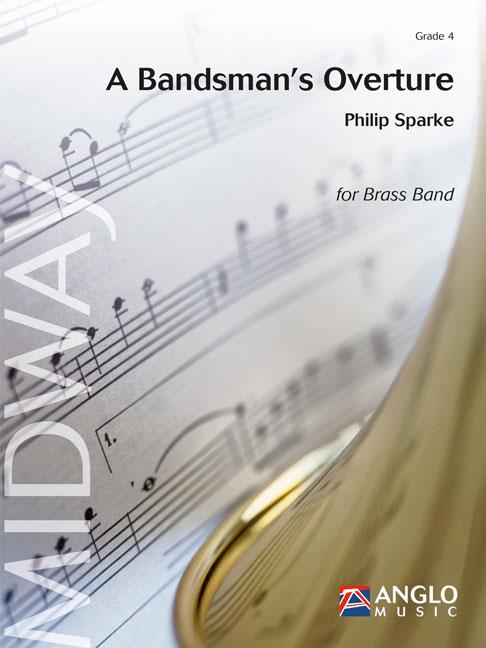
A Bandsman's Overture (Brass Band - Score and Parts) - Sparke, Philip
A Bandsman's Overture was commissioned by British Bandsman magazine to celebrate its 125th anniversary in 2012. It was premiered by Black Dyke Band, conducted by Dr Nicholas Childs, at a special anniversary concert held in Symphony Hall, Birmingham, on July 1st.British Bandsman was for a period known as British Bandsman and Contest Field, following an amalgamation of two magazines. The then owner, John Henry Iles, celebrated this new title by commissioning Ord Hume to write the famous march, BB & CF. As a salute to this heritage A Bandsman's Overture starts with the four notes, B(b)-B(b)-C-F, a motive which permeates an opening fanfare, which contrasts a busy opening with a more legato central section. This gives way to a bustling Vivo, based on repeated staccato notes. A change of key heralds a central cantabile melody, first on euphoniums and baritone and then played by the full band, which is followed by a short development section. This leads to a transformed reprise and a return of the opening fanfare, decorated this time by florid muted cornets.Duration: 6:00
Estimated dispatch 7-14 working days
-
 £107.95
Symphony in Two Movements (Brass Band - Score and Parts) - Gregson, Edward
Selected as the Championship Section test piece for the National Brass Band Championships of Great Britain 2025This work was jointly commissioned by the National Youth Brass Band of Great Britain (NYBBGB) and the National Youth Brass Band of Wales (NYBBW), the latter with funding from T Cerdd (Music Centre Wales), to celebrate their 60th and 30th anniversaries respectively. The first performances were given at Cadogan Hall, London, in April 2012, by the NYBBGB, conducted by Bramwell Tovey; and at the Great Hall, Aberystwyth University, in July 2012, by the NYBBW, conducted by Nicholas Childs.When I was approached about a joint commission to write a new work to celebrate the anniversaries of these two outstanding youth bands I was delighted to accept, and decided to respond by writing a work apposite for the magnitude of these special occasions, namely a 'symphony for brass'.Through a long journey of writing music for brass band, which commenced with Connotations (1977), and continued with Dances and Arias (1984), Of Men and Mountains (1991), The Trumpets of the Angels (2000) and Rococo Variations (2008), I arrived at what I regard as the most important work of the cycle to date, combining as it does serious musical intent with considerable technical demands. It is perhaps my most abstract work for brass band, avoiding any programmatic content.The symphony lasts for some 19 minutes and is structured in two linked movements. The form is based on that used by Beethoven in his final piano sonata (Op.111), which is in two movements only: a compact sonata-form allegro, followed by a more expansive theme and four variations. Prokofiev also adopted this model in his 2nd Symphony of 1925.The opening Toccata of this Symphony is highly dramatic but compact, whilst still retaining the 'traditional' structural elements of exposition, development and recapitulation; indeed, it also has the 'traditional' element of a contrasting second subject - a gentle, lyrical modal melody first heard on solo cornets.In contrast, the longer and more substantial second movement Variations is built around a theme and four variations. The slowly unfolding chorale-like theme accumulates both added note harmony and increasing instrumentation, whilst the four variations which follow are by turn mercurial (fast, starting with all the instruments muted), march-like (menacing, with short rhythmic articulations underpinning an extended atonal melody), serene (a series of 'romances' for solo instruments alongside echoes of the chorale) with an emerging theme eventually bursting into a climax of passionate intent; whilst the final variation is a dynamic scherzo (concertante-like in its series of rapid-fire solos, duets, trios and quartets) with the music gradually incorporating elements of the main ideas from the first movement, thus acting as a recapitulation for the whole work. It reaches its peroration with a return to the very opening of the symphony, now in the 'home' tonality of F, and thus creating a truly symphonic dimension to the music.Most of the melodic material of the symphony is derived from the opening eleven-note 'row', which contains various intervallic sets, and although the work is not serially conceived it does use some typical quasi-serial procedures, such as canons, inversions, and retrogrades. The symphony uses somewhat limited percussion, in line with a 'classical' approach to the sound world of the brass band, alongside a use of multi-divisi instrumentation, whereby each player has an individual part rather than the traditional doubling within certain sections of the band.- Edward GregsonDuration: 19.00
Estimated dispatch 7-14 working days
-
 £57.95
Symphony in Two Movements (Brass Band - Score only) - Gregson, Edward
Selected as the Championship Section test piece for the National Brass Band Championships of Great Britain 2025This work was jointly commissioned by the National Youth Brass Band of Great Britain (NYBBGB) and the National Youth Brass Band of Wales (NYBBW), the latter with funding from T Cerdd (Music Centre Wales), to celebrate their 60th and 30th anniversaries respectively. The first performances were given at Cadogan Hall, London, in April 2012, by the NYBBGB, conducted by Bramwell Tovey; and at the Great Hall, Aberystwyth University, in July 2012, by the NYBBW, conducted by Nicholas Childs.When I was approached about a joint commission to write a new work to celebrate the anniversaries of these two outstanding youth bands I was delighted to accept, and decided to respond by writing a work apposite for the magnitude of these special occasions, namely a 'symphony for brass'.Through a long journey of writing music for brass band, which commenced with Connotations (1977), and continued with Dances and Arias (1984), Of Men and Mountains (1991), The Trumpets of the Angels (2000) and Rococo Variations (2008), I arrived at what I regard as the most important work of the cycle to date, combining as it does serious musical intent with considerable technical demands. It is perhaps my most abstract work for brass band, avoiding any programmatic content.The symphony lasts for some 19 minutes and is structured in two linked movements. The form is based on that used by Beethoven in his final piano sonata (Op.111), which is in two movements only: a compact sonata-form allegro, followed by a more expansive theme and four variations. Prokofiev also adopted this model in his 2nd Symphony of 1925.The opening Toccata of this Symphony is highly dramatic but compact, whilst still retaining the 'traditional' structural elements of exposition, development and recapitulation; indeed, it also has the 'traditional' element of a contrasting second subject - a gentle, lyrical modal melody first heard on solo cornets.In contrast, the longer and more substantial second movement Variations is built around a theme and four variations. The slowly unfolding chorale-like theme accumulates both added note harmony and increasing instrumentation, whilst the four variations which follow are by turn mercurial (fast, starting with all the instruments muted), march-like (menacing, with short rhythmic articulations underpinning an extended atonal melody), serene (a series of 'romances' for solo instruments alongside echoes of the chorale) with an emerging theme eventually bursting into a climax of passionate intent; whilst the final variation is a dynamic scherzo (concertante-like in its series of rapid-fire solos, duets, trios and quartets) with the music gradually incorporating elements of the main ideas from the first movement, thus acting as a recapitulation for the whole work. It reaches its peroration with a return to the very opening of the symphony, now in the 'home' tonality of F, and thus creating a truly symphonic dimension to the music.Most of the melodic material of the symphony is derived from the opening eleven-note 'row', which contains various intervallic sets, and although the work is not serially conceived it does use some typical quasi-serial procedures, such as canons, inversions, and retrogrades. The symphony uses somewhat limited percussion, in line with a 'classical' approach to the sound world of the brass band, alongside a use of multi-divisi instrumentation, whereby each player has an individual part rather than the traditional doubling within certain sections of the band.- Edward GregsonDuration: 19.00
Estimated dispatch 7-14 working days
-
 £59.95
The Ellacombe Chronicles (Brass Band - Score and Parts) - Curnow, James
This piece was commissioned by Brass Band of Columbus for the occasion of the band's 25th anniversary in 2009. It is dedicated to current and former members of the band and its founding Director, Dr Paul Droste. The hymns of Isaac Watts (1674 - 1748) have been a source of inspiration for musical thought and development by composers for over 200 years. His glorious hymn 'I sing the mighty power of God' has been coupled with the hymn tune 'Ellacombe' in many hymnals over these two centuries. This work was created and inspired by Isaac Watts's text and chronicles the three verses of the hymn through a set of diverse variations on the hymn tune 'Ellacombe'. The opening fanfare is intended to capture the joy and exuberance of the first phrase of the first verse, 'I sing the mighty power of God that made the mountains rise'. The developmental material following the fanfare gives a hint of the three large variations that are extracted from the tune.
Estimated dispatch 7-14 working days
-
£29.95
The Ellacombe Chronicles (Brass Band - Score only) - Curnow, James
This piece was commissioned by Brass Band of Columbus for the occasion of the band's 25th anniversary in 2009. It is dedicated to current and former members of the band and its founding Director, Dr Paul Droste. The hymns of Isaac Watts (1674 - 1748) have been a source of inspiration for musical thought and development by composers for over 200 years. His glorious hymn 'I sing the mighty power of God' has been coupled with the hymn tune 'Ellacombe' in many hymnals over these two centuries. This work was created and inspired by Isaac Watts's text and chronicles the three verses of the hymn through a set of diverse variations on the hymn tune 'Ellacombe'. The opening fanfare is intended to capture the joy and exuberance of the first phrase of the first verse, 'I sing the mighty power of God that made the mountains rise'. The developmental material following the fanfare gives a hint of the three large variations that are extracted from the tune.
Estimated dispatch 7-14 working days
-
£89.95
Infinity (Brass Band - Score and Parts) - Redhead, Robert
In the post-modern age in which we live, 'absolutes' are difficult for many to comprehend. Yet infinity, which means absolute, total, all-embracing, having no limits or boundaries in time, space, extent, or magnitude, has always been central to the Christian's concept of God.Through the ages, as human understanding has grown, particularly at a remarkable rate from the latter part of the twentienth century, Christianity has been continually challenged to interpret traditional beliefs in the light of new discoveries, but always within the reality of the infinite Being. In addition, scripture tells us that 'humanity was made in God's image'. Humankind is part of God's creation and as such, responsible for its upkeep. Such a commission has never been more relevant than in this present age. Psalm 8 creates a great picture of the majesty, eternal, infinte quality of God and yet reveals the desire of God to share in spirit with humankind. It recognises humankind as being, not a tool of the infinite, but as a creative contributing part of the ongoing movement and activity of the infinite. The music is deliberately melodic in context, creating a sense of unity with the infinite, in tandem with the varying expressions of individuality. It is not based on the Psalm but reflects some of the sentiments lying therein. The 'hymn-like' theme expresses the nature of the Divine using the Old Testament image of the infinite God coming to finite humankind, not in the 'wind', the 'earthquake', the 'fire', but in the 'still small voice' of quietness (1 Kings 19: 11-13). The ensuing musical development, in different styles and patterns, expresses this continual link between infinite and finite. Thus the conclusion, rather than being a symbol of might, power and magnificence, reflects the same sentiment as the opening.
Estimated dispatch 7-14 working days
-
£44.95
Infinity (Brass Band - Score only) - Redhead, Robert
In the post-modern age in which we live, 'absolutes' are difficult for many to comprehend. Yet infinity, which means absolute, total, all-embracing, having no limits or boundaries in time, space, extent, or magnitude, has always been central to the Christian's concept of God.Through the ages, as human understanding has grown, particularly at a remarkable rate from the latter part of the twentienth century, Christianity has been continually challenged to interpret traditional beliefs in the light of new discoveries, but always within the reality of the infinite Being. In addition, scripture tells us that 'humanity was made in God's image'. Humankind is part of God's creation and as such, responsible for its upkeep. Such a commission has never been more relevant than in this present age. Psalm 8 creates a great picture of the majesty, eternal, infinte quality of God and yet reveals the desire of God to share in spirit with humankind. It recognises humankind as being, not a tool of the infinite, but as a creative contributing part of the ongoing movement and activity of the infinite. The music is deliberately melodic in context, creating a sense of unity with the infinite, in tandem with the varying expressions of individuality. It is not based on the Psalm but reflects some of the sentiments lying therein. The 'hymn-like' theme expresses the nature of the Divine using the Old Testament image of the infinite God coming to finite humankind, not in the 'wind', the 'earthquake', the 'fire', but in the 'still small voice' of quietness (1 Kings 19: 11-13). The ensuing musical development, in different styles and patterns, expresses this continual link between infinite and finite. Thus the conclusion, rather than being a symbol of might, power and magnificence, reflects the same sentiment as the opening.
Estimated dispatch 7-14 working days
-
£10.00
Infinity (Brass Band - Study Score) - Redhead, Robert
In the post-modern age in which we live, 'absolutes' are difficult for many to comprehend. Yet infinity, which means absolute, total, all-embracing, having no limits or boundaries in time, space, extent, or magnitude, has always been central to the Christian's concept of God.Through the ages, as human understanding has grown, particularly at a remarkable rate from the latter part of the twentienth century, Christianity has been continually challenged to interpret traditional beliefs in the light of new discoveries, but always within the reality of the infinite Being. In addition, scripture tells us that 'humanity was made in God's image'. Humankind is part of God's creation and as such, responsible for its upkeep. Such a commission has never been more relevant than in this present age. Psalm 8 creates a great picture of the majesty, eternal, infinte quality of God and yet reveals the desire of God to share in spirit with humankind. It recognises humankind as being, not a tool of the infinite, but as a creative contributing part of the ongoing movement and activity of the infinite. The music is deliberately melodic in context, creating a sense of unity with the infinite, in tandem with the varying expressions of individuality. It is not based on the Psalm but reflects some of the sentiments lying therein. The 'hymn-like' theme expresses the nature of the Divine using the Old Testament image of the infinite God coming to finite humankind, not in the 'wind', the 'earthquake', the 'fire', but in the 'still small voice' of quietness (1 Kings 19: 11-13). The ensuing musical development, in different styles and patterns, expresses this continual link between infinite and finite. Thus the conclusion, rather than being a symbol of might, power and magnificence, reflects the same sentiment as the opening.
Estimated dispatch 7-14 working days
 View Music