
Results
-
 £27.50
Russian Dance
From a mysterious start gradually to a rampaging finish, with everything thrown in along the way, just about describes this piece.
Estimated dispatch 7-14 working days
-
 £54.99
The Dance Club - Peter Kleine Schaars
After the success of Dance Starters, a follow-up in the Flexible 4 Series was a must. Again, Peter Kleine Schaars composed four dances, in which he, by means of refreshing chords, uncomplicated rhythms and simple melody lines, takes youthful musicians to The Dance Club. There, they learn the cha-cha-cha, the rumba, disco dancing and an actual Oriental belly dance. Great fun for everyone.
Estimated dispatch 5-14 working days
-
 £87.99
Moon Song, Sun Dance - Philip Sparke
Moon Song, Sun Dance was commissioned by Flugel Horn virtuoso, Claude Romailler, and premiered by him at the Swiss National Solo and Quartet Championships in April 2012. As the title implies, the work is in two contrasting movements, which can be performed separately or together.Moon Song opens with a flowing modal theme, which the soloist embellishes before the band takes centre stage. A central section brightens the mood with a new melody over the lightest of accompaniments; this is once again developed by the soloist until the original theme reappears, played by the band. This introduces a cadenza for the soloist which either closes the movement, or canbe extended to link directly to the second movement.Sun Dance is a vivace 6/8 scherzo which opens with a flourish from the band. The soloist then introduces the main theme, which in turn is taken up by the band. A short bridge passage heralds a change of key and a new melody from the soloist. A brief central interlude then introduces a change of meter and recalls the main melody of Moon Song, before a recapitulation leads to a florid coda, which brings the work to a close.
Estimated dispatch 5-14 working days
-
 £60.99
Let's Dance - Henk Hogestein
Let's Dance takes you on an exciting night of dancing,being cool on the dance floor with your designer clothes, dancing the night away and forgetting about your daily worries. It's party time on the dance floor with this grooving new work. Brass Band goes Disco!
Estimated dispatch 5-14 working days
-
 £69.99
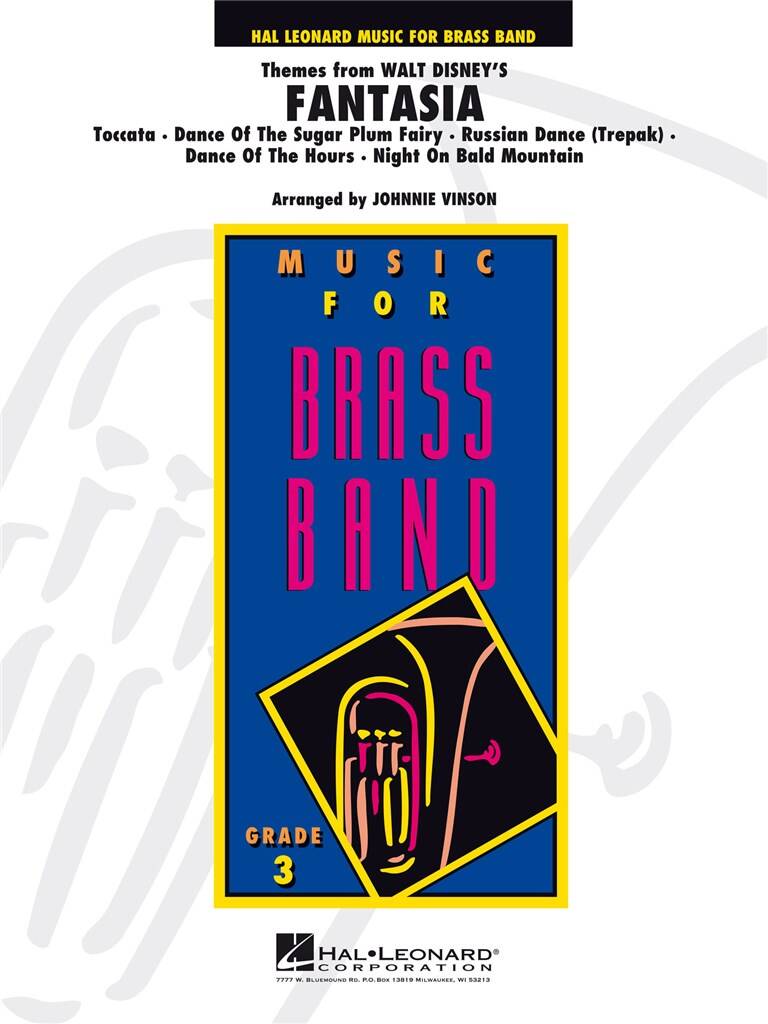
Themes from Fantasia - Johnnie Vinson
A very playable medley from the classic movie 'Fantasia' containing 'Toccata', 'Dance Of The Sugar Plum Fairy', 'Russian Dance (Trepak), 'Dance Of The Hours' and 'Night On Bald Mountain'. Ideal for young bands and very entertaining for your audience!
Estimated dispatch 5-14 working days
-
 £72.99
Balkan Dance - Etienne Crausaz
The Balkans region has always been a source of musical inspiration for composers throughout the centuries. Strong rhythms and often-abundant musical climaxes are two important characteristics of this rich and varied musical style.Etienne Crausaz took some of these elements and mixed it with elements of rock, turning this Balkan Dance into an exuberant and spectacular piece of music, during which no one can remain seated!
Estimated dispatch 5-14 working days
-
 £87.99
Prelude, Dance and March - Malcolm Arnold - Robin Norman
Malcolm Arnold is one Britain's best-loved composers. In 1948 he composed a very short suite for the National Youth Orchestra of Great Britain - entitled simply To Youth. Seven years later he took To Youth and made some fairly major revisions, including a complete new movement, and the Little Suite for Orchestra was born. The Little Suite for Orchestra follows a very similar pattern to the later suites for brass band, starting with a bold, strident Prelude, which strangely ends quietly before a lovely, lilting, Dance composed in 3/8 time. Finally a rollicking and militaristic March brings the suite to a conclusion. This arrangement for brass band by Robin Norman is sure tobecome a classic in the brass band repertoire.
Estimated dispatch 5-14 working days
-
 £59.99
A Stroll in the Park - Philip Sparke
A Stroll in the Park is a piece in the tradition of "walking" music (such as the Promenade from Mussorgsky's Pictures at an Exhibition or Gershwin's Walking the Dog from Shall we Dance). It strives to describe the joyful benefits of a relaxing walk in a city park on a summer Sunday afternoon and should be played in a relaxed, carefree and laidback manner.
Estimated dispatch 5-14 working days
-
£60.99
Brazilian Bay Dance - Harm Evers
This piece, by the Dutch composer Harm Evers, takes you and your musicians to the hot atmosphere of a Brazilian beach party. Everyone celebrates until late at night and dances to the cheerful sounds of Latin American music.
Estimated dispatch 5-14 working days
-
 £50.00
Unsquare Dance - Dave Brubeck
As in the famous 'Take Five' Brubeck enjoyed playing with time signatures that most people would find unfamiliar. The reason for the title of this piece is obvious when one notices that it is in 7/4 time! This arrangement forBrass Band is by Mark Freeh and includes the Score and all parts. It would be suitable for a good secondary school band.
Estimated dispatch 5-14 working days
 View Music