
Results
-
 £60.00
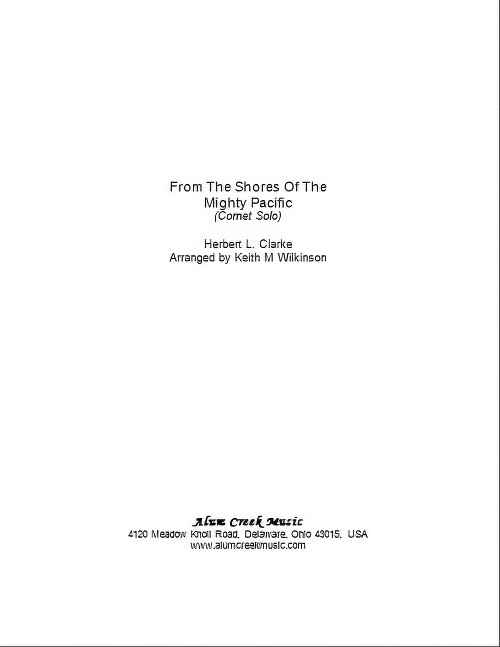
From the Shores of the Mighty Pacific (Cornet Solo with Brass Band - Score and Parts) - Clarke, Herbert L. - Wilkinson, Keith M.
Cornet Solo with Brass BandHerbert L. Clarke (1867 - 1945) is regarded by many as one of the finest cornet players of all time, noted not only for his amazing technique but also for his warm, lyrical tone. He has left a multitude of cornet solos as well as collections of studies which are still very widely used. He was a member of The Sousa Band briefly in 1893 and then from 1898 to 1917 where he was not only the distinguished cornet soloist but also became assistant director.From The Shores Of The Mighty Pacific is an all-time favourite rondo-caprice cornet solo and was first published in 1912. A brass band arrangement was requested by Chris Lichtler, principal cornet of Brass Band of the Western Reserve, musical director Dr. Keith M. Wilkinson. Chris has performed it many times with BBWR and it was recorded by them on the CD, Without Reserve!.
Estimated dispatch 7-14 working days
-
 £34.95
A Happy Day (Cornet Solo with Brass Band - Score and Parts) - Leidzen, Erik
This composition was awarded first prize in the Theme and Variations Section of the 1926 Salvation Army Band Music Competition and has remained popular with cornet soloists and audiences ever since. This was the first in a trilogy of cornet solos with the word 'day' in the title written by Erik Leidzen, the others being 'Happy all the Day' and 'Wondrous Day'.
Estimated dispatch 7-14 working days
-
£17.50
A Happy Day (Cornet Solo with Brass Band - Score only) - Leidzen, Erik
This composition was awarded first prize in the Theme and Variations Section of the 1926 Salvation Army Band Music Competition and has remained popular with cornet soloists and audiences ever since. This was the first in a trilogy of cornet solos with the word 'day' in the title written by Erik Leidzen, the others being 'Happy all the Day' and 'Wondrous Day'.
Estimated dispatch 7-14 working days
-
 £19.95
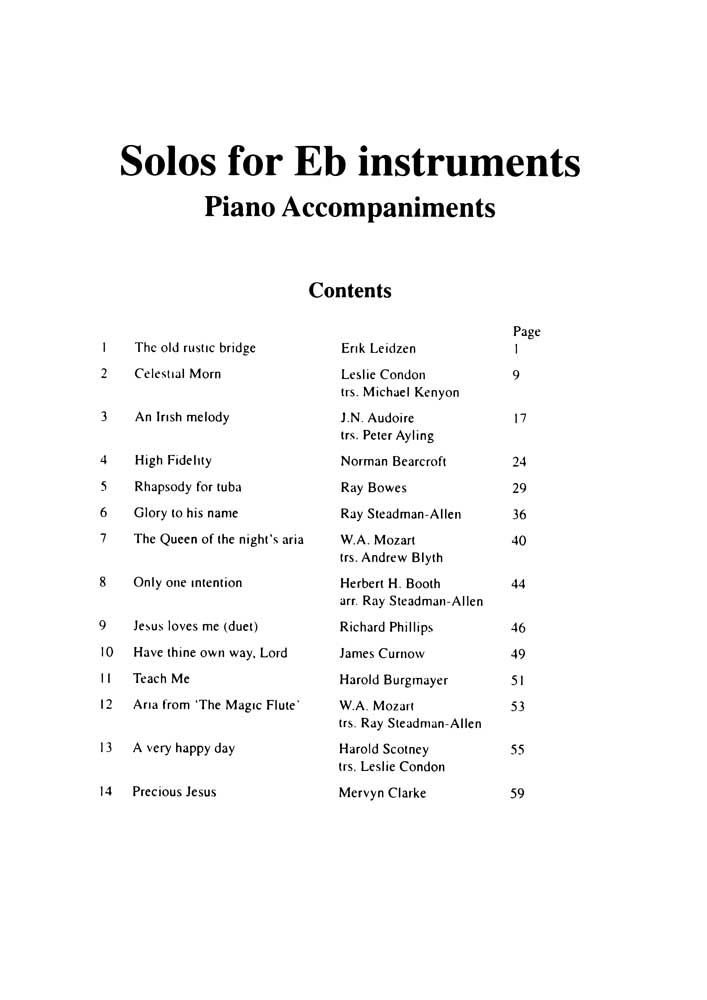
Eb Solos Album
Includes: The old rustic bridge; Celestial Morn; An Irish melody; High Fidelity; Rhapsody for tuba; Glory to his name; The Queen of the night's aria; Only one intention; Jesus loves me (duet); Have thine own way, Lord; Teach me; Aria from 'The Magic Flute'; A very happy day; Precious JesusInstrumentation: Solos for Eb Soprano Cornet, Eb Tenor Horn & Eb Bass with Piano Accompaniment
Estimated dispatch 7-14 working days
-
 £54.20
FRANK SINATRA (Cornet/Brass Band) - Wormald, Christopher
Grade: easy-medium. Three solos for Cornet & BB. Includes: All the Way; Guess I'll Hang My Tears Out to Dry; I've Got You Under My Skin.
Estimated dispatch 7-14 working days
-
 £110.00
To Every Thing There is a Season (Cornet Solo with Brass Band - Score and Parts) - Rutter, John - Noble, Paul
Upon first hearing this beautiful composition by John Rutter, it seemed obvious that it would not only be a great piece for combined Band and Chorus, but also would be a perfect solo for trumpet. Therefore, in addition to the arrangement for either combined band and chorus, or trumpet solo and band, this arrangement for Brass Band is now available as well. The beauty and simplicity of the piece should certainly allow it to become a mainstay in the repertoire of trumpet solos at any level.
Estimated dispatch 7-14 working days
-
 £40.00
The Maid of the Mist (Trumpet Solo)
Herbert L Clarke (1867 - 1945) is regarded by many as one of the finest cornet players of all time, noted not only for his amazing technique but also for his warm, lyrical tone. He has left a multitude of cornet solos as well as collections of studies which are still very widely used. He was a member of The Sousa Band briefly in 1893 and then from 1898 to 1917 where he was not only the distinguished cornet soloist but also became assistant director.The Maid Of The Mist dates from 1912 and is named after the famous sightseeing boat trips at Niagara Falls.This arrangement was prepared for a concert in May, 2009, given by Brass Band of the Western Reserve, musical director Keith M Wilkinson, in which Michael Sachs, principal trumpet of the Cleveland Orchestra, appeared as guest soloist.
Estimated dispatch 7-14 working days
-
 £34.95
Judd: A Happy Day
This composition was awarded first prize in the Theme and Variations Section of the 1926 Salvation Army Band Music Competition and has remained popular with cornet soloists and audiences ever since. This was the first in a trilogy of cornet solos with the word 'day' in the title written by Erik Leidzen, the others being 'Happy all the Day' and 'Wondrous Day'.
Estimated dispatch 7-14 working days
-
 £34.95
Elixir of Youth - Christopher Bond
Elixir of Youth (2013) was written for the 2013 Brass for Heroes charity event where it was premiered on 19th October 2013 at St Paul's Hall in Huddersfield under the baton of Philip Harper. The title of the work reflects the nature of the band that was put together for that premiere performance; an all-star youth band comprising a selection of the country's young brass banding talent, with the term Elixir referring here to the everlasting talent seen in young brass players throughout the United Kingdom's brass bands and bands' and teachers abilities to keep producing such high quality musicians for the banding movement.The work, structured in three sections, is a showcase for band with a heroic opening where fanfare-like gestures in the cornets and trombones juxtapose rapid euphonium and baritone runs, alongside sweeping horns and percussion effects. As the piece progresses, a grove is introduced - just in the tubas at first, accompanied by a hi-hat - before spreading through the band, definitely stuff to tap your toes to! The middle, slower section of the work sees both flugel and cornet solos, with additional inputs from the euphonium and solo horn before a climax and return to the tempo and music of the opening section. A rousing close concludes the work where all of the work's themes are interweaved to create a sense of power, unity and grandeur; an Elixir of Youth.
Estimated dispatch 10-14 working days
-
 £34.95
Elixir of Youth (Brass Band - Score and Parts)
Elixir of Youth (2013) was written for the 2013 Brass for Heroes charity event where it was premiered on 19th October 2013 at St Paul's Hall in Huddersfield under the baton of Philip Harper. The title of the work reflects the nature of the band that was put together for that premiere performance; an all-star youth band comprising a selection of the country's young brass banding talent, with the term Elixir referring here to the everlasting talent seen in young brass players throughout the United Kingdom's brass bands and bands' and teachers abilities to keep producing such high quality musicians for the banding movement.The work, structured in three sections, is a showcase for band with a heroic opening where fanfare-like gestures in the cornets and trombones juxtapose rapid euphonium and baritone runs, alongside sweeping horns and percussion effects. As the piece progresses, a grove is introduced - just in the tubas at first, accompanied by a hi-hat - before spreading through the band, definitely stuff to tap your toes to! The middle, slower section of the work sees both flugel and cornet solos, with additional inputs from the euphonium and solo horn before a climax and return to the tempo and music of the opening section. A rousing close concludes the work where all of the work's themes are interweaved to create a sense of power, unity and grandeur; an Elixir of Youth.
Estimated dispatch 7-14 working days
 View Music