
Results
-
 £30.00
Bilby Bomp - Beginner Brass Band - TSM002 - P. W. Jones
COMPOSER: P. W. Jones"Bilby Bomp" has been written as an early work for the beginner Band. It is a sectional arrangement with no divisiwithin parts or sections i.e. no 1st. and 2nd.parts.Melody sheets in all pitches have been included to enable you to give the melody to any player to assist with managing missing players.The Bilby, of approximately 55cm plus a 29cm tail, is the largest member of the family of marsupials called Bandicoots.It is found in North West Australia and is now on the endangered species list.It is a nocturnal animal relying on smell and feel to move about looking for food.Its rear legs work the same as a kangaroo therefore it is always moving about in small bomps.
In Stock: Estimated dispatch 3-5 working days
-
 £30.00
Blaenwern - Brass Band - RMP005 - Frank Culross
COMPOSER:ARRANGER: Frank CulrossScottish arranger Frank Culross has crated a beautiful setting of they hymn tune Blaenwern.CLICK HERE TO HEAR THIS PIECE - Blaenwern Hymn arr: Frank Culross
In Stock: Estimated dispatch 3-5 working days
-
 £59.95
Bonnie Northumbria - Brass Band - LM786
COMPOSER: Laurie JohnstonProgramme NotesNorthumberland, or Northumbria as it is also known, is the most northern county in England and has magnificent and stunning landscapes just waiting to be explored. Filled with mystical castles, atmospheric ruins and historical sites and edged by spectacular coastal scenery, there is something wonderful to see at every turn. The Devils Causeway passes through Northumbria and reaches Berwick upon Tweed at the coast. Walkers and cyclists can also take the Coast and Castles Cycle Route or the North Sea Trail which journey through some of the most beautiful scenery along the way.The Blaydon Races is aGeordiefolk songwritten in the 19th century byGeordie Ridley, in a style deriving frommusic hall. It is regarded by many as the unofficialanthemofTynesideand is frequentlysungby supporters ofNewcastle United Football ClubandNewcastle Falconsrugby club.Blaydonis a small town inGateshead, situated about 4 miles (6.4km) fromNewcastle upon Tyne, inNorth East England. The race used to take place on the Stella Haugh 1 mile (1.6km) west of Blaydon.Stella South Power Station(demolished in 1995) was built on the site of the track in the early 1950s, after the races had stopped taking place in 1916.Water of Tyne (sometimes rendered as The Waters of Tyne) is a folk song (Roud number1364) from the north-east of England. The song is sung by a girl or woman lamenting the fact that her paramour is on the opposite bank of theRiver Tyne. Sleeve notes to Michael Hunt's recording of Tyneside songs states that "the ferry is believed to be that atHaughton Castleon theNorth Tyne". Alternatively the "rough river" in the last line may indicate a point further downstream, possiblyTynemouth.The song was collected byJohn Bellin 1810 and published two years later inRhymes of Northern Bards.The Keel Row is a traditional Tyneside folk song evoking the life and work of thekeelmenofNewcastle upon Tyne. A closely related song was first published in aScottishcollection of the 1770s, but may be considerably older, and it is unclear whether the tune is Scottish or English in origin.The opening lines of the song set it inSandgate, that part of the quayside overlooking the River Tyne to the east of the city centre where the keelmen lived and which is still overlooked by theKeelmen's Hospital.Versions of the song appear in both England and Scotland, with Scottish versions referring tothe Canongaterather than Sandgate. The earliest printing was in the 1770s inEdinburghin A Collection of Favourite Scots Tunes, edited by Charles Maclean, though the tune was also found in several late eighteenth-century English manuscript collections. As the term "keel" was used both sides of the border, it has not been determined which version was the original, althoughFrank Kidsonsurmised that like many other songs collected by Maclean it may originally have been aJacobiteair from the time of the1745 rebellion. Some versions of the song make reference to a "blue bonnet[...] with a snowy rose upon it", a clear attempt to evoke Jacobite symbolism, whether dating from 1745 or not.Kidson, however, also noted that he had found the tune of The Keel Row associated with an early dance called "The Yorkshire Lad" as early as 1748.By the 19th century the tune was well associated with the River Tyne; a few years before the 1850s the keelmen had met yearly to celebrate the founding of the Keelmen's Hospital, perambulating the town to the accompaniment of bands playing The Keel Row.Dance To Thy Daddyis a traditional Englishfolksong, originating inNorth East England. An early source for the lyrics, Joseph Robson's "Songs of the bards of the Tyne", published 1849, can be found on the Farne archive. In Farne's notes to the song, it is stated that these lyrics were written by William Watson around 1826.
In Stock: Estimated dispatch 3-5 working days
-
 £30.00
Boxing Day Promenade - Brass Band - LM772
COMPOSER: John Lee
In Stock: Estimated dispatch 3-5 working days
-
 £31.00
Braithwaite For Brass - Brass Band - MM013 - Ian Thomas, Daryl Braithwaite, Wlater Becker & Ricky Lee Jones - Tim Middleton
COMPOSER: Ian Thomas, Daryl Braithwaite, Wlater Becker & Ricky Lee JonesARRANGER: Tim MiddletonAll new Brass Band arrangement featuring the best of Daryl Braithwaite including:"The Horses", "One Summer", and "As The Days Go By"A must for your summer concerts!
In Stock: Estimated dispatch 3-5 working days
-
 £30.00
Breathe On Me Breath of God - Brass Band Sheet Music Full Score & Parts - LM942
COMPOSER: Edwin Hatch & Robert JacksonARRANGER: John DavisA delightful new arrangement of the classic Hymn TuneLM942 - ISMN : 9790570009428
In Stock: Estimated dispatch 3-5 working days
-
 £30.00
Brumes de Widor (Chris Cobon) - Brass Band Sheet Music Full Score and Parts - LM699
COMPOSER: Chris CobonBrumes de Widor (Mists of Widor) is an original composition with hints of Widors Toccata
In Stock: Estimated dispatch 3-5 working days
-
 £65.00
Brythonica (Peter Bray) - Brass Band - Full Score & Parts - LM484
COMPOSER:Peter BrayA symphonic poem from the pen of Peter BrayA rollercoaster ride for all sections with plenty of rhythm and tunes creatively mixed together to form this 10 and a half minute masterpiece.Have a listen below...LM484ISMN : 9790570004843
In Stock: Estimated dispatch 3-5 working days
-
 £21.50
Build Me Up Buttercup (The Foundations) - Brass Band Full Score & Parts Sheet Music - LM721
COMPOSER: Michael D'Abo & Tony MacaulayARRANGER: David BealBrass Band Full Score & Parts Sheet MusicUK SALES ONLYOriginally a hit for The Foundations back in 1968 with Colin Young singing lead vocals.But now available as a brass band arrangement ready for your next concert.A definite crowd pleaser and foot-tapper.LM721 - ISMN : 9790570007219
In Stock: Estimated dispatch 3-5 working days
-
 £45.00
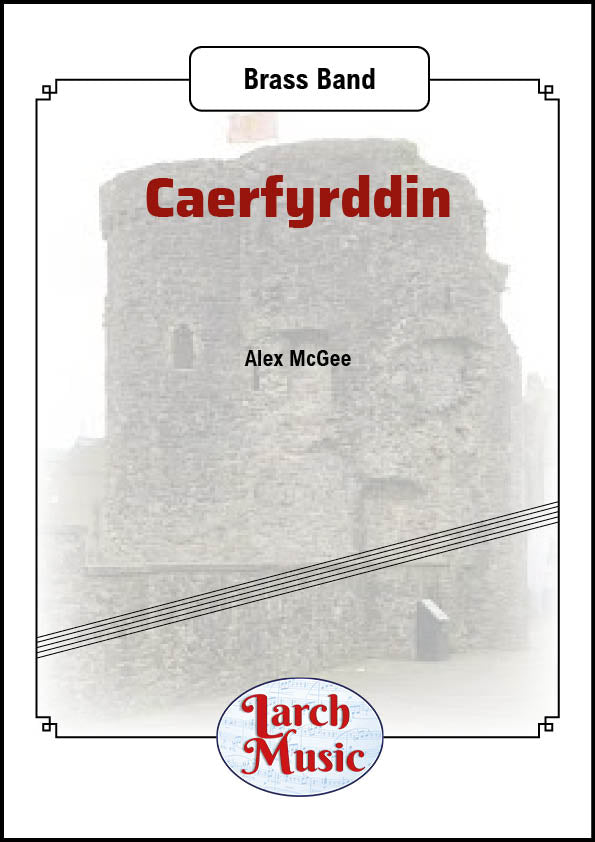
Caerfyrddin - Brass Band - LM957
COMPOSER: Alex McGeeA four movement work describing the historic county town of Carmarthen.1. FanfareThe first movement is an opening Fanfare,2. Castell Caerfyrddyn(Carmarthen Castle)The second movement is a lament describing the now ruined castle.Carmarthen Castle(Welsh:Castell Caerfyrddin) is a ruinedcastleinCarmarthen,West Wales. First built by Walter, Sheriff of Gloucester in theearly 1100s, the castle was captured and destroyed on severaloccasions before being rebuilt in stoneduring the 1190s. The castle was captured byOwain Glyndrin 1405.Henry VII's father died at Carmarthen Castle in 1456. During theWars of the Rosesthe castle fell toWilliam Herbertand, during theCivil War,was captured by Parliamentary forces. It was dismantled by order ofOliver Cromwellin the mid 1600s.It has been used as the site of Carmarthen's gaol until the 1920s.The remains of the castle were given a Grade Iheritage listingin 1954and is currently a tourist attraction and site of the town's Tourist Information Centre.3. Pysgota Cwrwgl(Coracle Fishing)The third movement is a Scherzo which depicts coracle fishing on the river Towy.Should you take an evening stroll down by the River Towy,if the weather and river conditions are suitable, you may be lucky enough to see apair of coracles float gently down river with a net suspended between them.The coracle man will hold the net in one hand and skilfully moving the paddle in afigure of eight motion in the other. As soon as a fish in caught, which many havedescribed as a 'silent noise travelling from the fish, into the net and up into thefisherman's arm', the two coracles are drawn together by pulling at the net.Sewin (sea trout) or salmon being the chosen catch.4. MarchThe Fourth movement is a March representing the town itself. Carmarthenshire in West Wales lies on the River Towy and claims to be the oldest town in Wales. Some variants of theArthurian legendclaim thatMerlinwas born outside the town and that he lies imprisoned in a cave in nearbyBryn Myrddin(Merlin's Hill), which stands right by the A40 trunk road.The myth maintains that his groans can be heard issuing forth from the hill and will continue until he is called to help his fellow countrymen. It is also claimed that, when Merlin's Oak fell, it would be the downfall of the town.For many years great effort was employed to brace the tree, situated in the town.Although it eventually died, it is hoped that catastrophe was averted by preservingsome bits in theCarmarthenshire County Museum.Larger branches are in the Civic Hall in Nott Square and a statue of Merlincarved from another local tree stands in the town centre.St. Peter's Church, the largest parish church in Wales,also has thelongest navemeasuring 60 metres and its tower containseight bellswith the heaviest weighing just under a tonne.It is surprising that few traces survive of the medieval town; however,a small section ofCivil War defences, thrown up by the Royalists, survives on the south-west of the town. They are known as "The Bulwarks," and consist of an earthwork bank and a well-preserved four-sided bastion.Suitable for Most Bands - Duration 8 mins (Approx.)
In Stock: Estimated dispatch 3-5 working days


