
Results
-
 £60.99
The Last Night of Fall - Etienne Crausaz
This beautiful chorale for Brass Band illustrates the winter solstice, the longest night of the year. Describing the end of nature's cycle, it has a rather melancholic character until the final chord which symbolises the new beginning.This contemplative work is ideal for creating a moment of tranquillity during a concert, and is also suitable as a warm-up piece.
Estimated dispatch 5-14 working days
-
 £36.00
Edward Gregson: The World Rejoicing
DescriptionComposer's NoteIn searching for a common link between the brass band traditions of the various European countries that commissioned this work, I considered the fact that hymns have always played an important role in the relationship that brass bands have with their particular communities; and thus I turned to a well-known Lutheran chorale, Nun danket alle Gott (Now thank we all our God), written around 1636 by Martin Rinkart, with the melody attributed to Johann Cruger. A number of composers have incorporated this chorale into their music, most famously J.S.Bach in his Cantatas no. 79 and 192, and Mendelssohn in the Lobsegang movement of his 2nd Symphony (the harmonization of which is usually used when this hymn is sung).It seemed fitting therefore for me to return to a compositional form I have used many times before (Variations) and to write a work based on this hymn. I have used it in a similar way to that which I employed in my Variations on Laudate Dominum of 1976 - that is, rather than writing a set of variations using elaborations of the complete tune, I have taken various phrases from the chorale and used them within the context of other musical material, applying an overall symphonic process of continuous variation and development. The structure, or sub-divisions of the work, which is through composed and plays without a break, is as follows: Prelude, Capriccio, La Danza 1, Processional, La Danza 2, Arias and Duets, Fuga Burlesca, Chorale, and Postlude.The work is also partly autobiographical - in the manner say of Strauss's Ein Heldenleben - in that I have incorporated into the score brief quotations from many of my other major works for brass band. In that respect, The World Rejoicing sums up a particular facet of my life as a composer, and reflects the admiration I have always had for what is surely one of the great amateur music-making traditions in the world.The World Rejoicing is dedicated 'in loving memory of my brother', Bramwell Logan Gregson, who sadly passed away in the Autumn of 2018.Edward Gregson
Estimated dispatch 7-14 working days
-
 £125.00
The World Rejoicing (Brass Band - Score and Parts)
The World Rejoicing was commissioned by the National Brass Band Associations of Belgium, Netherlands, Norway, Switzerland, and the British Open, as the test piece for their competitions in 2020/21. Although the work was completed in 2019, the pandemic of 2020 meant that these competitions were postponed until 2021/22. The premiere took place in September 2021 at Symphony Hall, Birmingham, UK.In searching for a common link between the brass band traditions of the various European countries that commissioned this work, I considered the fact that hymns have always played an important role in the relationship that brass bands have with their particular communities; and thus I turned to a well- known Lutheran chorale, Nun danket alle Gott (Now thank we all our God), written around 1636 by Martin Rinkart, with the melody attributed to Johann Cruger. A number of composers have incorporated this chorale into their music, most famously J.S. Bach in his Cantatas no. 79 and 192, and Mendelssohn in the Lobsegang movement of his 2nd Symphony (the harmonisation of which is usually used when this hymn is sung).It seemed fitting therefore for me to return to a compositional form I have used many times before (Variations) and to write a work based on this hymn. I have used it in a similar way to that which I employed in my Variations on Laudate Dominum of 1976 - that is, rather than writing a set of variations using elaborations of the complete tune, I have taken various phrases from the chorale and used them within the context of other musical material, applying an overall symphonic process of continuous variation and development. The structure, or sub-divisions of the work, which is through composed and plays without a break, is as follows:Prelude, Capriccio, La Danza 1, Processional, La Danza 2, Arias and Duets, Fuga Burlesca, Chorale, and Postlude.The work, which is around 16 minutes in length, is also partly autobiographical - in the manner say of Strauss's Ein Heldenleben - in that I have incorporated into the score brief quotations from many of my other major works for brass band. In that respect, The World Rejoicing sums up a particular facet of my life as a composer, and reflects the admiration I have always had for what is surely one of the great amateur music-making traditions in the world.Duration: 16.00
Estimated dispatch 7-14 working days
-
£40.00
The World Rejoicing (Brass Band - Score only)
The World Rejoicing was commissioned by the National Brass Band Associations of Belgium, Netherlands, Norway, Switzerland, and the British Open, as the test piece for their competitions in 2020/21. Although the work was completed in 2019, the pandemic of 2020 meant that these competitions were postponed until 2021/22. The premiere took place in September 2021 at Symphony Hall, Birmingham, UK.In searching for a common link between the brass band traditions of the various European countries that commissioned this work, I considered the fact that hymns have always played an important role in the relationship that brass bands have with their particular communities; and thus I turned to a well- known Lutheran chorale, Nun danket alle Gott (Now thank we all our God), written around 1636 by Martin Rinkart, with the melody attributed to Johann Cruger. A number of composers have incorporated this chorale into their music, most famously J.S. Bach in his Cantatas no. 79 and 192, and Mendelssohn in the Lobsegang movement of his 2nd Symphony (the harmonisation of which is usually used when this hymn is sung).It seemed fitting therefore for me to return to a compositional form I have used many times before (Variations) and to write a work based on this hymn. I have used it in a similar way to that which I employed in my Variations on Laudate Dominum of 1976 - that is, rather than writing a set of variations using elaborations of the complete tune, I have taken various phrases from the chorale and used them within the context of other musical material, applying an overall symphonic process of continuous variation and development. The structure, or sub-divisions of the work, which is through composed and plays without a break, is as follows:Prelude, Capriccio, La Danza 1, Processional, La Danza 2, Arias and Duets, Fuga Burlesca, Chorale, and Postlude.The work, which is around 16 minutes in length, is also partly autobiographical - in the manner say of Strauss's Ein Heldenleben - in that I have incorporated into the score brief quotations from many of my other major works for brass band. In that respect, The World Rejoicing sums up a particular facet of my life as a composer, and reflects the admiration I have always had for what is surely one of the great amateur music-making traditions in the world.Duration: 16.00
Estimated dispatch 7-14 working days
-
 £15.00
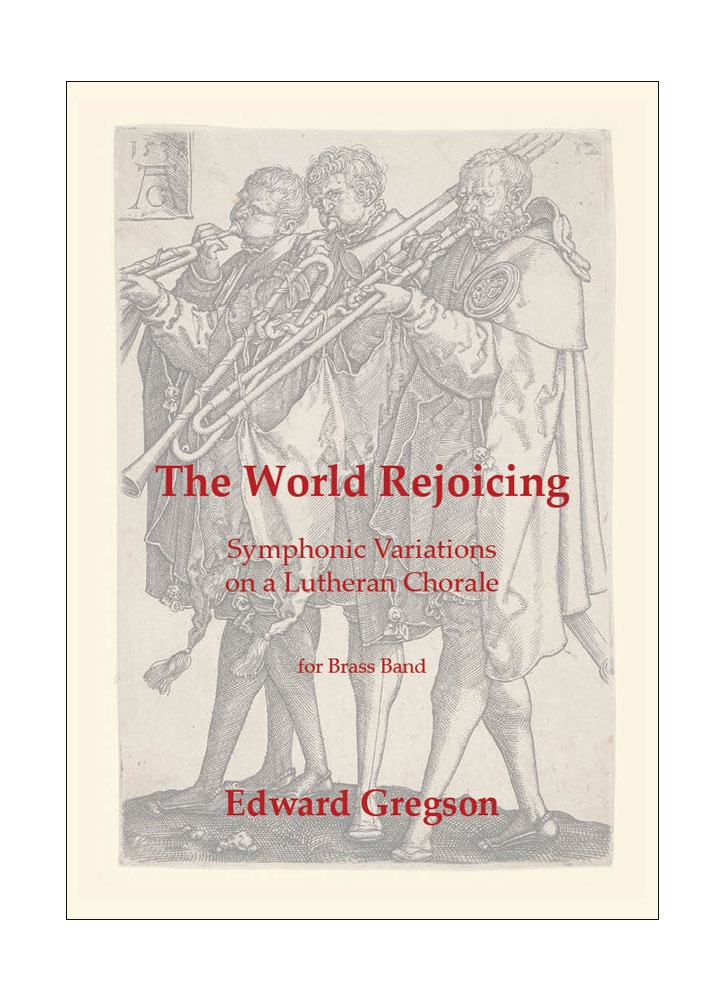
The World Rejoicing (Brass Band - Study Score)
In searching for a common link between the brass band traditions of the various European countries that commissioned this work, I considered the fact that hymns have always played an important role in the relationship that brass bands have with their particular communities; and thus I turned to a well-known Lutheran chorale, Nun danket alle Gott (Now thank we all our God), written around 1636 by Martin Rinkart, with the melody attributed to Johann Crger. A number of composers have incorporated this chorale into their music, most famously J.S.Bach in his Cantatas no. 79 and 192, and Mendelssohn in the Lobsegang movement of his 2nd Symphony (the harmonization of which is usually used when this hymn is sung).It seemed fitting therefore for me to return to a compositional form I have used many times before (Variations) and to write a work based on this hymn. I have used it in a similar way to that which I employed in my Variations on Laudate Dominum of 1976 - that is, rather than writing a set of variations using elaborations of the complete tune, I have taken various phrases from the chorale and used them within the context of other musical material, applying an overall symphonic process of continuous variation and development. The structure, or sub-divisions of the work, which is through composed and plays without a break, is as follows: Prelude, Capriccio, La Danza 1, Processional, La Danza 2, Arias and Duets, Fuga Burlesca, Chorale, and Postlude.The work is also partly autobiographical - in the manner say of Strauss's Ein Heldenleben - in that I have incorporated into the score brief quotations from many of my other major works for brass band. In that respect, The World Rejoicing sums up a particular facet of my life as a composer, and reflects the admiration I have always had for what is surely one of the great amateur music-making traditions in the world.The World Rejoicing is dedicated 'in loving memory of my brother', Bramwell Logan Gregson, who sadly passed away in the Autumn of 2018.Edward Gregson
Estimated dispatch 7-14 working days
-
 £22.99
Albinus Variations (Brass Band - Score only)
Johann Georg Albinus wrote a number of Lutheran hymns set to music by various composers. Johann Sebastian Bach reworked and inserted some of these hymns into his cantatas, particularly the chorale "Alle Menschen mssen sterben" in BWV 162. Albinus Variations opens with a solemn cadenza followed by five contrasted variations on this chorale. Both versions of the chorale, in major and minor keys, were used as a reference for this work.Duration: 12.45
Estimated dispatch 7-14 working days
-
£114.99
Albinus Variations (Brass Band - Score and Parts)
Johann Georg Albinus wrote a number of Lutheran hymns set to music by various composers. Johann Sebastian Bach reworked and inserted some of these hymns into his cantatas, particularly the chorale "Alle Menschen mssen sterben" in BWV 162. Albinus Variations opens with a solemn cadenza followed by five contrasted variations on this chorale. Both versions of the chorale, in major and minor keys, were used as a reference for this work.Duration: 12.45
Estimated dispatch 7-14 working days
-
 £89.95
Tuba Concerto (Score and Parts)
This work was commissioned by the Besses o' th' Barn Band with funds provided by the Arts Council of Great Britain. It was written for, and is dedicated to, John Fletcher, who gave the first performance in Middleton Civic Hall, near Manchester, on 24 April, 1976, with Besses o' th' Barn Band conducted by the composer. Another interesting feature about the premire was that it was recorded by BBC Television for an Omnibus programme with Andr Previn as presenter. The concerto exists in three versions: with brass band (1976), orchestra (1978) and wind band (1984).The concerto is in three movements, following the usual, quick-slow-quick pattern: Allegro deciso,Lento e mesto, Allegro giocoso. The first movement has a sonata form shell with two contrasting themes, the first one being rhythmic in character, the second lyrical. There is a reference made in passing to the Vaughan Williams Tuba Concerto, but this merges into the other material in the development section.The second movement begins with a chorale, but after the entry of the tuba it leads to a cantabile theme, softly unfolded by the soloist. The opening chorale passage returns, this time briefly on muted brass, and leads to a middle section which is more chromatic in style and soon builds to a powerful climax, where the opening cantabile theme triumphantly returns. The music subsides, returning to the opening chorale and ending peacefully.The finale is light and breezy in style, and is cast in rondo form. After a brief introduction the tuba announces the main rondo theme, which is dance-like and a little jaunty. There are two episodes: the first a broad sweeping tune, the second a slowish waltz and a little jazz-like. After a virtuoso cadenza reference is made to the very opening of the concerto before the work ends with a triumphal flourish.The Tuba Concerto has established itself as one of the main works in the solo tuba repertoire. It has been performed and broadcast in over 40 countries all over the world. There are currently six commercial recordings of the concerto in its various versions.resolution in C major, pointed by a simple but expansive melody towards which the piece has been heading, and ending in a blaze of joyful colour.
Estimated dispatch 7-14 working days
-
 £32.00
The Cistercians
DescriptionThe Cistercianswas written during December 2003 and January 2004 as an entry for Morecambe Band's Centenary New Music Competition, which it went on to win. The first two performances were at the final of this competition, part of the band's 100th Anniversary Concert at The Dome in Morecambe on 9 July 2004.The music was inspired by visits to three of Britain's great Cistercian Abbeys; Valle Crucis, Fountains and Rievaulx. The Cistercian Order was founded at Citeaux in France in the 11th Century and was based on the principles of austerity, humility and piety. Cistercian Abbeys were deliberately sited in remote, difficult areas. Despite this many of them, especially Rievaulx, became immense centres of commerce and power, with ever more complex administration and hierarchies.In a way the music reflects this; all the material in the piece is derived from two simple motifs played by flugel and solo horn in the opening bars and becomes more complex and further removed from the original material as the piece develops. After a tranquil opening section a fugal chorale develops over a medieval-style "tenor" - a stretched out version of one of the original motifs. A burst of semiquavers leads into a faster, folk-dance type section - our medieval abbey has become a bustling trade centre - before rhythmic quaver pulses in the horns and cornets accompany powerful chords in the low brass; this is another "tenor" derived from the opening motifs. A short development section, including the folk dance "hocketing" round the band and a slightly disjointed 10/8 section leads to a restatement of the fugal chorale from the beginning before a frenetic coda brings the work to a triumphant conclusion.Performance Notes:Percussion instruments required are Bass Drum, Suspended Crash Cymbal, Glockenspiel, 2 x Tom-toms, Snare Drum, Tambourine, Tam-Tam, 2 x Timpani (G-C, C-F), Triangle, Wood Block. All cornets will require metal stratight mutes and all except soprano require cup mutes. All trombones require cup and metal straight mutes.You can follow a preview of the score in the video below.
Estimated dispatch 7-14 working days
-
£38.50
Intrada - Farr, R
Based on the Chorale 'Ein' Feste Burg' (A Safe Stronghold) by Martin Luther this song became a battle song for the Reformation. The setting contrasts the piety of the chorale with modern rhythms and harmonies in a dramatic and daring presentation.The piece works best with four trombones but small note 'cues' are provided. The cornets should be divided into three groups, spread as widely as is practical.
In Stock: Estimated dispatch 1-3 working days
 View Music