
Results
-
 £48.00
Red Vest Man (Brass Band - Score and Parts) - Waterman, Steve
Red Vest Man was composed as a dedication to cornet player Buddy Bolden, one of the first jazz musicians. He was reputed to always perform wearing a red vest. The piece is a New Orleans funeral march, something Bolden would have been called to do many times in his career. It starts with a slow mournful march, featuring solos from trumpet and trombone and finishes with a joyful 2nd line New Orleans rhythm. Duration: 8.00. Suitable for 2nd Section Bands and above.
Estimated dispatch 7-14 working days
-
 £38.00
Blewz (Brass Band - Score and Parts) - Anderson, Keiron
There are many harmonic forms of the blues from a standard chord sequence to a more complex set with a circle of fifths. This bright, entertaining work is fun to play and easy to programme with a hint of jazz and a swing feel, complete with a little interplay section for bass trombone and tuba, which adds to the entertainment value of this piece. Duration: 3.30. Suitable for 1st Section Bands and above
Estimated dispatch 7-14 working days
-
 £34.95
Kings Of Swing (Brass Band - Score and Parts) - Larsson, Kevin
The opening features a cornet, trombone and tuba trio, intended to be the three kings, as they swing their way to Bethlehem using the classic Christmas carol, 'We three kings of Orient are'.
Estimated dispatch 7-14 working days
-
£17.50
Kings Of Swing (Brass Band - Score only) - Larsson, Kevin
The opening features a cornet, trombone and tuba trio, intended to be the three kings, as they swing their way to Bethlehem using the classic Christmas carol, 'We three kings of Orient are'.
Estimated dispatch 7-14 working days
-
 £60.99
Best Friends (Cornet or Euphonium Solo with Brass Band - Score and Parts) - Nijs, Johan
With Best Friends, Belgian composer Johan Nijs portrays friendship in a wonderful ballad that can be played on the cornet, euphonium or trombone. A great chance to put one of your players in the spotlight!Duration: 3.45
Estimated dispatch 7-14 working days
-
 £74.99
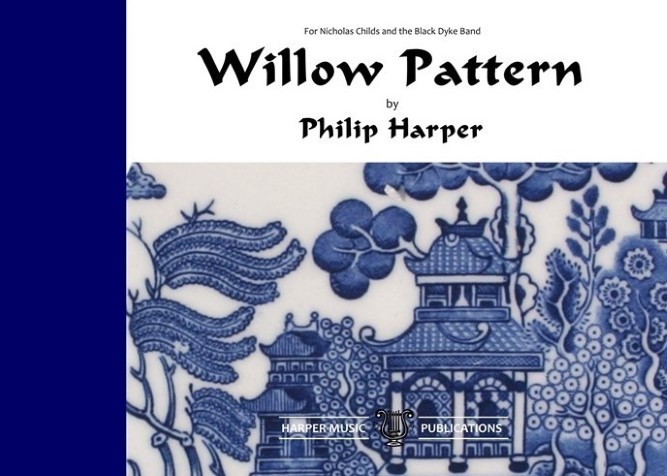
Willow Pattern (Brass Band - Score and Parts) - Harper, Philip
Composed in 2009 for Nicholas Childs and the Black Dyke BandThis piece tells the Willow Pattern legend through music. Several leitmotifs are used both for the different characters and also for some of the important emotions in the tale. Additionally, Knoon-se's part is mainly played by the flugel horn, Chang by the euphonium, the Mandarin by the Eb Bass and the Duke Ta-jin by the trombone.The Willow Pattern Legend:Once, in ancient China, there lived a wealthy and powerful Mandarin who had a beautiful daughter, Knoon-se. She had fallen in love with Chang, a humble accountant, which angered her father who imprisoned her in the Pavilion by the river with only the exotic birds for company. She learnt that the Mandarin planned to marry her to the pompous Duke Ta-jin and that the wedding would take place on the day the blossom fell from the willow tree, so she sent Chang a message: "Gather thy blossom, ere it be stolen". The Duke arrived by sea amid great fanfare when the tree was heavy with bud, and nights of magnificent banquets followed. After one such occasion when the Mandarin slept, Chang crept over the crooked fence and tiptoed into the Pavilion to rescue Knoon-se, but as they escaped the alarm was raised. They fled over the bridge with the Mandarin close on their heels brandishing his whip. They managed to escape by boat to a secluded island where they lived happily for a time. Meanwhile, the Mandarin learned of their refuge and, intent on revenge, he ordered his soldiers to kill them. As Knoon-se and Chang slept at night, the men set fire to the pagoda in which they lived and the lovers perished in the flames. However, the Gods, moved by the lovers' plight, transformed their souls into two turtle-doves which rose from the charred remains, soaring above the Earth, symbolising eternal happiness.Willow Pattern is dedicated to the memory of Jean Harper who passed away as I was completing the piece and who was a great collector of porcelain and china-ware.Duration: 12:00
Estimated dispatch 7-14 working days
-
£17.50
Concert Etude (Bb Solo with Brass Band - Score only) - Goedicke, Alexander - Broughton, William
Although firmly established in the trumpet repertoire, this exciting work has also been featured by cornet, tenor horn, trombone and even tuba players!
Estimated dispatch 7-14 working days
-
£24.95
He Can Break Every Fetter (Brass Band - Score and Parts) - Downie, Kenneth
This is a setting of a chorus that the composer remembers being sung in Scotland as a child. The words encapsulate the truth of the Christian gospel in one sentence; 'He can break every fetter, He can set you free!'. Starting with trombone quartet, two more statements of the chorus follow, each in a new key. The final, extended, cadence emphasizes the spiritual release declared in the text.
Estimated dispatch 7-14 working days
-
£12.50
He Can Break Every Fetter (Brass Band - Score only) - Downie, Kenneth
This is a setting of a chorus that the composer remembers being sung in Scotland as a child. The words encapsulate the truth of the Christian gospel in one sentence; 'He can break every fetter, He can set you free!'. Starting with trombone quartet, two more statements of the chorus follow, each in a new key. The final, extended, cadence emphasizes the spiritual release declared in the text.
Estimated dispatch 7-14 working days
-
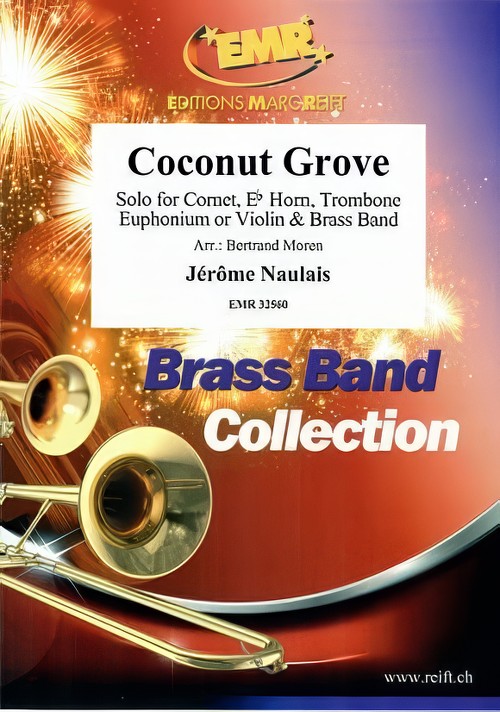 £95.00
Coconut Grove (Flexible Solo with Brass Band - Score and Parts) - Naulais, Jerome - Moren, Bertrand
Solo for Cornet, Eb Horn, Trombone, Euphonium or ViolinDuration: 4.30
Estimated dispatch 7-14 working days
 View Music