
Results
-
 £44.95
The Flowers of the Forest (Brass Band - Score only) - Bennett, Richard Rodney - Hindmarsh, Paul
In a preface to the score, the composer explains that 'the folk song The Flowers of the Forest is believed to date from 1513, the time if the battle of Flodden, in the course of which the archers of the Forest (a part of Scotland) were killed almost to a man'. Bennett had already used the same tune in his Six Scottish Folksongs (1972) for soprano, tenor and piano, and it is the arrangement he made then that forms the starting-point for the brass-band piece. A slow introduction (Poco Adagio) presents the folk song theme three times in succession - on solo cornet, on solo cornets and tenor horns, and on muted ripieno cornets in close harmony - after which the work unfolds through five sections and a coda. Although played without a break, each of these five sections has its own identity, developing elements of the tune somewhat in the manner of variations, but with each arising from and evolving into the next. The first of these sections (Con moto, tranquillo) is marked by an abrupt shift of tonality, and makes much of the slow rises and falls characteristic of the tune itself. The tempo gradually increases, to arrive at a scherzando section (Vivo) which includes the first appearance of the theme in its inverted form. A waltz-like trio is followed by a brief return of the scherzando, leading directly to a second, more extended, scherzo (con brio) based on a lilting figure no longer directly related to the theme. As this fades, a single side drum introduces an element of more overtly martial tension (Alla Marcia) and Bennett says that, from this point on, he was thinking of Debussy's tribute to the memory of an unknown soldier (in the second movement of En Blanc et noir, for two pianos). Bennett's march gradually gathers momentum, eventually culminating in a short-lived elegiac climax (Maestoso) before the music returns full-circle to the subdued melancholy of the opening. The work ends with a haunting pianissimo statement of the original tune.
Estimated dispatch 7-14 working days
-
£154.99
Bulgarian Dances (Part II) (Brass Band - Score and Parts)
Bulgarian folk music has a long tradition and numerous typical characteristics, such as particular dissonances and complex, irregular rhythms. In Bulgarian Dances (Part II) (which can be performed together with the previously published title Bulgarian Dances) Franco Cesarini has preserved the original spirit of Bulgarian folk music, yet has imbued it with a symphonic character and brought it into the concert hall. The three different movements give us a meditative, moving folksong and a lively dance, before a distinctly symphonic part leads to a glittering finale.
Estimated dispatch 7-14 working days
-
 £59.70
French Folk Festival (Brass Band - Score and Parts) - Smith, Sandy
Based on the French Folk Song Fr?re Jacques
Estimated dispatch 7-14 working days
-
 £60.99
Shalom Alechem (Brass Band - Score and Parts)
The characteristic so typical of Jewish folk music is clearly apparent in this arrangement of the Jewish folk song, Shalom Alechem. It is typical in the sense, in that, in spite of the minor key, songs are often cheerful by nature, Johan Nijs managed to capture this perfectly in this outstanding arrangement. 02:50
Estimated dispatch 7-14 working days
-
 £40.00
Slavonic Dance No.8 (Brass Band - Score and Parts) - Dvorak, Antonin - Littlemore, Phillip
Antonin Dvorak composed his first set of eight Slavonic Dances in 1878. The music is lively and overtly nationalistic, although the tunes themselves are all original and are not taken from any Slavic folk dances. Slavonic Dance No.8 is high-spirited and in the style of a furiant, the boldest of Czech folk dances. Although written in a 3/4 metre throughout, Dvorak creates cross-rhythms that shift this metre in to 2/4, which is an important characteristic of the furiant. Duration: 4.10
Estimated dispatch 7-14 working days
-
 £34.95
Three Carols (Brass Band - Score and Parts) - Turrin, Joseph
Three Carols was commissioned by the New York Philharmonic as part of their Holiday Brass series and was premiered at Avery Fisher Hall by the New York Philharmonic Principal Brass and Canadian Brass. Originally for 10 players, soon after the premiere I decided to score the piece for brass band. The brass band version was first performed by the New York Staff Band.Through the years I have been intrigued by carious carols from different countries and the challenge of creating musical treatments that sound fresh and original. When commissioned to write these brass arrangements, I wanted to create contrasting movements that could be performed either as a set or individually and thought that three carols from different countries would allow the opportunity for that contrast. The featured carols are the traditional Polish carol Infant Holy, What child is this? with lyrics by William Dix and set to the English folk song Greensleeves and the lesser-known Catalonian carol Cold December flies away.- Joseph Turrin
Estimated dispatch 7-14 working days
-
 £110.00
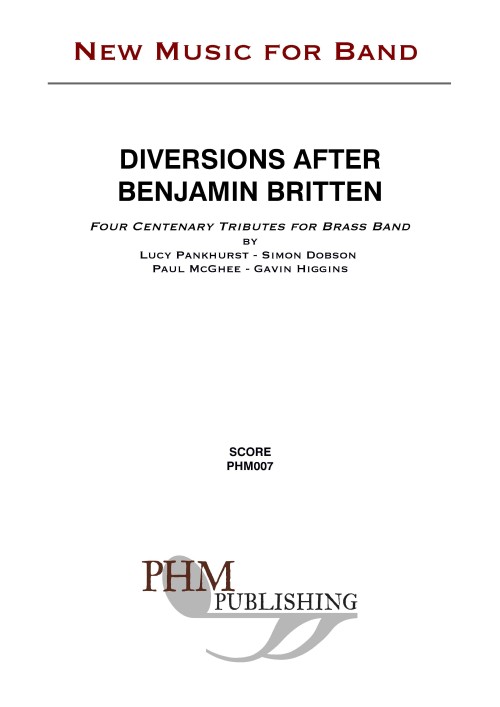
Diversions after Benjamin Britten (Brass Band - Score and Parts)
Suite by Lucy Pankhurst, Simon Dobson, Paul McGhee and Gavin HigginsHaving devised a collective centenary tribute for Michael Tippett at the 2006 RNCM Festival of Brass (Variations on a Theme of Michael Tippett by five eminent composers of brass band music, PHM002), I commissioned this companion piece as a Benjamin Britten tribute for the 2013 festival. In the late 1970s, while researching a book about the English composer, and Britten's first teacher, Frank Bridge (1879 - 1941), I came across a copy of the printed score of Benjamin Britten's Variations on a Theme of Frank Bridge (Op.10) for string orchestra, in which Britten had written descriptive titles for each of the variations suggesting appropriate character traits of his much loved mentor and guide. The character variations are cast in march, song and dance forms.Taking inspiration from Britten's youthful tribute, I invited four award-winning composers, who have all made significant contributions to the brass band medium, to create their own personal reflections on four aspects of Britten's character and music, designed to form a suite of Diversions after Benjamin Britten, but which can also be played separately.Lucy Pankhurst's hauntingly lyrical Prelude: His Depth refers to the emotional and symbolic subtexts that underpin Britten's operas, taking its musical cue from Britten's many arrangements of folk songs. The flugel horn takes a prominent role throughout.Simon Dobson's breathless Scherzo: His Vitality reminds us with its rapid passage work and leaping bass 'groove' that Britten loved tennis and fast cars in his younger days.Paul McGhee's evocative interpretation of the March: His Sympathy represents Benjamin Britten's pacifism, as the composer writes: 'We view the music through the eyes of a pacifist. Whilst war and violence surround us, we do not engage in it and though it continues to happen around us. With the use of muted effects in most of the band throughout the piece, the flugel horn is the lone voice of reason, standing firm against the mechanical and destructive society in which it is forced to live. As the machine of war continues around the lone voice, the voice is gradually dismissed and mocked as the war machine rumbles on into the distance.'In an extended finale, entitled Toccata: His Skill, Gavin Higgins celebrates Benjamin Britten's consummate creativity. For the RNCM Festival of Brass premiere, the four contrasting movements were framed and connected by Britten's Fanfare for St. Edmundsbury for three trumpets, with the trumpet soloists spaced round the hall. I am grateful to the Britten Estate and publishers Boosey & Hawkes for giving permission for the elements of Britten's fanfare to be incorporated in the collective work.- Paul HindmarshDuration: 19.30
Estimated dispatch 7-14 working days
-
£45.00
Diversions after Benjamin Britten (Brass Band - Score only)
Suite by Lucy Pankhurst, Simon Dobson, Paul McGhee and Gavin HigginsHaving devised a collective centenary tribute for Michael Tippett at the 2006 RNCM Festival of Brass (Variations on a Theme of Michael Tippett by five eminent composers of brass band music, PHM002), I commissioned this companion piece as a Benjamin Britten tribute for the 2013 festival. In the late 1970s, while researching a book about the English composer, and Britten's first teacher, Frank Bridge (1879 - 1941), I came across a copy of the printed score of Benjamin Britten's Variations on a Theme of Frank Bridge (Op.10) for string orchestra, in which Britten had written descriptive titles for each of the variations suggesting appropriate character traits of his much loved mentor and guide. The character variations are cast in march, song and dance forms.Taking inspiration from Britten's youthful tribute, I invited four award-winning composers, who have all made significant contributions to the brass band medium, to create their own personal reflections on four aspects of Britten's character and music, designed to form a suite of Diversions after Benjamin Britten, but which can also be played separately.Lucy Pankhurst's hauntingly lyrical Prelude: His Depth refers to the emotional and symbolic subtexts that underpin Britten's operas, taking its musical cue from Britten's many arrangements of folk songs. The flugel horn takes a prominent role throughout.Simon Dobson's breathless Scherzo: His Vitality reminds us with its rapid passage work and leaping bass 'groove' that Britten loved tennis and fast cars in his younger days.Paul McGhee's evocative interpretation of the March: His Sympathy represents Benjamin Britten's pacifism, as the composer writes: 'We view the music through the eyes of a pacifist. Whilst war and violence surround us, we do not engage in it and though it continues to happen around us. With the use of muted effects in most of the band throughout the piece, the flugel horn is the lone voice of reason, standing firm against the mechanical and destructive society in which it is forced to live. As the machine of war continues around the lone voice, the voice is gradually dismissed and mocked as the war machine rumbles on into the distance.'In an extended finale, entitled Toccata: His Skill, Gavin Higgins celebrates Benjamin Britten's consummate creativity. For the RNCM Festival of Brass premiere, the four contrasting movements were framed and connected by Britten's Fanfare for St. Edmundsbury for three trumpets, with the trumpet soloists spaced round the hall. I am grateful to the Britten Estate and publishers Boosey & Hawkes for giving permission for the elements of Britten's fanfare to be incorporated in the collective work.- Paul HindmarshDuration: 19.30
Estimated dispatch 7-14 working days
-
 £45.00
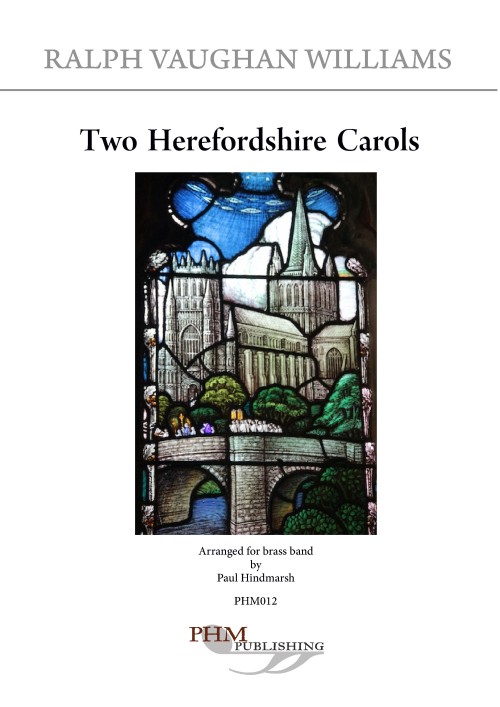
Two Herefordshire Carols (Brass Band - Score and Parts) - Vaughan Williams, Ralph - Hindmarsh, Paul
The two traditional tunes that comprise this straightforward setting were sung to Ralph Vaughan Williams (1872-1958) by Mrs. Esther Smith of Dilwyn, near Hereford, during one of the great composer's folk song collecting tours of England in the early years of the twentieth century. They were included in Twelve Traditional Carols from Herefordshire, edited by E.M. Leather and Vaughan Williams. The words to which Mrs. Smith sung the first tune were probably drawn from eighteenth century evangelical sources. The editors replaced these with six of the 16 verses of a traditional seventeenth century carol text, Joseph and Mary.The second melody, which appears as the centre piece of this arrangement, was sung to a carol that tells of a farmer who ploughed on Christmas Day. It is in fact a translation of a German traditional carol Gelobet seist du Jesu Christ that was published in Goodly Psalmes and Spiritualle Songes (1546) translated by Miles Coverdale. Vaughan Williams used the title Coverdale's Carol.The brass band settings follow the settings made by Vaughan Williams in 1920 for the Oxford Book of Carols. Since his simple harmonic approach is similar in both settings, three verses of his haunting version of Coverdale's Carol have been folded inside four verses of the slightly more animated treatment of Joseph and Mary. The harmonisations of Vaughan Williams have been given some brass band colour, with some verses taken by soloists from the ensemble. The accompaniment figuration that embellishes the second verse of Joseph and Mary has been used to open and close this arrangement and to bind the verses together.- Paul HindmarshDuration: 5.00
Estimated dispatch 7-14 working days
-
 £35.00
Carol of the Bells (Brass Band - Score and Parts) - Littlemore, Phillip
This popular Christmas piece was composed by Mykola Leontovych around 1916. It is based on a Ukrainian folk chant known as 'Shchedryk', a New Year's carol. However, it was not until after the composer's death in 1921 that it was first introduced to Western audiences, when the Ukrainian National Choir included it on their tour of Europe and the Americas that same year. The film composer John Williams incorporated it into the score for the 1990 film Home Alone and he is credited for bringing it to a wider audience still, although it had been released on Christmas albums by a number of popular artists before that. This transcription for brass band has been adapted from the arrangement by Robert Prizeman, who created it for Libera, the world famous boys choir that he both founded and directs. Their unique, enchanting and, some say, heavenly sound delights audiences throughout the world through extensive concerts, recording and TV broadcasts. This brass band transcription introduces this skilled choral arrangement to a new genre and a whole new audience as well. Duration: 3.00
Estimated dispatch 7-14 working days
 View Music