
Results
-
 £30.00
Iceni Autumn (Brass Band - Score only) - Barry, Darrol
The piece is in four movements; SPQR, Cockley Cley, Boudicca - Battles and Requiem and Venta Icenorum.S.P.Q.R. is an initialism of a Latin noun phrase, Senatus Populusque Romanus ("The Senate and the Roman People"). This movement attempts to portray the mood in England under Roman occupation and contains important themes developed throughout the suite.Cockley Cley is a reconstruction of the type of village occupied by the Iceni. For many years it was a popular tourist attraction in Norfolk.Boudicca (also known as Boadicea) was the wife of King Prasutagus of the Iceni, a British tribe that lived in East Anglia during the time of the Roman Emperor Nero. When Prasutagus, an ally of the Romans died, the local Roman government officials decided that they would seize her wealth and lands for themselves. When Boudicca protested, saying she was a Roman ally who was being treated no better than a slave, the Roman soldiers fogged her and raped her daughters. Boudicca called her tribe to arms and revolted against their Roman oppressors; this saw the complete devastation of Colchester, St Albans and London. In the final battle the Romans slaughtered about 80,000 Britons including women, children and old men, repaying atrocities in kind. Boudicca and her two daughters poisoned themselves rather than be captured and taken to Rome as prisoners of war.Venta Icenorum was the capital of the Iceni Tribe, who inhabited the flatlands and marshes of Norfolk and earned immortality for their revolt against Roman rule under their queen Boudicca in the winter of 61 AD. This triumphant march brings various themes together and ends with a final reference.
Estimated dispatch 7-14 working days
-
 £124.95
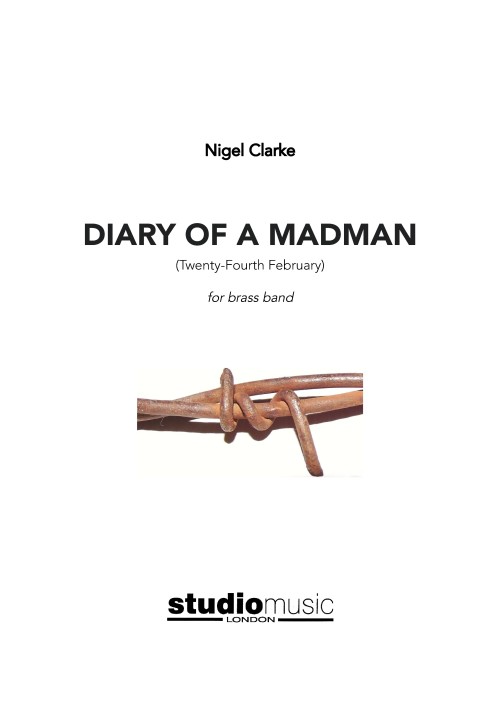
Diary of a Madman (Twenty-Fourth February) (Brass Band - Score and Parts) - Clarke, Nigel
From the beginning of history, warlords, emperors and dictators have risen up, some benign but many of them a scourge on humanity. Names that resonate to this day include Julius Caesar, Caligula, Genghis Khan, Ivan IV (The Terrible), Attila the Hun, Vlad IV (The Impaler), Hitler, Stalin, Mao Zedong, Pol Pot, all of whom were responsible for wanton destruction and the torture and death of millions of victims, either citizens of invaded countries and territories and or indeed, their own peoples.Diary of a Madman starts with a light-hearted march that gives the impression of toy tin soldiers parading in a brightly-coloured ceremonial pageant from a fairy tale, conveying peace and innocence. This spectacle is abruptly interrupted by a 'shock and awe' fanfare-like march, symbolising aggression and war. This theme grinds slowly to a halt, and an atmosphere of introspection, sadness and despair takes over. Rising above the smoky theatre of war, we then hear a distant cornet give a rendition of the Ukrainian Nation Anthem (The glory and freedom of Ukraine has not yet perished. Luck will still smile on us brother-Ukrainians). The solo cornet soon enters a fragile duet with a second cornet accompanied by dark undertones. One by one, we hear short shards of aggressive fanfare-like figures from various instruments in the band. The mood breaks - we hear strident fortissimo whole-tone scales representing pealing church bells, warning of danger. In contrast, we also hear pianissimo whole-tone scales announcing that the enemy's troops are falling back. A counter-offensive soon takes centre stage, and battles and skirmishes are heard, with short quotations from Mussorgsky's `Great Gates of Kyiv' symbolising the defenders' heroic struggle.All sides are victims of the Dictator's ambition! The slow central section offer us moments of melancholic beauty and utilises Henry Purcell's `When I am laid in earth' (`Dido's Lament' from Dido and Aeneas 1688). This music represents the loss of homes, dignity and loved ones. There are occasional hints at better times as the theme of the parading toy tin soldiers is heard from afar, like a distant memory.To announce the final push, we hear a church bell strike and an air raid siren signalling a ferocious musical counter-attack. After one final rendition of the Purcell theme, Diary of a Madman closes with a mood of triumph over tyranny.- Nigel Clarke
Estimated dispatch 7-14 working days
-
£57.95
Diary of a Madman (Twenty-Fourth February) (Brass Band - Score only) - Clarke, Nigel
From the beginning of history, warlords, emperors and dictators have risen up, some benign but many of them a scourge on humanity. Names that resonate to this day include Julius Caesar, Caligula, Genghis Khan, Ivan IV (The Terrible), Attila the Hun, Vlad IV (The Impaler), Hitler, Stalin, Mao Zedong, Pol Pot, all of whom were responsible for wanton destruction and the torture and death of millions of victims, either citizens of invaded countries and territories and or indeed, their own peoples.Diary of a Madman starts with a light-hearted march that gives the impression of toy tin soldiers parading in a brightly-coloured ceremonial pageant from a fairy tale, conveying peace and innocence. This spectacle is abruptly interrupted by a 'shock and awe' fanfare-like march, symbolising aggression and war. This theme grinds slowly to a halt, and an atmosphere of introspection, sadness and despair takes over. Rising above the smoky theatre of war, we then hear a distant cornet give a rendition of the Ukrainian Nation Anthem (The glory and freedom of Ukraine has not yet perished. Luck will still smile on us brother-Ukrainians). The solo cornet soon enters a fragile duet with a second cornet accompanied by dark undertones. One by one, we hear short shards of aggressive fanfare-like figures from various instruments in the band. The mood breaks - we hear strident fortissimo whole-tone scales representing pealing church bells, warning of danger. In contrast, we also hear pianissimo whole-tone scales announcing that the enemy's troops are falling back. A counter-offensive soon takes centre stage, and battles and skirmishes are heard, with short quotations from Mussorgsky's `Great Gates of Kyiv' symbolising the defenders' heroic struggle.All sides are victims of the Dictator's ambition! The slow central section offer us moments of melancholic beauty and utilises Henry Purcell's `When I am laid in earth' (`Dido's Lament' from Dido and Aeneas 1688). This music represents the loss of homes, dignity and loved ones. There are occasional hints at better times as the theme of the parading toy tin soldiers is heard from afar, like a distant memory.To announce the final push, we hear a church bell strike and an air raid siren signalling a ferocious musical counter-attack. After one final rendition of the Purcell theme, Diary of a Madman closes with a mood of triumph over tyranny.- Nigel Clarke
Estimated dispatch 7-14 working days
 View Music