
Results
-
 £61.99
Dreamsong (Euphonium Solo with Brass Band - Score and Parts)
Dreamsong was commissioned by Geir Ulseth and the Nidaros Brass Band from Trondheim, Norway. After a short introduction, the soloist introduces a rather nostalgic melody, accompanied by the lower brass parts. A fast central section is then played by the band, which leads to a climax. Eventually, the main melody played by the solo cornet and flugel horn returns, overlaid with an ornamented counter-melody from the soloist, who then closes the piece with a short cadenza. Duration: 4.30
Estimated dispatch 7-14 working days
-
 £44.95
Pyrotechnic Variations on 1812 (Brass Band - Score and Parts)
Pyrotechnic Variations on 1812 was composed for Brass Band Schoonhoven, and used as part of their programme for Brass in Concert in November 2016.'Pyrotechnic Variations' is a modern day twist on Tchaikovsky's famous '1812' Overture. A heraldic opening introduces some familiar themes, before leading into a frantic virtuosic passage (especially for euphonium!), where quotes can be heard all through the band. This subsides into the central 'slow' section (via the unusual route of a bass and drum kit feature). After a whisper quiet reintroduction of the main theme, we build to the 'canon' finale - ending in a glorious celebratory style!
Estimated dispatch 7-14 working days
-
 £84.95
In League with Extraordinary Gentlemen (Euphonium Solo with Brass Band)
Concerto for EuphoniumIn League with Extraordinary Gentlemen combines two of composer Peter Graham's life interests - composition and 19th century popular fiction. Each of the concerto's three movements takes its musical inspiration from extraordinary characters who have transcended the original genre and have subsequently found mass audiences through film, television and comic book adaptations.The first movement follows a traditional sonata form outline with one slight modification. The order of themes in the recapitulation is reversed, mirroring a plot climax in the H.G. Wells novella The Time Machine (where the protagonist, known only as The Time Traveller, puts his machine into reverse bringing the story back full circle).The Adventure of the Final Problem is the title of a short story published in The Memoirs of Sherlock Holmes by Arthur Conan Doyle. This is an account of the great detective's final struggle with his long-time adversary Professor Moriarty at the Reichenbach Falls in Switzerland. The music takes the form of a slowed down lndler (a Swiss/Austrian folk dance) and various acoustic and electronic echo effects call to mind the alpine landscape. The final bars pose a question paralleling that of Conan Doyle in the story - have we really seen the last of Sherlock Holmes?The final movement, The Great Race, (available separately) follows Phileas Fogg on the last stage of his epic journey "Around the World in Eighty Days" (from the novel by Jules Verne). The moto perpetuo nature of the music gives full rein to the soloist's technical virtuosity. As the work draws to a conclusion, the frantic scramble by Fogg to meet his deadline at the Reform Club in Pall Mall, London, is echoed by the soloist's increasingly demanding ascending figuration, set against the background of Big Ben clock chimes.In League with Extraordinary Gentlemen was first performed in the brass band version by David Thornton and the Black Dyke Band, conductor Nicholas Childs, at the RNCM Concert Hall Manchester on January 30, 2009.
Estimated dispatch 7-14 working days
-
 £39.95
When Thunder Calls (Brass Band - Score and Parts)
When Thunder Calls was commissioned by Dr Nicholas Childs and the Black Dyke Band for their performance at the Gala Concert of the Swiss Open Championships in September 2011. When composing this piece, I decided to focus on both the music and the stage presentation. The way the piece has been composed and designed makes it a very effective way of starting a concert or a second half of a concert.At the start of the piece, the percussion enter the stage and take their positions in their usual place behind the band. They begin playing the piece without a conductor. They keep repeating the opening section while the Basses, Horns, Baritones and Euphoniums march onto the stage.This group of musicians take their seats with the Horns, Baritones and Euphoniums sitting where they usually sit in the band but the Basses sit where the solo cornets usually sit, forming an inner semi-circle of lower brass. When seated and when the music gets to the end of bar 4 the piece continues onto section A. All performers keep repeating this next 4-bar phrase until the trombones march onto stage and stand at the front of the stage with the Bass Trombone standing in between the other two trombones.All performers then play from figure B to C with the trombones taking the lead at the front. When the performers get to rehearsal figure C they repeat this section (the same as section A) while the trombones move from the front of the stage and take their positions where the Basses would normally sit (between the horns and the percussion) and remain standing. Meanwhile, the flugel enters the stage and stands at the front of the stage (standing where the trombones did). When in position the flugel soloist picks up into rehearsal figure D.When the flugel soloist finishes playing, just before rehearsal figure F they then move to their normal seat in the band. At figure F the cornets march onto the stage from either side, they turn and stand side by side each other facing outward towards the audience forming two 'fanfare' lines either side of the lower brass. The conductor follows the cornets on stage and on cue they lift their instruments at the same time and perform when the piece gets to figure G.There is no more moving around from this point on other than the solo cornet to move forward with the solo euphonium and perform their duet at letter H. Also the horns are required to stand and play at letter I and then sit just before J.When performed with all the choreography, this piece makes for an exciting addition to any concert repertoire both for the performer and the audience.Suitable for 3rd Section Bands and Above
Estimated dispatch 7-14 working days
-
 £64.95
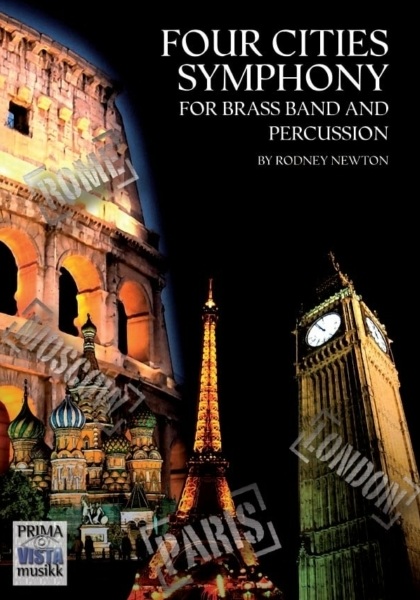
Four Cities Symphony (Brass Band - Score and Parts)
This piece was commissioned by the National Contesting Council as the 4th section test piece for the 2008 Regional Brass Band Championships of Great Britain.This symphony (the composer's 12th) has four movements played without a break. The first centres on two aspects of the city of London: its history and pageantry and its role as a busy modern metropolis.The second movement depicts Paris, its street cafes and boulevards and riverside walks, in the form of a romantic waltz.The third movement is constructed around the Gregorian chants of the Lord's Prayer (Pater noster, qui es in caelis) and the Creed (Credo in unum Deum) in an evocation of the city of Rome. After a powerful climax, mysterious tramping footsteps are heard as the ghosts or a Roman legion march through the city by night. The vision fades and the pater noster is heard once again before the movement is brought to a close with the ancient Ambrosian chant, Christus Vincit, Christus Regnet, Christus Imperat.The final movement is an evocation of the city of Moscow, with its great historic buildings, its turbulent history and its fiery traditional music. At the outset a rather dour folk-like melody is heard which is transformed into a lively Cossack dance.This work is dedicated to Howard Wilson, former principal euphonium of City of Coventry Band who, in 1972, introduced the composer to top section brass band contesting.Duration: 11.00
Estimated dispatch 7-14 working days
-
 £94.95
Dances and Arias (Brass Band - Score and Parts)
This work was commissioned by Boosey & Hawkes Band Festivals (with funds provided by the Arts Council of Great Britain) for the National Brass Band Championships of Great Britain, held at the Royal Albert Hall, London, on 7th October 1984.Dances and Arias is in one continuous movement, but as the title suggests is a series of alternating fast and slow sections as follows: Dance - Aria I - Dance (scherzo) - Aria II - Dance. The opening dance is energetic and introduces a four-note motif (on trombones) which is the basis for much of the melodic material in the work. Throughout, there is a continuous process of thematic cross-reference and transformation.The first aria unfolds a long melody on solo cornet, eventually continued by all the solo cornets, and dissolving into a shimmering harmonic background (muted cornets, horns and baritones) over which is heard a brief self-quotation on solo tuba. This leads into the second dance, a frenetic scherzo, followed by the second aria, in the style of a lament (solo euphonium, followed by two flugel horns). This builds to a powerful climax which subsides, leaving the percussion to introduce the final toccata-like dance. It transforms material from the opening before a coda brings the music to a triumphant close. The large percussion section is an integral part in the work and uses a wide variety of instruments including timpani, glockenspiel, vibraphone, xylophone, tubular bells, tom-toms, snare drum, bongos and tam-tam.
Estimated dispatch 7-14 working days
-
 £34.95
Botallack Moor - Euphonium Solo for Brass Band - Paul Saggers
Commissioned by the Pendeen Silver Band in loving memory of Brian Stevens
-
 £33.20
'Sanctus' from Faure's 'Requiem' - Brass Band (Faure arr. Andrew Wainwright)
Faure's Requiem stands as one of the most cherished choral works in the classical repertoire. Unlike many of his contemporaries who focused on the dramatic aspects of death and judgment, Faure's Requiem is characterised by its serene and comforting nature. The Sanctus, a pivotal movement within this larger work, encapsulates a sense of peace and transcendence that resonates deeply with audiences. This brass band setting by Andrew Wainwright of the Sanctus remains faithful to the essence of Faure's original orchestration, although is scored down a tone from the original. To view a rolling score video of the work please visit https://www.youtube.com/watch?v=mo55Q6M2H18 Sheet music available from www.brassband.co.uk Difficulty Level: 2nd Section + Instrumentation: Soprano Cornet Eb Solo Cornet Bb Repiano Cornet Bb 2nd Cornet Bb 3rd Cornet Bb Flugel Horn Bb Solo Horn Eb 1st Horn Eb 2nd Horn Eb 1st Baritone Bb 2nd Baritone Bb 1st Trombone Bb 2nd Trombone Bb Bass Trombone Euphonium Bb Bass Eb Bass Bb Timpani Suspended Cymbal Vibraphone (or Glockenspiel)
In Stock: Estimated dispatch 1-3 working days
-
 £36.89
A Fugal Overture (Brass Band) Gustav Holst arr. Rob Bushnell
A Fugal Overture was written in 1922 by Gustav Holst. It was first performed at the Royal Opera House, Covent Garden on 14 May 1923 and was used as an opening work to Holst's one-act opera The Perfect Fool. It received its concert premiere on 11 October 1923 at one of Henry Wood's Queen's Hall Promenade Concerts. It is an early example of neoclassicism and was influenced by the counterpoint of J. S. Bach, despite its unconventional use of the fugal process. Holst began writing the piece in the summer of 1922, having hoped to develop it into a ballet. It is divided into three sections, the fugal subject with its distinct 3+3+2 pattern, a slower section with solos at the end, and a third section where the subject returns. Although reviews of the piece were mixed at the time of its premiere, the likes of Adrian Boult have said it was "an invigorating work that could effectively start any [...] concert". In more recent years, it has been compared to John Adam's A Short Ride in a Fast Machine. This arrangement is for the British-style brass band, with alternative parts for horns in F and bass-clef lower brass. A recording of the original composition can be found here: www.youtube.com/watch?v=a8xfwJyFq2E. Duration: Approx. 5.40 minutes Difficulty Level: 1st Section + PDF download includes parts and score. Sheet music available from www.brassband.co.uk Instrumentation: Soprano Cornet Eb Solo Cornet Bb Repiano Cornet Bb 2nd Cornet Bb 3rd Cornet Bb Flugel Horn Bb Solo Horn Eb 1st Horn Eb 2nd Horn Eb 1st Baritone Bb 2nd Baritone Bb 1st Trombone Bb 2nd Trombone Bb Bass Trombone Euphonium Bb Bass Eb Bass BbTimpani Percussion 1-2
In Stock: Estimated dispatch 1-3 working days
-
 £22.13
A Joyous Fanfare (Brass Band) Andrew Wainwright
A Joyous Fanfare is a short majestic concert prelude that captures the essence of celebration and festive spirit. Derived from the original Fanfare of Joy, commissioned by the Burbage Band (Buxton) and conductor Steven Critchlow in 2017, this piece takes inspiration from the beloved carol Joy to the World. Duration: 1.20 minutes Difficulty Level: 3rd Section + This PDF download includes the full score and parts. Sheet music available at www.brassband.co.uk (UK) or https://satradecentral.org (USA) Instrumentation: Soprano Cornet Eb Solo Cornet 1&2 Bb Solo Cornet 3&4 Bb Repiano Cornet Bb 2nd Cornet Bb 3rd Cornet Bb Flugel Horn Bb Solo Horn Eb 1st Horn Eb 2nd Horn Eb 1st Baritone Bb 2nd Baritone Bb 1st Trombone Bb 2nd Trombone Bb Bass Trombone Euphonium Bb Bass Eb Bass Bb Timpani Snare Cymbals
In Stock: Estimated dispatch 1-3 working days
 Watch video