
Results
-
 £84.00
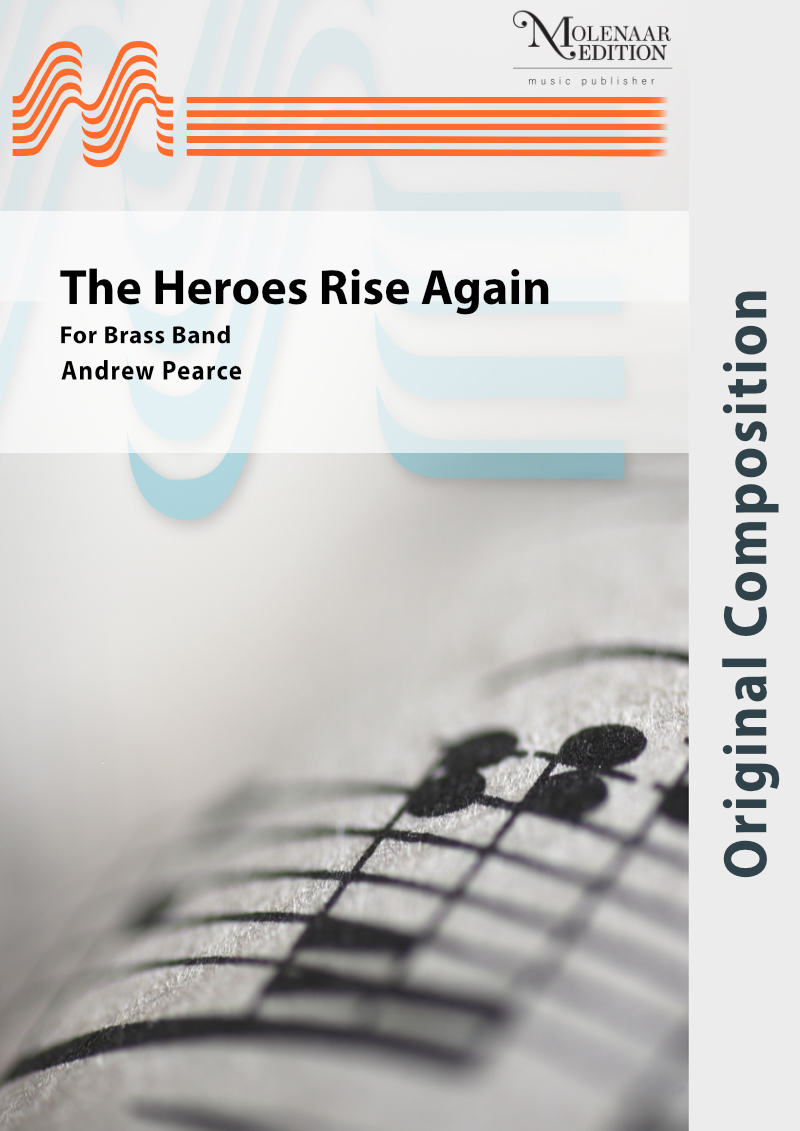
The Heroes Rise Again - Andrew Pearce
As the title suggests, the piece is heroic and olympic in feel. One might imagine an Olympic Games opening ceremony where the athletes assemble to compete on the world stage. The Heroes Rise Again is an exciting and memorable piece that your band will love performing and is sure to give a tingle down the spine, leaving your audience wishing for more as they whistle the tune out the door!
Estimated dispatch 10-14 working days
-
 £25.00
Canzona XIII
DescriptionCanzona XIII, also known as Canzon Septimi Octavi Toni a 12, was first published in 1597 as part of a collection entitled 'Symphoniae Sacrae' - this collection was a mixture of instrumental and choral pieces, and also included the famous Sonata Pian'e Forte, probably his best known work.Gabrieli was born in Venice sometime between 1554 and 1557 and studied with the renowned Dutch composer Orlando di Lassus. He also studied with his uncle, Andrea Gabrieli, and eventually succeeded him as the organist and composer at St Mark's Basilica in Venice. Already renowned as a musical centre, Venice became a magnet for composers wishing to study with Gabrieli after 'Symphoniae Sacrae' was published.Like many of his works, this Canzona was written to take advantage of the unique layout of St Mark's, which had galleries on three sides where the musicians could be placed to create novel spatial effects - utterly new and exciting for sixteenth century listeners. Canzona XIII has three different antiphonal 'choirs' and in this arrangement the band is split into three groups to reflect Gabrieli's innovative idea. Ideally the three groups should be clearly separated so the the antiphonal effect comes across clearly, although this will of course depend on the performance space. On no account should the band remain in its normal seated formation!As Gabrieli didn't have any percussionists (and percussion was widely thought inappropriate for music performed in church anyway) there are no percussion parts in this music.This arrangement was first performed by the Coppull and Standish Band conducted by Andrew Baker in 2009.You can follow a preview of the score while listening to an audio export of the music below!
Estimated dispatch 7-14 working days
-
 £16.00
Sonata Pian'e Forte
DescriptionSonata Pian'e Forte means an instrumental piece using soft and loud dynamics. A "Sonata" (at this time) meant a piece for instruments (as opposed to voices). It was probably written to be played as part of a service at St Mark's, Venice. This is the earliest known piece to specify both the instruments to be played AND the dynamics in the written music.Gabrieli was born in Venice sometime between 1554 and 1557 and studied with the renowned Dutch composer Orlando di Lassus. He also studied with his uncle, Andrea Gabrieli, and eventually succeeded him as the organist and composer at St Mark's Basilica in Venice. Already renowned as a musical centre, Venice became a magnet for composers wishing to study with Gabrieli after 'Symphoniae Sacrae' was published.Like many of his works, Sonata Pian'e Forte was written to take advantage of the unique layout of St Mark's, which had galleries on three sides where the musicians could be placed to create novel spatial effects - utterly new and exciting for sixteenth century listeners. Sonata Pian'e Forte has two different antiphonal 'choirs' and in this arrangement the band is split into two groups to reflect Gabrieli's innovative idea. Ideally the two groups should be clearly separated so the the antiphonal effect comes across clearly, although this will of course depend on the performance space. On no account should the band remain in its normal seated formation!As Gabrieli didn't have any percussionists (and percussion was widely thought inappropriate for music performed in church anyway) there are no percussion parts in this music.This arrangement is available for full brass band or 8-piece brass ensemble andwas first performed by the Blackley Band conducted by Andrew Baker in 2004.Listen to a computer realisation and follow the score in the video below:Duration approximately 4'20".
Estimated dispatch 7-14 working days
-
 £30.00
Finale from Tosca, Act 1 (Te Deum)
DescriptionPuccini's opera Tosca, one of his most successful and popular works is set in 1800 in Rome, as Napoleon's invading army is approaching. There are rebels in Rome who see Napoleon as a liberator from Neapolitan rule and are plotting secretly. One of those is the young firebrand artist Cavaradossi. He and his lover, the beautiful and tempestuous Tosca, are being pursued by the evil chief of the secret police, Scarpia. At the end of Act 1, Scarpia is revelling in his plot to capture Cavaradossi and trick Tosca into sleeping with him to buy her lover's freedom, all inside a church in Rome while a Te Deum service is being sung; in the background the bells are tolling and we hear distant cannonfire from the approaching army.In this arrangement the part of Scarpia is played mostly by the solo trombone. There is an optional organ part, although all of the organ part is covered in the band parts.This arrangement was first performed by the Harrogate Band conducted by Andrew Baker in 2022. Watch a video preview of the score below!
Estimated dispatch 7-14 working days
-
 £16.00
Coventry Carol
DescriptionCoventry Carol is a traditional English Christmas carol dating back to at least the sixteenth century, where it formed part of the Pageant of the Shearmen and Tailors, one of the Coventry mystery plays. The plays themselves date back to at least 1392, but the earliest surviving record of the music is in a manuscript writen in 1534. Religious suppression put a stop to the plays by the end of the sixteenth century, but the manuscript recording the Coventry Carol survived and was published in 1817 as part of a revival of interest in the medieval and renaissance periods. The carol refers to the 'Massacre of the Innocents' from chapter two of the Gospel of Matthew, in which Herod orders the massacre of all Hebrew children under the age of two.This arrangement was first performed by the Blackley Band conducted by Andrew Baker in 2004.You can follow the score with and audio preview below: Duration approximately 3'05".Playable by all standards of band.
Estimated dispatch 7-14 working days
-
£67.00
Last Christmas - George Michael - Haakon Esplo
Who does not know the big hit Last Christmas from the pop group Wham! The duo sold 25 million albums between 1982 until they dissolved in 1986.The front figure, vocalist George Michael and guitarist/singer Andrew Ridgeley is also known for hits such as Club Tropicana and Wake Me Up Before You Go-Go which was their first song to reache the top on both the UK and US hitlists.Last Christmas is a natural choice for the next Christmas concert. And the audience will definitely sing along....
Estimated dispatch 7-14 working days
-
£34.95
DELIBERATE (Brass Band Set) - Andrew Mackereth
So that there is no doubt about the correct pronunciation, the title of this festival (concert) march means 'to think about'! It was written in 2010 for the Belfast Temple Music School and recalls a particularly impressive open-air meeting from the previous year's school. The main theme heard is 'Onward, Christian soldiers' while there is also reference to 'A mighty fortress is our God'.
Estimated dispatch 7-14 working days
-
£44.95
DEUS INVICTUS - GOD UNCONQUERED (Brass Band Set) - Andrew Mackereth
Deus Invictus draws its inspiration from well-known words from Romans 8: 38-39; 'For I am convinced that neither death nor life, neither angels nor demons, neither the present nor the future, nor any owers, neither height nor depth, nor anything else in all creation, can separate us from the love of God'. The music reflects the confidence and certainty of the scripture text while, as in everyday life, trials and tests come along which are reflected in a sequence of musical skirmishes. The work introduces the 19th century hymn 'St Albinus' to a wider audience and also includes references to the tunes 'St Margaret' and 'Rachie'. A setting of the Easter Hymn, 'Christ the Lord is risen today!', is heard followed by a final reprise of 'St Albinus'.
Estimated dispatch 7-14 working days
-
£44.95
TRAILBLAZERS (Brass Band Set) - Andrew Mackereth
This overture draws its inspiration from the story of the first Household Troops Band. It tells the story of the 1887 band, the subsequent lull of nearly a hundred years and the re-awakening of the Troops phenomenon in 1985. It was originally written in 1995 and featured prominently by the band on its North American tour of 2002. Given the history of the Household Troops Band, it is fitting that this composition is preoccupied with marching. It begins with a marching song played by a solitary muted cornet, symbolic not only of the call to bandsmen to join the evangelical effort but also a muso-dramatic device to indicate the steady increase in members and technical ability! The music quickly develops into stirring versions of 'A robe of white' and 'Storm the forts of darkness' with two early day Salvation Army tunes crucially adding to the narrative; 'Marching on in the light of God' and 'Soldiers of our God, arise!' The second section is a reflective setting of the Herbert Booth song, 'The penitent's plea'. This song serves to represent the many people who were 'saved' during those early day campaigns. The expressive music transports the listener through a period of uncertainty and angst until finally reaching the song, 'There is a message, a simple message, and it's a message for us all'. The final section deals first with the emergence from the annals of history with the muted cornet figure again before, symbolically, the present day band bursts forth with an emphatic statement of 'Would you be free from your burden of sin? There's power in the blood'. The stirring climax represents a fitting tribute to those gallant pioneering musicians and their equally impressive and dedicated contemporaries.
Estimated dispatch 7-14 working days
-
£44.95
CAVATINE FOR TROMBONE (Brass Band Set) - Saint-Saens - Andrew Blyth
Cavatine was originally written for trombone and piano in 1915 quickly becoming part of the standard repertoire for this combination. This transcription for trombone and brass band seeks to capture the spirit and style of the original.
Estimated dispatch 7-14 working days
 View Music