
Results
-
 £39.99
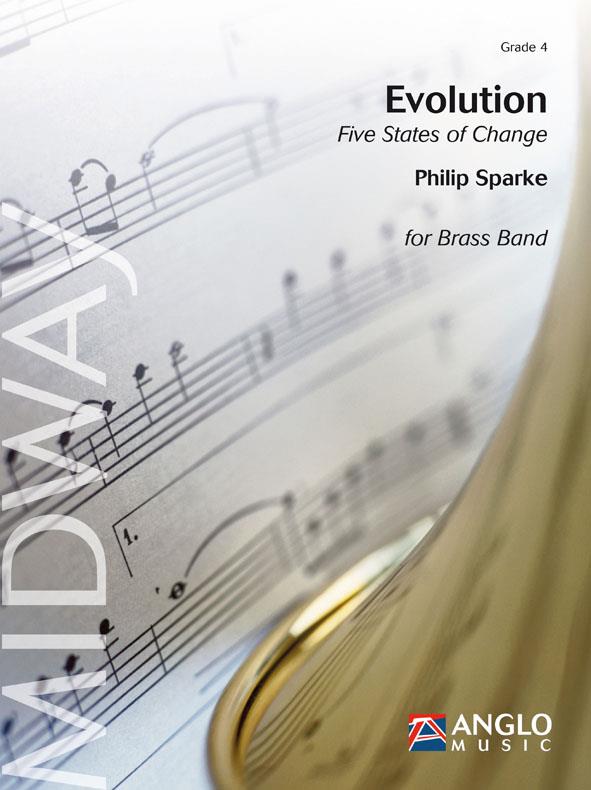
Evolution (Five States of Change) (Brass Band - Score only) - Sparke, Philip
Evolution was commissioned by Kunstfactor for the 4th section of the Dutch National Brass Band Championships (NBK) 2011. It is dedicated to Jappie Dijkstra and the Music Information Centre (MUI), Arnhem, Holland, in acknowledgement of their outstanding work in developing brass band repertoire.The composer writes:The idea for the piece came when I was reading an article about a branch of Chinese philosophy which is abbreviated as Wu Xing, which has no exact translation but can mean, for example, five elements, five phases or five states of change. It is central to all elements of Chinese thought, including science, philosophy, medicine and astrology, and in simple terms tries to create various cyclic relationships between five elements in all walks of life. An example is: Earth - Metal - Water - Wood - Fire - (Earth) etc. where (in one cycle) earth bears metal, metal changes to liquid (water) when heated, water helps trees grow, wood burns to create fire, fire produces ash (earth) and the cycle continues. I was particularly interested in the cycle of emotions: Meditation - Sorrow - Fear - Anger - Joy - (Meditation) etc. and thought this cyclic principle would provide an effective emotional journey for a piece of music. So Evolution has five equal sections which loosely characterise this emotional cycle. I have tried to make the music grow organically, with minimal repetition, and each movement evolves from the musical elements at the end of the previous one, with the opening material appearing, transformed, at the end of the piece to complete the cycle.- Philip SparkeDuration: 11:15
Estimated dispatch 7-14 working days
-
£106.99
Evolution (Five States of Change) (Brass Band - Score and Parts) - Sparke, Philip
Evolution was commissioned by Kunstfactor for the 4th section of the Dutch National Brass Band Championships (NBK) 2011. It is dedicated to Jappie Dijkstra and the Music Information Centre (MUI), Arnhem, Holland, in acknowledgement of their outstanding work in developing brass band repertoire.The composer writes:The idea for the piece came when I was reading an article about a branch of Chinese philosophy which is abbreviated as Wu Xing, which has no exact translation but can mean, for example, five elements, five phases or five states of change. It is central to all elements of Chinese thought, including science, philosophy, medicine and astrology, and in simple terms tries to create various cyclic relationships between five elements in all walks of life. An example is: Earth - Metal - Water - Wood - Fire - (Earth) etc. where (in one cycle) earth bears metal, metal changes to liquid (water) when heated, water helps trees grow, wood burns to create fire, fire produces ash (earth) and the cycle continues. I was particularly interested in the cycle of emotions: Meditation - Sorrow - Fear - Anger - Joy - (Meditation) etc. and thought this cyclic principle would provide an effective emotional journey for a piece of music. So Evolution has five equal sections which loosely characterise this emotional cycle. I have tried to make the music grow organically, with minimal repetition, and each movement evolves from the musical elements at the end of the previous one, with the opening material appearing, transformed, at the end of the piece to complete the cycle.- Philip SparkeDuration: 11:15
Estimated dispatch 7-14 working days
-
 £30.00
Accolade (Brass Band - Score and Parts) - Littlemore, Phillip
Accolade, meaning an award, an honour or a laudatory notice. This fanfare for brass band literally builds from the bottom up - a battery of percussion leads to the lower band's statement of the theme before passing through the middle of the band that builds a series of interjections. The theme is then restated in the upper band before the battery of percussion returns to end. The fanfare was written for Regent Brass as the title track for their 1990 recording to celebrate both their 5th anniversary and to celebrate being crowned 3rd Section Champion Band of Great Britain in 1988 - an accolade indeed!?Duration: 1:00
Estimated dispatch 7-14 working days
-
 £89.95
TRUMPETS OF THE ANGELS - 2016 Edition (Gregson) (Brass Band - Score and Parts) - Gregson, Edward
The Trumpets of the Angels is a large-scale work, scored for seven solo trumpets (or cornets), brass band and percussion (deploying 'dark' instruments such as three tam-tams, bass drum and two sets of timpani). The genesis of the work is a quotation from the Book of Revelation ... and I saw the seven angels which stood before God; and to them were given seven trumpets.Thus the idea behind the work is highly dramatic and I have tried to achieve this by the spatial deployment of seven solo trumpets around the band. Trumpet 7 remains separate from the band throughout and, indeed, has the most dramatic and extended cadenza, representing the words of the seventh angel ... and time shall be no more.The work opens with a four-note motif announced by off-stage horns and baritones and answered by fanfare figures on four solo trumpets. In turn, each then play cadenzas before joining together, independently playing their own music. This leads to a sung Kyrie Eleison with accompanying solos for Flugel Horn and Baritone, after which we hear the entry of solo trumpets 5 and 6 with music that is more urgent and rhythmic, describing the Horsemen of the Apocalypse.The music reaches another climax, more intense this time, with the horns and baritones (now on-stage) again sounding the transformed motif, before subsiding into what might be described as a lament of humanity - slow, yearning music, which builds from low to high, from soft to loud, with a melody that is both simple and poignant. At its climax, Trumpet 7 makes a dramatic entry, playing the opening four-note motif, but expanded to almost three octaves. This cadenza (to the partial accompaniment of 3 tam-tams, representing the Holy Trinity) introduces new material and foreshadows the ensuing Scherzo, introduced by antiphonal timpani before the band enters with music that is fast and foreboding. Despite the somewhat desolate and 'unstable' mood of this music, it slowly moves towards an optimistic conclusion, transforming the 'humanity' music into an affirmative and triumphant statement.The original version of The Trumpets of the Angels was commissioned by the Fodens Band for their centenary concert at The Bridgewater Hall, Manchester, in 2000, and contained an important part for organ. In 2015 I was asked by Nicholas Childs to create a New Performing Edition for the Black Dyke Band; without organ, and including newly composed material. This New Performing Edition was given its first performance at the European Brass Band Festival in Lille in April 2016. The work is dedicated In tribute to Olivier Messiaen.- Edward Gregson
Estimated dispatch 7-14 working days
-
£44.95
TRUMPETS OF THE ANGELS - 2016 Edition (Gregson) (Brass Band - Score only) - Gregson, Edward
The Trumpets of the Angels is a large-scale work, scored for seven solo trumpets (or cornets), brass band and percussion (deploying 'dark' instruments such as three tam-tams, bass drum and two sets of timpani). The genesis of the work is a quotation from the Book of Revelation ... and I saw the seven angels which stood before God; and to them were given seven trumpets.Thus the idea behind the work is highly dramatic and I have tried to achieve this by the spatial deployment of seven solo trumpets around the band. Trumpet 7 remains separate from the band throughout and, indeed, has the most dramatic and extended cadenza, representing the words of the seventh angel ... and time shall be no more.The work opens with a four-note motif announced by off-stage horns and baritones and answered by fanfare figures on four solo trumpets. In turn, each then play cadenzas before joining together, independently playing their own music. This leads to a sung Kyrie Eleison with accompanying solos for Flugel Horn and Baritone, after which we hear the entry of solo trumpets 5 and 6 with music that is more urgent and rhythmic, describing the Horsemen of the Apocalypse.The music reaches another climax, more intense this time, with the horns and baritones (now on-stage) again sounding the transformed motif, before subsiding into what might be described as a lament of humanity - slow, yearning music, which builds from low to high, from soft to loud, with a melody that is both simple and poignant. At its climax, Trumpet 7 makes a dramatic entry, playing the opening four-note motif, but expanded to almost three octaves. This cadenza (to the partial accompaniment of 3 tam-tams, representing the Holy Trinity) introduces new material and foreshadows the ensuing Scherzo, introduced by antiphonal timpani before the band enters with music that is fast and foreboding. Despite the somewhat desolate and 'unstable' mood of this music, it slowly moves towards an optimistic conclusion, transforming the 'humanity' music into an affirmative and triumphant statement.The original version of The Trumpets of the Angels was commissioned by the Fodens Band for their centenary concert at The Bridgewater Hall, Manchester, in 2000, and contained an important part for organ. In 2015 I was asked by Nicholas Childs to create a New Performing Edition for the Black Dyke Band; without organ, and including newly composed material. This New Performing Edition was given its first performance at the European Brass Band Festival in Lille in April 2016. The work is dedicated In tribute to Olivier Messiaen.- Edward Gregson
Estimated dispatch 7-14 working days
-
 £79.95
The Plantagenets (Brass Band - Score and Parts) - Gregson, Edward
A Symphonic Study for Brass BandThe Plantagenets was Gregson's first major test piece, written specially for the 1973 National Brass Band Championships.In this ambitious symphonic study he turned his attention to music which sets out to create a mood or atmosphere, in contrast to his earlier brass band works such as Essay and Partita where the underlying concerns are technical rather than expressive. However, Gregson is at pains to emphasise that The Plantagenets is not programme music. 'Symphonic' is the optimum word here. In its textural and harmonic complexity, its rhythmic and melodic variety, this was his most ambitious brass band piece so far. His language, with its roots in Hindemith and Bartok is further enriched here with the expressive language of Holst and Rachmaninov.As he says in his notes on the work: The Plantagenets attempts to portray the mood and feelings of an age - that of the House of Plantagenet which lasted from the middle of the twelfth century to the end of the fourteenth. To many it conjures up an age of chivalry and this is represented by fanfare motifs which occur throughout the work in varied form.Characteristically, the composer then goes on to describe not the atmosphere or mood he is trying to convey, but the means by which the music has been composed: the opening fanfares, based on the interval of the third, generating the musical material for the whole work; an exposition of two themes - one fanfare-like, one lyrical (on horns); a slow episode introducing a new melody on solo horn (answered by cornet and euphonium in canon); a little scherzo, fugal in character; and a recapitulation leading to a maestoso statement of the slow movement theme with a final reference to the fanfares as a triumphant conclusion.Duration: 11.30
Estimated dispatch 7-14 working days
-
£39.95
The Plantagenets (Brass Band - Score only) - Gregson, Edward
A Symphonic Study for Brass BandThe Plantagenets was Gregson's first major test piece, written specially for the 1973 National Brass Band Championships.In this ambitious symphonic study he turned his attention to music which sets out to create a mood or atmosphere, in contrast to his earlier brass band works such as Essay and Partita where the underlying concerns are technical rather than expressive. However, Gregson is at pains to emphasise that The Plantagenets is not programme music. 'Symphonic' is the optimum word here. In its textural and harmonic complexity, its rhythmic and melodic variety, this was his most ambitious brass band piece so far. His language, with its roots in Hindemith and Bartok is further enriched here with the expressive language of Holst and Rachmaninov.As he says in his notes on the work: The Plantagenets attempts to portray the mood and feelings of an age - that of the House of Plantagenet which lasted from the middle of the twelfth century to the end of the fourteenth. To many it conjures up an age of chivalry and this is represented by fanfare motifs which occur throughout the work in varied form.Characteristically, the composer then goes on to describe not the atmosphere or mood he is trying to convey, but the means by which the music has been composed: the opening fanfares, based on the interval of the third, generating the musical material for the whole work; an exposition of two themes - one fanfare-like, one lyrical (on horns); a slow episode introducing a new melody on solo horn (answered by cornet and euphonium in canon); a little scherzo, fugal in character; and a recapitulation leading to a maestoso statement of the slow movement theme with a final reference to the fanfares as a triumphant conclusion.Duration: 11.30
Estimated dispatch 7-14 working days
-
 £34.95
The Mansions of Glory (Brass Band - Score and Parts) - Bates, Jonathan
"A young, talented and tender-hearted actress was passing along the street of a large city. Seeing a pale, sick girl lying upon a couch just within the half-open door of a beautiful dwelling, she entered, with the thought that by her vivacity and pleasant conversation she might cheer the young invalid. The sick girl was a devoted Christian, and her words, her patience, her submission and heaven-lit countenance so demonstrated the spirit of her religion that the actress was led to give some earnest thought to the claims of Christianity, and was thoroughly converted and became a true follower of Christ. She told her father, the leader of a theatre troupe, of her conversion and of her desire to abandon the stage, stating that she could not live a consistent Christian life and follow the life of an actress. Her father was astonished beyond measure and told his daughter that their living would be lost to them and their business ruined if she persisted in her resolution. Loving her father dearly, she was shaken somewhat in her purpose and partially consented to fill the published engagement to be met in a few days. She was the star of the troupe, and a general favourite. Every preparation was made for the play in which she was to appear. The evening came and the father rejoiced that he had won back his daughter and that their living was not to be lost. The hour arrived; a large audience had assembled. The curtain rose and the young actress stepped forward firmly, amid the applause of the multitude. But an unwonted light beamed from her beautiful face. Through Christ she had conquered and, leaving the audience in tears, she retired from the stage, never to appear upon it again. Through her influence her father was converted, and through their united evangelistic labours many were led to God."
Estimated dispatch 7-14 working days
-
£17.50
The Mansions of Glory (Brass Band - Score only) - Bates, Jonathan
"A young, talented and tender-hearted actress was passing along the street of a large city. Seeing a pale, sick girl lying upon a couch just within the half-open door of a beautiful dwelling, she entered, with the thought that by her vivacity and pleasant conversation she might cheer the young invalid. The sick girl was a devoted Christian, and her words, her patience, her submission and heaven-lit countenance so demonstrated the spirit of her religion that the actress was led to give some earnest thought to the claims of Christianity, and was thoroughly converted and became a true follower of Christ. She told her father, the leader of a theatre troupe, of her conversion and of her desire to abandon the stage, stating that she could not live a consistent Christian life and follow the life of an actress. Her father was astonished beyond measure and told his daughter that their living would be lost to them and their business ruined if she persisted in her resolution. Loving her father dearly, she was shaken somewhat in her purpose and partially consented to fill the published engagement to be met in a few days. She was the star of the troupe, and a general favourite. Every preparation was made for the play in which she was to appear. The evening came and the father rejoiced that he had won back his daughter and that their living was not to be lost. The hour arrived; a large audience had assembled. The curtain rose and the young actress stepped forward firmly, amid the applause of the multitude. But an unwonted light beamed from her beautiful face. Through Christ she had conquered and, leaving the audience in tears, she retired from the stage, never to appear upon it again. Through her influence her father was converted, and through their united evangelistic labours many were led to God."
Estimated dispatch 7-14 working days
-
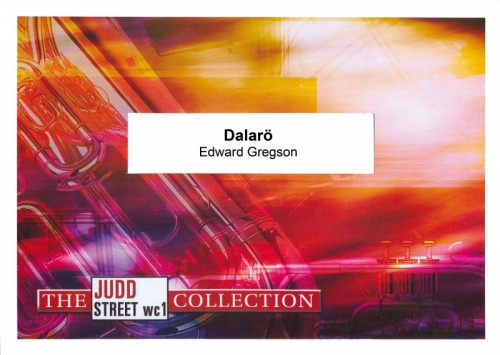 £29.95
Dalaro (Brass Band - Score and Parts) - Gregson, Edward
The name of Edward Gregson is well known in Salvationist circles as well as in the wider music world, his music receiving performances and being recorded and published regularly. This music is individual and of high worth with an assured technique. It is always a pleasurable task for the musician to handle music with these qualities, whether one is editor, conductor or player.Written in connection with the International Salvation Army Students' Fellowship Conference held in Dalaro, Sweden in 1964, this is a 'festival' rather than processional march. Section C is a tune from the Swedish Tune Book (No. 303 in the 1945 edition), Jag gar till det land dar ovan (I go to that Land above). There is a slight divergence from the tune book version (labelled, by the way, as an English tune); this could well be the manner in which the tune is sung - we are all aware of the way in which congregations modify tunes.
Estimated dispatch 7-14 working days
 View Music