
Results
-
 £67.24
Armistice at Flanders Fields (Brass Band) Dwayne Bloomfield
This poignant and powerful work for brass band by Dwayne Bloomfield describes the day peace was announced to end World War I. The piece was written in 2023 to be played by bands around the world to mark Armistice Day. The composer writes: 'Unless you were there, it's impossible to imagine what it must have been like the day peace was announced ending World War I. The feelings soldiers experienced, who after years of fighting and suffering, to know it was over and they would return home to see family and loved ones again. This piece tries to tell their story. The work begins by approaching the front, distant artillery and battle sounds heard while the carnage and loss of lives was already known to the world. The band builds as we enter the thick of battle, the death and destruction, the conditions faced and the loss of hope of ever surviving. The next section, in 7/8 time, reflects the two sides fighting - both sides attacking and defending with mostly little result, but for the loss of more lives. Two euphoniums then depict the news and hope of peace talks. However, fighting did continue right up to the very end and on the last day there would be another 2,738 casualties. The Canadians were still battling to capture the town of Mons that morning. A song is sung in reflection of the estimated 5.5 million allied soldiers who lost their lives during World War I, then a clock ticks down the final minutes. The last three known casualties are depicted with French soldier Augustin Trebuchon, killed at 10:45am by a single shot as he rushed down the trenches to spread the news of coming peace; Canadian George Lawrence Price killed by a sniper round at 10:58am at the battle of Mons, and lastly a machine gun burst that killed American Henry Gunther, who is believed to have fallen on the 11th hour. Bells then toll ringing around the world announcing the end of the war. After years of war, it must have been jubilation for the families at home knowing their loved ones would be returning to them. The band builds with a hymn for peace as a final tribute to those who fought, before the piece resides with one of the most dreaded sounds at that time, the knock on the door from a telegram delivery boy or better known then as the Angels of Death. It wasn't just the 2,738 families from the casualties of the last day who would receive such a knock, but many more who expected their loved ones to be returning home would instead find out they were instead killed in the last weeks. So close. Driving around the battlefields today one comes across many intersections in the countryside which have cemetery signposts pointing in every direction. While the last post sounds in ceremonies today, this last bugle call instead depicts the horrors, devastation and death the soldiers faced during the war and right up the 11th hour of the 11th day of the 11th month, Armistice at Flanders Fields.' To view a video of Dallas Brass Band performing the work please visit https://www.youtube.com/watch?v=ljfyVz3cMgk Duration: Approx. 15.00 minutes Difficulty Level: 2nd Section + PDF download includes parts and score. Sheet music available from www.brassband.co.uk Instrumentation: Soprano Cornet Eb Solo Cornet Bb Repiano Cornet Bb 2nd Cornet Bb 3rd Cornet Bb Flugel Horn Bb Solo Horn Eb 1st Horn Eb 2nd Horn Eb 1st Baritone Bb 2nd Baritone Bb 1st Trombone Bb 2nd Trombone Bb Bass Trombone Euphonium Bb Bass Eb Bass Bb Percussion 1-3
In Stock: Estimated dispatch 1-3 working days
-
£132.00
Myte - Torstein Aagaard-Nilsen
Commissioned by Radoy Brass for their 20 years anniversary.This version was first performed by Manger Skulemusikklag in 2005.The Work is devided into Five Scenes:1. Sverdet (The Sword) 3:452. Advarsel - fra en vis mann (Warning - from a Wise Man) 2:303. Dragen (The Dragon) 3:004. Advarsel II - fra syngende fugler (Warning II - from singing birds) 1:355. Gull - forbannelsen (Gold - The Curse) 2:50Total durata 13:30This work is based on five scenes from the tale about "Sigurd Favnesbane" (Sigurd the dragonslayer). Moods and atmospheres in the piece represent my way of retelling the old myth.1. The SwordThe dwarf blacksmith Regin is hammering and sharpening the edges of the magical sword Gram. After three attempts the sword is finally sharp enough to kill a dragon. 2. Warning - from a Wise manRichard Wagners opera Sigfried is based on the same story. In the opera the hero get warned by a wise man. He tells the secret of how to survive an attack of the dragon by hiding in a hole in the pathway and then kill the dragon with the sword as the dragon passes on its way to the river to drink water.3. DragonThe Dragon (Favne) guards a fantastic treasure, but he is also the brother of the blacksmith Regin. Favne get killed and his blood flows slowly while he laments (trombone/bass trombone).4. Warning II - from singing birdsWhile frying the heart, Sigurd burns his thumb and put it into his mouth to cool it down. Then he swallow a drop of fresh magic dragon blood which transfers the ability to understand the birdlanguage. The birds sing warnings to Sigurd telling him that Regin will betray him and later kill him. Sigurd then kills Regin instead.5. Gold - the CurseSigurd takes the gold treasure and escapes on the horseback of Grane. But his robbery of the gold lead him into trouble: The gold is banned and a curse will hit everyone whotakes it...Myth is a programmatic work where the story is quite clearly illustrated throughout the piece:In the first movement you can hear the blacksmith working with hammer on ambolt while the heat is intense from the glows. The dwarf has got his own theme i lower brass (bar 4-5). The hero Sigurd has his own identifying chord (2 bars before F). The chord is also a symbol of the sword.In the second movement the warning from the wise man is expressed in the lyric bass line.The airblow in instruments illustrate the dragon Favne on his way out of his cave, and later the blood flows slowly. The dragon takes his last deep breath after a painful duet in trombones. The birds sing their motifs (lightly, but not cheerful though), until Sigurd cuts the head off Regin and it hits the ground.The last movement describes the atmosphere andstate of mind as the curse infects the obsessed thief.
Estimated dispatch 7-14 working days
-
 £95.00
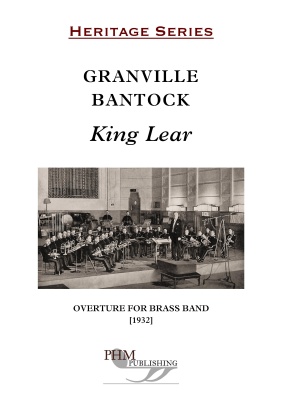
King Lear (Brass Band - Score and Parts)
Sir Granville Bantock (1868 - 1946) composed the second of his five major brass band work for Callender's Cableworks Band, completing the commission on 30 November 1932. Based in the Thames-side district of Belvedere near Erith, the band was active between 1898 and 1961. The works band of the Callender Cable & Construction Co. Ltd, it was at the peak of its popularity during the 1930s and was a frequent broadcaster on the radio. The band employed an in-house arranger and played saxophones in its lighter material. King Lear was one of the band's major commissions and was not published in Bantock's lifetime. The manuscript score and parts were thought to be lost for decades, but were found in the library of the Haydock Band (Lancashire), which had inherited part of Callender's library of manuscripts material and bespoke arrangements after it has been transferred to nearby Prescott Cables Band after Callender's Cable Works closed.King Lear is a substantial work, in essence a dramatic tone poem in the romantic Tchaikovskian manner, presenting a series of character portraits of the foolish old king and his three daughters, Goneril, Regan and Cordelia. The music is dramatic and lyrical by turns, with the most generous lyrical episode revealing perhaps the warm-hearted Cordelia. An expansive melody that flows from this is brought back towards the end as the main climax of the work.In 2001, Bantock's score was recorded by the University of Salford Brass Band, conducted by Dr. Roy Newsome. The original is serviceable, but in comparison with the orchestral version he made in 1936 (part of which was recorded on a Paxton 78 rpm) and later brass band scores, performing editions of which were prepared by others, it lacks colour and range typical of Bantock's orchestral work. Above all it lacks percussion, which can be heard on the recorded extract. With the kind permission of the Bantock Estate, I have prepared a performing edition for publication that incorporates percussion, derived from the orchestral recording and added editorially in similar manner elsewhere. I have revoiced some of the low- lying instrumental parts to present the material in more comfortable ranges. Editorial interventions more elaborate than revoicing the original text have been identified as cue notes.- Paul HindmarshDuration: 15.00
Estimated dispatch 7-14 working days
-
£40.00
King Lear (Brass Band - Score only)
Sir Granville Bantock (1868 - 1946) composed the second of his five major brass band work for Callender's Cableworks Band, completing the commission on 30 November 1932. Based in the Thames-side district of Belvedere near Erith, the band was active between 1898 and 1961. The works band of the Callender Cable & Construction Co. Ltd, it was at the peak of its popularity during the 1930s and was a frequent broadcaster on the radio. The band employed an in-house arranger and played saxophones in its lighter material. King Lear was one of the band's major commissions and was not published in Bantock's lifetime. The manuscript score and parts were thought to be lost for decades, but were found in the library of the Haydock Band (Lancashire), which had inherited part of Callender's library of manuscripts material and bespoke arrangements after it has been transferred to nearby Prescott Cables Band after Callender's Cable Works closed.King Lear is a substantial work, in essence a dramatic tone poem in the romantic Tchaikovskian manner, presenting a series of character portraits of the foolish old king and his three daughters, Goneril, Regan and Cordelia. The music is dramatic and lyrical by turns, with the most generous lyrical episode revealing perhaps the warm-hearted Cordelia. An expansive melody that flows from this is brought back towards the end as the main climax of the work.In 2001, Bantock's score was recorded by the University of Salford Brass Band, conducted by Dr. Roy Newsome. The original is serviceable, but in comparison with the orchestral version he made in 1936 (part of which was recorded on a Paxton 78 rpm) and later brass band scores, performing editions of which were prepared by others, it lacks colour and range typical of Bantock's orchestral work. Above all it lacks percussion, which can be heard on the recorded extract. With the kind permission of the Bantock Estate, I have prepared a performing edition for publication that incorporates percussion, derived from the orchestral recording and added editorially in similar manner elsewhere. I have revoiced some of the low- lying instrumental parts to present the material in more comfortable ranges. Editorial interventions more elaborate than revoicing the original text have been identified as cue notes.- Paul HindmarshDuration: 15.00
Estimated dispatch 7-14 working days
-
 £64.99
Oregon (Brass Band - Score and Parts)
This fantasy tells the story of Oregon, one of America's north-western states. Traveling by train on the Northern Pacific Railroad, the listener is taken through the fascinating Oregon landscape. Indians, cowboys, golddiggers and hooded wagons will file past on this adventurous journey. The piece has some similarities with a soundtrack of a movie. Various melodies, which could be the main themes of a movie, pass the review.The piece begins in a slow movement, introducing the first theme in minor. Then we hear in the following fast movement the trombones imitate the train, whistling the steam-flute. We hear the characteristic minor theme again, but now in different variants (also in major). The rhythmic structure of "western" stile and rock succeed each other. This is leading to the slow movement, where the signals of horns and trumpets introduce a wonderful vocal melody. After this characteristic melody, the fast movement appears shortly again, the trombones whistling the steam-flute again (now in major). We hear also some musical elements, that plays a part in the following Presto. Barchanges, jazzy chords, interesting rhythmic patterns (with bongo) and an original theme are the characteristics of this Presto. After this, the horns announce the last section of the piece. Interesting is the fact that we hear in this Allegro section a variant of the vocal melody in the slow movement. Also the Presto theme returns shortly, followed by the Allargando, which is a grand characteristic end of a soundtrack. The movie of our travelling fantasy has come to an end.Duration: 9:10
Estimated dispatch 7-14 working days
-
 £33.62
Gobsmacked! (Brass Band) Robbert Vos
VIEW SCORE PDF Gobsmacked was commissioned by Ravnanger Brass Band (Norway). The composer Robbert Vos writes: 'Gobsmacked is composed as an opening or encore piece which, as the title already reveals, is meant to surprise or overwhelm the audience! After a brief opening fanfare, the main theme is introduced by the solo cornet and euphonium. An accelerando leads to a quick movement, where this main theme is transformed into a con brio. In this section there's a lot of energy to be unleashed and every band member plays a roll in creating that. Throughout the piece there are many surprises, for example some unexpected time changes, percussion effects to wake you and some trombone glissandi to make you smile. After a short and atmospheric reminiscence by the flugel to the solos from the beginning of the piece, there comes a brief percussion interruption which leads to a reprise of the con brio, but this time in slightly different form. This all comes together in the finale where a big accelerando will lead to an exciting close.' Sheet music available from: UK - www.brassband.co.uk USA - www.solidbrassmusic.com Difficulty Level: 1st Section + Instrumentation: Soprano Cornet Eb Solo Cornet Bb Repiano Cornet Bb 2nd Cornet Bb 3rd Cornet Bb Flugel Horn Bb Solo Horn Eb 1st Horn Eb 2nd Horn Eb 1st Baritone Bb 2nd Baritone Bb 1st Trombone Bb 2nd Trombone Bb Bass Trombone Euphonium Bb Bass Eb Bass Bb Timpani Percussion 1-4
In Stock: Estimated dispatch 1-3 working days
-
.png) £34.95
£34.95Casper's Lament (for Brass Band) - Jonathan Bates
'Casper's Lament' was composed for the Foden's Band's appearance at the 2021 Brass in Concert Championships held at The Sage, gateshead. The music is inspired by the lesser known side to 'Casper the Friendly Ghost'; a "good ghost" who much to the annoyance of his uncles chooses to help people rather than scare them. Despite the uplifting and joyful narrative to the 'Casper' stories, there is a much more tragic back story of how he come to be. Casper's mother passed away during his birth leaving him to be raised solely by his extremely devoted father until the age of 12 when having begged his father for a sled to play in the snow Casper contracted pneumonia from playing out in the cold for too long and passed away shortly after. Throughout Casper's childhood years, the pair were inseparable. So much so, that after his tragically young death, Casper simply could not leave his father to be alone in the mortal world and as a result he stuck around as the ghost we love come to know and love through the many books, series and films over the years. . .
In Stock: Estimated dispatch 1-3 working days
-
 £30.00
Apres un Reve - Euphonium & Brass Band Sheet Music Full Score & Parts - LM563
COMPOSER: Gabriel FaureARRANGER: Stuart J. RogersTrois melodiesis a set ofmelodiesfor solo voice and piano, byGabriel Faure.It consists of "Apres un reve" (Op. 7, No. 1), one of Faure's most popular vocal pieces,"Hymne" (Op. 7, No. 2), and "Barcarolle" (Op. 7, No. 3).The songs were written between 1870 and 1877, and published in 1878.They were not, however, originally conceived together as a set of three;theopus number7 was imposed on them retrospectively in the 1890s,almost 20 years after their first publications.In "Apres un Reve" (After a Dream),a dream of romantic flight with a lover,away from the earth and "towards the light", is described.However, upon awakening,the dreamer longs to return to the "mysterious night"and the ecstatic falsehood of his dream.LM563 - ISMN : 9790570005635
In Stock: Estimated dispatch 3-5 working days
-
 £32.00
Barcelona - Vocal Duet or Cornet & Euphonium - Brass Band Sheet Music Full Score & Parts - LMAM054
COMPOSER: Mike Moran & Freddie MercuryARRANGER: David Beal"Barcelona" is a single released by Queen vocalist Freddie Mercury and operatic soprano Montserrat Caballe. A part of their collaborative album Barcelona, it also appeared on Queen's Greatest Hits III. The song reflects Mercury's love of opera with his high notes and Caballe's operatic vocals, backed by a full orchestra. Originally released in 1987, it was one of the biggest hits of Mercury's solo career, reaching number eight in the UK singles chart. After Mercury's death in 1991, it was featured at the 1992 Summer Olympics. The single was re-issued on 20 July 1992, after which the track climbed even higher, peaking at number two in the UK, the Netherlands and New Zealand. In 2004, BBC Radio 2 listed Barcelona at number 41 in its Sold On Song Top 100.Scored here for British Brass Band.
In Stock: Estimated dispatch 3-5 working days
-
£67.00
Det vakreste som fins - Teigen-Lovland-Borochstein - Haakon Esplo
The most beautiful thing is one of Jahn Teigens most popular pop ballads.It was written in 1988 together with Rolf Lovland and Ove Borochstein and went straight to the top of the Norwegian hitlists. Even 20 years after its release, in 2008, it reached the hitlists after Teigen performed it during the Eurovision Song Contest. The song is often played on Norwegian radio and was the 70th most played in the period 1993-2013 on the radio channel P4.Now it's finally arranged for band in the popular Young Band series with adaptation of key that fit young musicians. It will definitely be a popular number in your next concert.
Estimated dispatch 7-14 working days
 Watch video
