
Results
-
 £34.95
Behold the Power of God - Christopher Bond
Behold the Power of God (2010) was written for and premiered by the Cornwall Youth Brass Band in dedication to their Musical Advisor at the time; the late Cornish composer Goff Richards who later described the work as 'a remarkable piece of writing'. The work's title, while implying a religious meaning, actually references Goff's name, with his full name Godfrey translating as 'God-peace' and Richards meaning 'Power'. Two energetic outer sections fall either side of a more lyrical middle section featuring the solo cornet. The perfect opening item at any concert.
Estimated dispatch 10-14 working days
-
 £34.95
Elixir of Youth - Christopher Bond
Elixir of Youth (2013) was written for the 2013 Brass for Heroes charity event where it was premiered on 19th October 2013 at St Paul's Hall in Huddersfield under the baton of Philip Harper. The title of the work reflects the nature of the band that was put together for that premiere performance; an all-star youth band comprising a selection of the country's young brass banding talent, with the term Elixir referring here to the everlasting talent seen in young brass players throughout the United Kingdom's brass bands and bands' and teachers abilities to keep producing such high quality musicians for the banding movement.The work, structured in three sections, is a showcase for band with a heroic opening where fanfare-like gestures in the cornets and trombones juxtapose rapid euphonium and baritone runs, alongside sweeping horns and percussion effects. As the piece progresses, a grove is introduced - just in the tubas at first, accompanied by a hi-hat - before spreading through the band, definitely stuff to tap your toes to! The middle, slower section of the work sees both flugel and cornet solos, with additional inputs from the euphonium and solo horn before a climax and return to the tempo and music of the opening section. A rousing close concludes the work where all of the work's themes are interweaved to create a sense of power, unity and grandeur; an Elixir of Youth.
Estimated dispatch 10-14 working days
-
 £24.95
Lest We Forget - Christopher Bond
Lest We Forget is a phrase added as a final line at the end of the Ode of Remembrance, taken from Laurence Binyon's poem For the Fallen, first published in The Times newspaper in September 1914. Providing the title for this work for brass band, the piece aims to combine both the acoustic nature of the brass band medium alongside narrated passages and pre-recorded extracts to provide a moving tribute. The words originally spoken by Prime Minister Herbert Asquith in 1914 can be narrated in performance. However, a free audio download, manipulated to sound like a 1914 radio broadcast is available from Prima Vista. Lest We Forget received its premiere at The Sage, Gateshead, on November 17th 2014, performed by the Grimethorpe Colliery Band, conducted by Robert Childs. The work opened their winning Brass in Concert programme, and has since been performed by bands all over the world as a fitting tribute to the Great War.
Estimated dispatch 10-14 working days
-
 £79.95
Lost Village of Imber, The - Christopher Bond
The village of Imber on Salisbury Plain had been inhabited for over one thousand years when it was evacuated in 1943 to make way for military training in the Second World War. At the time, with preparations for the Allied invasion of Europe underway, most villagers put up no resistance, despite being upset, with the belief that they'd return once the war had concluded. To this day, Imber and its surrounding land remain a military training ground. The villagers never returned, and just the shell of what was once a community remains. Structured in three movements, it is on this very real story that the work is based, setting out the series of events of 1943 in chronological order. The first movement, On Imber Downe, portrays a sense of jollity and cohesiveness - a community of individuals living and working together before news of the evacuation had broken. Sounds of the village are heard throughout, not least in a series of percussive effects - the anvil of the blacksmith; the cowbell of the cattle and the bells of the church. The second movement, The Church of St. Giles, begins mysteriously and this sonorous, atmospheric opening depicts Imber in its desolate state and the apprehension of residents as they learn they have to leave their homes. Amidst this is the Church, a symbol of hope for villagers who one day wish to return, portrayed with a sweeping melodic passage before the music returns to the apprehension of villagers facing eviction around their sadness at losing their rural way of life. In complete contrast, the third movement, Imemerie Aeternum, portrays the arrival of the military, complete with the sounds of the ammunition, firing and tanks - sounds which were all too familiar to those living in the surround areas. To close, the Church of St. Giles theme returns in a triumphant style, representing the idea that the church has always been, even to this day, a beacon of hope for the villagers and local community - both the centrepiece and pinnacle of a very real story. The work was commissioned by Bratton Silver Band in celebration of the band's 160th Anniversary, with funding from the Arts Council National Lottery Project Grants Fund and the Brass Bands England Norman Jones Trust Fund.
Estimated dispatch 10-14 working days
-
 £34.00
Meditation: It is Well With My Soul
ABOUT THIS PIECE: Cantatio are pleased to release this hymn meditation on the much-loved hymn by Adam D J Taylor. Commissioned by the world famous Wingates Band, this arrangement became a centrepiece of the band's online presence during the COVID pandemic. Story time... Horatio Spafford was a successful attorney and real estate investor who lost a fortune in the great Chicago fire of 1871. Around the same time, his beloved four-year-old son died of scarlet fever. Thinking a vacation would do his family some good, he sent his wife and four daughters on a ship to England, planning to join them after he finished some pressing business at home. However, while crossing the Atlantic Ocean, the ship was involved in a terrible collision and sunk. More than 200 people lost their lives, including all four of Horatio Spafford's precious daughters. His wife, Anna, survived the tragedy. Upon arriving in England, she sent a telegram to her husband that began: "Saved alone. What shall I do?" Horatio immediately set sail for England. At one point during his voyage, the captain of the ship, aware of the tragedy that had struck the Spafford family, summoned Horatio to tell him that they were now passing over the spot where the shipwreck had occurred. As Horatio thought about his daughters, words of comfort and hope filled his heart and mind. He wrote them down, and they have since become a well-beloved hymn: When peace like a river, attendeth my way, When sorrows like sea billows roll-- Whatever my lot, thou hast taught me to say It is well, it is well with my soul. ENSEMBLE: Standard British Brass Band WHEN YOU BUY THIS PRODUCT, YOU GET: High-quality printed score and parts LEVEL: 2 - 3 LISTEN: DURATION: c. 7-minutes, 30-seconds EXAMPLE SCORE: Click here LEVEL GUIDE: Level 1- Accessible to all Level 2 - c. UK third section and higher Level 3 - c. UK second section and higher Level 4 - c. UK first section and higher Level 5 - c. UK championship section level
Estimated dispatch 5-7 working days
-
 £30.00
Let All Mortal Flesh Keep Silence
ABOUT THIS PIECE: Let All Mortal Flesh Keep Silence by Edward Bairstow is a setting of the ancient hymn text from the Liturgy of St. James, and embodies a profound sense of reverence and awe. Bairstow, a renowned composer and organist, served as Master of Music at the iconic York Minster, one of the most famous Gothic cathedrals in the world. His tenure at York Minster significantly influenced his compositions, many of which are celebrated for their spiritual depth and grandeur, and that use the incredible acoustic of the cathedral as part of their very structure. This arrangement translates Bairstow's choral masterpiece into a stirring brass setting, maintaining the richness and gravitas that makes it so memorable. Ideal for concerts, services, or ceremonial occasions, the piece provides a powerful and reflective experience for performers and audiences alike. ENSEMBLE: Standard British Brass Band WHEN YOU BUY THIS PRODUCT, YOU GET: High-quality printed score and parts LEVEL: 1 LISTEN: Click here to listen to a computer generated version Watch below a quintet version of this piece: DURATION: 3-minutes 20-secondsEXAMPLE SCORE: Click here LEVEL GUIDE: Level 1- Accessible to all Level 2 - c. UK third section and higher Level 3 - c. UK second section and higher Level 4 - c. UK first section and higher Level 5 - c. UK championship section level
Estimated dispatch 5-7 working days
-
 £57.00
Conspirators Overture by Andrew Duncan
Composer: Andrew Duncan Conspirators Overture was written for Katrina Marzella-Wheeler and the Cooperation Band for their winning programme played at the 2025 Brass in Concert competition at the Glass House in Gateshead England. The piece describes a meeting in a cafe in Paris in 1912 between three very influential Russians. The composer Igor Stravinsky, the dancer Vaslav Nijinsky and the impresario Sergei Diaghilev. Together they conspired about how Stravinsky's new Ballet, Le Sacre du Printemps (The rite of Spring) was going to disrupt what was then a very conservative, classical music scene in Paris. Stravinsky's music would forever change the way harmonies and rhythms are used in classical and jazz music. Starvinsky's full name is Igor Fyodorovich Stravinsky. The piece uses the morse code rhythm for IFS, which is Stravinsky's initials as a pulsating 11/8 rhythm which is the foundation of the overture. The opening notes from the Rite of Spring, played by a solo bassoon, are also quoted in the piece in a jazz waltz setting and in a short fugue towards the end of the piece. Suitable for Championship or First Section Bands.
-
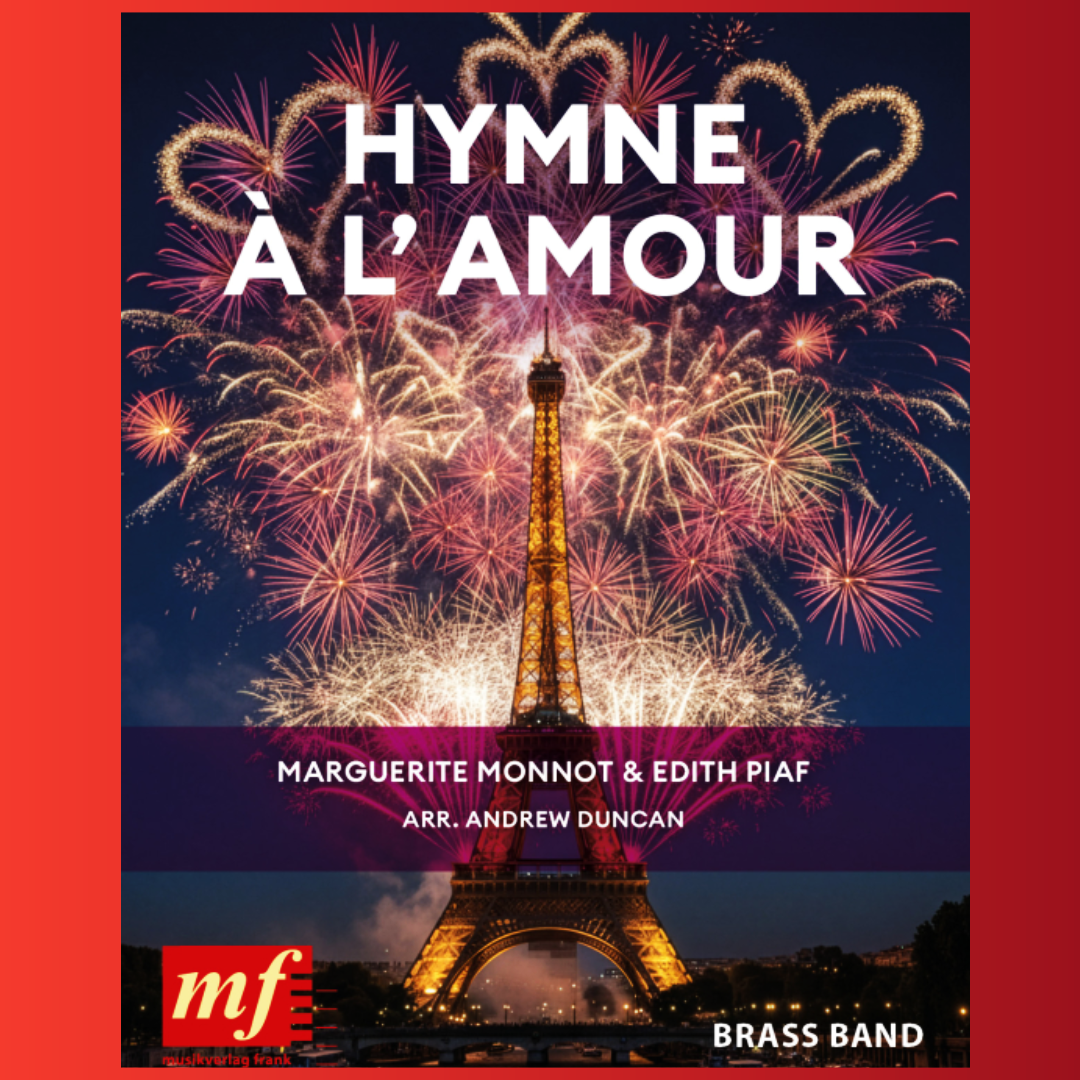 £66.00
Hymne A L' Amour for Brass Band
Title: Hymne A L'Amour Composers: Marguerite Monnot & Edith Piaf Arranger: Andrew Duncan Instrumentation: Brass Band Publisher: Musikverlag Frank Description An arrangement of the beautiful French song Hymne A L'Amour arranged for brass band by Andrew Duncan This arrangement was originally sung by Edith Piaf then Josh Groban and more recently by Celine Dion in a memorable performance on the Eiffel Tower at the 2024 Paris Olympics. The Cooperation Band conducted by Katrina Marzella played this arrangement at Brass in Concert 2025 as the finale of their winning performance and was an audience favourite. It has been much shared on social media and can also be streamed on World Of Brass Play. The arrangement for brass band can be played with and without a marimba. There are alternate parts to the marimba within the band. Versions for Concert Band and Fanfare Band also available. IN STOCK
-
 £35.00
One Small Step. Andrew Duncan
Recommended - Championship & 1st Section One Small Step is a programmatic piece describing the launch, the journey to the moon and the successful landing on the Moon's surface by the crew of the Apollo 11 mission in 1969. Commissioned by The Flowers Band, helping to lead them to their 'Most Entertaining Band' award-winning performance at the 2013 Butlins Mineworkers Brass Band contest, the piece also won the 'Best New Composition' award at the 2013 West Lothian Festival of Brass with its performance by The Co-operative Funeralcare Band. It is an ideal concert feature for entertainment contests opening up opportunities to incorporate multi-media snippets of the associated Presidential speeches and video footage of the historic moments that the piece depicts. Includes Score & Parts
-
 £35.00
Swan Lake (Finale). Tchaikovsky.
Recommended - Championship & 1st Section The Finale from Swan lake is the turbulent and dramatic conclusion to Tchaikovsky's celebrated ballet so as a 'finisher' this music is as exciting as it gets! The music begins at whirlwind speed before giving way to the famous tender love theme, which is skilfully developed before the music builds to a thrilling and exciting conclusion. This arrangement won the prize for the best new arrangement at 'Spennymore' in 1996, played by the Fodens Band. Includes score & Parts