
Results
-
£44.95
TRAILBLAZERS (Brass Band Set) - Andrew Mackereth
This overture draws its inspiration from the story of the first Household Troops Band. It tells the story of the 1887 band, the subsequent lull of nearly a hundred years and the re-awakening of the Troops phenomenon in 1985. It was originally written in 1995 and featured prominently by the band on its North American tour of 2002. Given the history of the Household Troops Band, it is fitting that this composition is preoccupied with marching. It begins with a marching song played by a solitary muted cornet, symbolic not only of the call to bandsmen to join the evangelical effort but also a muso-dramatic device to indicate the steady increase in members and technical ability! The music quickly develops into stirring versions of 'A robe of white' and 'Storm the forts of darkness' with two early day Salvation Army tunes crucially adding to the narrative; 'Marching on in the light of God' and 'Soldiers of our God, arise!' The second section is a reflective setting of the Herbert Booth song, 'The penitent's plea'. This song serves to represent the many people who were 'saved' during those early day campaigns. The expressive music transports the listener through a period of uncertainty and angst until finally reaching the song, 'There is a message, a simple message, and it's a message for us all'. The final section deals first with the emergence from the annals of history with the muted cornet figure again before, symbolically, the present day band bursts forth with an emphatic statement of 'Would you be free from your burden of sin? There's power in the blood'. The stirring climax represents a fitting tribute to those gallant pioneering musicians and their equally impressive and dedicated contemporaries.
Estimated dispatch 7-14 working days
-
 £77.00
General Series Brass Band Journal, Numbers 2234 - 2237, August 2023
2234: Festival March - Above all names (Geoff McCorriston)This Festival March was originally written for the Camberwell Citadel Band, Melbourne, Australia. This composition marks the composers debut within our band journals. Geoff McCorriston served as Deputy Bandmaster at Preston Corps (Australia) for many years before joining the Camberwell Citadel Band. He has also been a member of the Melbourne Red Shield Band. Above all names is distinct from a standard street march in that it is more developed, both rhythmically and thematically. It is an original march that references We plough the fields and scatter (S.A.S.B. 70) and Camberwell (T.B. 182).2235: Flugel Horn Solo - Father, Creator (Simon Gash)Emma Pears has a gift for contemporary song-writing, with several of her songs featuring in the Sing to the Lord publication. The style and relaxed nature of the melody of Father, Creator (first published in the Children's Voices Series in 2011, and later in the Mixed Voices in 2014) seemed a perfect fit for the Flugel Horn. Throughout the piece, juxtaposed with Father, Creator, we hear snippets of the tune St Theodulph (T.B. 231), which outline the first lines of Albert Chesham's words, 'O Father and Creator, Thou God of perfect love' (S.A.S.B. 46).2236: A winter's carol (trs. Neil Smith)The history of the carol O come, Immanuel (C.C. 62) is, like the carol itself, a little mysterious! The melody was conceived as a monastic chant during the 8th century. It was not until 1851 that the priest and hymn writer John Mason Neale translated the verses into English, exposing the carol to a wider audience. There is an aura and enigmatic feel to this melody which is captivating to so many who hear it. This setting was originally conceived for wind band by American composer Mark Williams. The brass band transcription introduces a new name to our journals, Bandmaster Neil Smith, who is the Territorial Music Director for the USA Western Territory.2237: Mighty to keep (Eiliv Herikstad)Mighty to keep marks the composer's first publication since his Promotion to Glory in April 2023. Bandmaster Eiliv Herikstad served faithfully in his native Norway throughout his life, and since the early 1970s, has provided The Salvation Army with a wealth of original compositions and skilful arrangements. Eiliv explored many styles of big-band and jazz writing which, in the 70s, were not commonplace amongst brass bands, particularly in The Salvation Army. Music Editorial are grateful to Eiliv for using his gifts to support Salvation Army music ministry.The subject of this piece is Herbert Booth's song Mighty to keep, which was first published by The Salvation Army in 1889. The chorus of the song is more well-known that the verse and was included in the chorus section of the 1986 Salvation Army Song Book.
Estimated dispatch 7-14 working days
-
 £32.00
Amazing Grace (Brass Band with optional Bagpipes - Score and Parts)
There are several occasions when a brass band is invited to play along with bagpipes and one of the first titles to be mentioned is the American traditional hymn melody, "Amazing Grace". This arrangement was prepared for one such occasion when Brass Band of the Western Reserve, musical director, Dr Keith M Wilkinson, was invited to play at a wedding in 2007. Parts for bagpipes are included in Concert Pitch (as shown in the full score) and in Db, the key in which they are normally pitched.There are optional parts which make the arrangement equally effective without bagpipes. A suggestion when this version is used is to place the cornet soloist at the beginning some distance from the band.
Estimated dispatch 7-14 working days
-
 £7.46
£7.46Adoration (Cornet Solo with Brass Band - Additional Parts) Price arr. Wainwright
Florence Price was an American classical composer, pianist, organist and music teacher. She is noted as the first African-American woman to be recognised as a symphonic composer, and the first to have a composition played by a major orchestra. Price composed over 300 works: four symphonies, four concertos, as well as choral works, art songs, chamber music and music for solo instruments. In 2009, a substantial collection of her works and papers that had been previously considered lost was found in her abandoned summer home. Amongst these was this delightful work, Adoration, which had been composed in the 1950s for organ. According to IMSLP.org, the piece "failed to meet notice or renewal requirements to secure statutory copyright with no 'restoration' under the GATT amendments" and therefore is in the public domain. A version for violin and piano by Elaine Fine has become popular. This setting for cornet soloist with brass band has been arranged by Andrew Wainwright. It is also available as a Bb solo with piano here. The additional parts included in this download are for low brass in bass clef. The full brass band set is available here. To view a video of Andrew Roe performing the work, please visit: www.youtube.com/watch?v=_7UYlz8Fzxo Difficulty Level: 4th Section + Length: 3.15 minutes Sheet music available from: UK - www.brassband.co.uk USA - https://satradecentral.org Included in download: 1st Baritone B.C. 2nd Baritone B.C. 1st Trombone B.C. 2nd Trombone B.C. Euphonium B.C. Tuba B.C. (Eb Bass Part) Tuba B.C. (Bb Bass Part)
In Stock: Estimated dispatch 1-3 working days
-
 £29.88
For Uncommon Valor (Brass Band) Andrew E. Lawson trs. Andrew Wainwright
A rousing fanfare for brass and percussion, this work by Andrew E. Lawson was the winner of the prestigious Dallas Winds Fanfare Competition 2019. Here it is has been transcribed for brass band by Andrew Wainwright. The composer writes: 'In honor of the 1,177 crewman killed among the battleship USS Arizona, For Uncommon Valor is inspired by the story of the brave men, women, and children who witnessed, fought, and endured the tragic events of December 7, 1941 at Pearl Harbor, and across the Hawaiian Island of Oahu. The story of Pearl Harbor, however, does not end with a sunken battleship, or a defeated nation. A mighty nation, 'the sleeping giant', awoke to face the challenge at hand and claim victory for those who could not claim it for themselves. The uncommon valor displayed by the men and women of the Pacific Fleet brought forth the greatest fighting force ever seen and put on display for all to see, the strength and resilience of the American people.' To view a video of Dallas Brass Band performing the work please visit: www.youtube.com/watch?v=hk-skGoNnro Sheet music available from: UK - www.brassband.co.uk USA - www.solidbrassmusic.com Instrumentation: Soprano Cornet Eb Solo Cornet Bb Repiano Cornet Bb 2nd Cornet Bb 3rd Cornet Bb Flugel Horn Bb Solo Horn Eb 1st Horn Eb 2nd Horn Eb 1st Baritone Bb 2nd Baritone Bb 1st Trombone Bb 2nd Trombone Bb Bass Trombone Euphonium Bb Bass Eb Bass Bb Timpani Percussion 1-4
In Stock: Estimated dispatch 1-3 working days
-
 £38.95
Unity Series Band Journal - Numbers 530 - 533, June 2024
530: Carol Arrangement - God rest you merry, gentlemen (Noel Jones)This swing arrangement of the traditional English carol also features references to O come, all ye faithful (C.C. 61) and Jingle Bells (C.C. 121). Play with imagination and a sense of style!531: Go, tell it on the mountain! (Nathanael Watchorn)Historically, the passion of enslaved people in America for singing about the Gospel of Jesus is well documented, but it was men of three generations, each named John Wesley Work, who enabled spirituals to become more widely known. John Wesley Work Sr, a church choir director in Nashville, Tennessee, wrote and arranged music for the pioneering Fisk Jubilee Singers whose early repertoire consisted largely of spirituals. This passion and knowledge of spirituals was passed down through the generations. John Work III travelled hundreds of miles to collect songs by attending church services in remote areas. In 1940, he published a collection of 230 songs which included a setting of Go, tell it on the mountain! that is still performed today.Nathanael Watchorn, a Bandsman at Regent Hall Corps in London, is a new contributor to the journals. He originally wrote this as a vocal arrangement for the group FourHymn, subsequently transcribing it for the corps' Young People's Band, while he was Band Leader.532: Carol Arrangement - They all were looking for a king (Stephen Hull)At the North American Composers Forum, Major Len Ballantine challenged participants to find an unfamiliar song in the Salvation Army Song Book and try to write an arrangement of the listed tune. Stephen Hull happened across They all were looking for a king (S.A.S.B. 128) and the tune Childhood (T.B. 421) which lead to this arrangement.533: March - Washed and healed (Eiliv Herikstad)The Christian experience of many people will have been positively impacted by the life of the late Bandmaster Eiliv Herikstad, either personally or through his musical leadership and compositions. This march is the second publication from this well-known Salvation Army composer since his Promotion to Glory last year. This march is more traditional in style that many of his compositions but contains a strong Christian message and demonstrates his compositional expertise.
Estimated dispatch 7-14 working days
-
 £55.00
Triumph Series Brass Band Journal, Numbers 1359 - 1362, March 2024
1359: Festival March - Coastal Celebration (Sam Creamer)Coastal Celebration was commissioned in 2019 by Nambour Salvation Army Band for the Corps' 125th anniversary celebrations. Nambour was the birthplace of The Salvation Army's work on the Beautiful Sunshine Coast in Queensland, Australia. Firring with this theme are subtle tributes to iconic Sunshine Coast landmarks, referenced with small phrases of popular secular melodies intertwined with the main tunes What a faithful God (S.A.S.B. 378) and All through the years (S.A.S.B. 826).1360: He's always been faithful (Craig Woodland)This meditative selection is an arrangement of the song by American singer and record producer Sara, Groves, He's always been faithful. The words express the joy and thankfulness in having a relationship with Jesus and knowing his presence in life. The melody and motifs of the traditional hymn, Great is thy faithfulness (S.A.S.B. 26), are heard throughout.1361: Christ's living water (Dean Jones)Christ's sacrificial love has been beautifully portrayed through the imagery of water in many songs, none more so that the skilfully crafted words we find in the chorus of I know a fount (S.A.S.B. 197), written by Oliver Cooke. To enhance the sentiments expressed, the pure sounds derived from Handel's Water Music fit perfectly in terms of music and imagery.1362: March - Fear Not! (Avelan Ntsiete)The Salvation Army continues to proclaim its music ministry in all corners of the world and, with this item under review, we introduce a new composer, originally from Congo Brazzaville, Central Africa. Avelan Ntsiete is currently a Bandsman at the Lilas Corps in Paris but has previously served in the Congo Brazzaville Territorial Band. This march, in traditional format, was written for an evangelistic campaign in Kindamba, where civil war has brought upheaval to the area and uncertainty for the local Salvationists. The composer was part of a small brass group which travelled for over 24 hours by truck and on foot to reach Kindamba and bring encouragement to the Salvationists within that community.
Estimated dispatch 7-14 working days
-
£33.62
Adoration (Cornet Solo with Brass Band) Florence Price trs. Andrew Wainwright
Florence Price was an American classical composer, pianist, organist and music teacher. She is noted as the first African-American woman to be recognised as a symphonic composer, and the first to have a composition played by a major orchestra. Price composed over 300 works: four symphonies, four concertos, as well as choral works, art songs, chamber music and music for solo instruments. In 2009, a substantial collection of her works and papers that had been previously considered lost was found in her abandoned summer home. Amongst these was this delightful work, Adoration, which had been composed in the 1950s for organ. According to IMSLP.org, the piece "failed to meet notice or renewal requirements to secure statutory copyright with no 'restoration' under the GATT amendments" and therefore is in the public domain. A version for violin and piano by Elaine Fine has become popular. This setting for cornet soloist with brass band has been arranged by Andrew Wainwright. It is also available as a Bb solo with piano here. To view a video of Andrew Roe performing the work, please visit: www.youtube.com/watch?v=_7UYlz8Fzxo Difficulty Level: 4th Section + Length: 3.15 minutes Sheet music available from: UK - www.brassband.co.uk USA - https://satradecentral.org Instrumentation: Cornet Soloist Bb Soprano Cornet Eb Solo Cornet Bb Repiano Cornet Bb 2nd Cornet Bb 3rd Cornet Bb Flugel Horn Bb Solo Horn Eb 1st Horn Eb 2nd Horn Eb 1st Baritone Bb 2nd Baritone Bb 1st Trombone Bb 2nd Trombone Bb Bass Trombone Euphonium Bb Bass Eb Bass Bb (Percussion Tacet)
In Stock: Estimated dispatch 1-3 working days
-
 £33.62
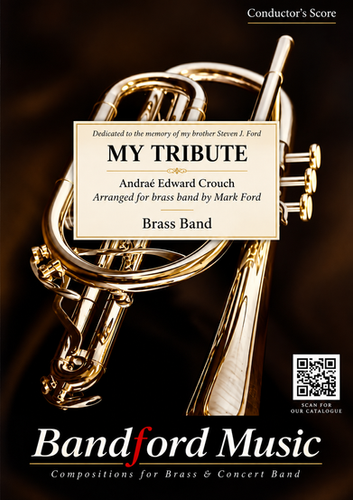
My Tribute (Euphonium Solo with Brass Band) Andrae Crouch arr. Mark Ford
My Tribute (To God Be The Glory) is a gospel song written by American gospel singer and songwriter Andrae Edward Crouch. He first recorded the song in 1972 on his album Keep on Singin'. The song is considered to be one of Crouch's most well-known songs. It is sometimes included in Christian children's song books. This arrangement for brass band from the pen of Mark Ford, features the euphonium as the soloist in a delightful setting sure to be popular with audiences. To view a performance video of the solo featuring Aaron Ford please visit https://youtu.be/6WGtAVgAsWc Duration: 1.30 minutes Difficulty Level: 3rd Section + This PDF download includes the full score and parts. Sheet music available at www.brassband.co.uk (UK) or https://satradecentral.org (USA) Instrumentation: Euphonium Soloist Bb Soprano Cornet Eb Solo Cornet Bb Repiano Cornet Bb 2nd Cornet Bb 3rd Cornet Bb Flugel Horn Bb Solo Horn Eb 1st Horn Eb 2nd Horn Eb 1st Baritone Bb 2nd Baritone Bb 1st Trombone Bb 2nd Trombone Bb Bass Trombone Euphonium Bb Bass Eb Bass Bb Drum Set Percussion
In Stock: Estimated dispatch 1-3 working days
-
 £33.62
The Piano Preludes (Brass Band) George Gershwin arr. Rob Bushnell
First performed by the composer at the Roosevelt Hotel in New York in 1926, The Piano Preludes (or Three Preludes) are a collection of short pieces by George Gershwin, show casing early-20th-century American classical music, as influenced by jazz. Gershwin originally planned to compose 24 preludes, wrote seven, performed only six publically and was further reduced to three when first published. The work was dedicated to friend and musical advisor Bill Daly. The first prelude begins with a five-note blues motif. It features syncopated rhythms based on the Brazilian baiao and minor-seventh chords throughout. The second prelude, which Gershwin said was "a sort of blues lullaby" consists of two sections: the first a "lazy" melody upon a steady beat of crotchets; the second the bass takes the melody, continuing with the steady beats. The third prelude was called "Spanish" by Gershwin, and features a question-and-answer type melody, starting in a minor tonality and ending in major one. This arrangement is for the British-style brass band, with alternative parts for horns in F and bass-clef lower brass. To view a follow-the-score video please visit www.youtube.com/watch?v=XqIQ0j1SWlc PDF download includes score and parts. Sheet music available from: UK - www.brassband.co.uk USA - www.solidbrassmusic.com Difficulty Level: 1st Section + Instrumentation: Soprano Cornet Eb Solo Cornet Bb Repiano Cornet Bb 2nd Cornet Bb 3rd Cornet Bb Flugel Horn Bb Solo Horn Eb 1st Horn Eb 2nd Horn Eb 1st Baritone Bb 2nd Baritone Bb 1st Trombone Bb 2nd Trombone Bb Bass Trombone Euphonium Bb Bass Eb Bass Bb Timpani Drum Kit Mallet Percussion
In Stock: Estimated dispatch 1-3 working days