
Results
-
 £40.00
UNSQUARE DANCE (Brass Band - Score and Parts) - Brubeck, Dave - Freeh, Mark
Dave Brubeck, the American jazz pianist, has contributed a huge amount of material to the genre, responsible for many titles now so often referred to as 'jazz standards'. Brubeck has experimented with irregular time signatures throughout his musical career including 'Pick Up Sticks' (which is in 6/4 time), Blue Rondo a la Turk (in 9/8 but over four beats as 2.2.2.3) and of course his most famous work, 'Take Five' (in 5/4!). His 'Unsquare Dance' (in 7/4 time) has been expertly arranged for brass band by Mark Freeh.Duration: 4.00
Estimated dispatch 7-14 working days
-
 £83.50
Victory! (Brass Band - Score and Parts) - Moren, Bertrand
Duration: 6.30Recorded on OBRCD946 The Way we Were (Cory Band)
Estimated dispatch 7-14 working days
-
 £40.00
Zadok the Priest (SAATBB Chorus with Brass Band - Score and Parts) - Handel, George Frideric - Littlemore, Phillip
Handel's coronation anthem?Zadok the Priest?was composed for the coronation of George II in 1727, and has been sung at every subsequent British coronation. Handel used texts from the King James Bible, which are derived from the biblical account of the anointing of Solomon. There are no choral parts included with the set, however it works with all the major editions of vocal score. Duration: 6:00
Estimated dispatch 7-14 working days
-
 £83.00
Zigeunerweisen (Euphonium Solo with Brass Band - Score and Parts) - De Sarasate, Pablo - Ruedi, Thomas
Gypsy Airs.Duration: 6.30
Estimated dispatch 7-14 working days
-
 £37.95
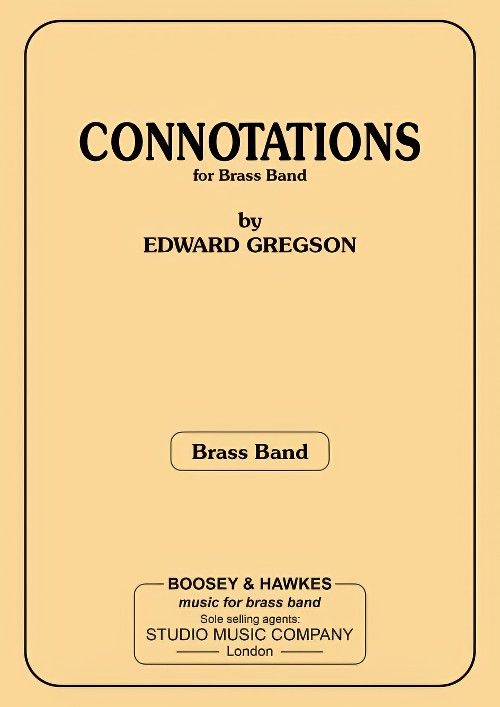
Connotations (Brass Band - Score only) - Gregson, Edward
Connotations was commissioned for the 1977 National Brass Band Championship finals, held in the Royal Albert Hall, London (the winner, incidentally, of that particular competition was the famous Black Dyke Mills Band).At the age of 32 Gregson was the youngest composer to have received the honour of such a commission. It came at the end of a productive five years writing for the brass band publisher R Smith. Some of those works - The Plantagenets, Essay and Patterns for example, with their direct and tuneful style, have remained popular with brass bands the world over.For Gregson, these were the means by which he sharpened the tools of his trade, preparing the ground, as it were, for his finest work to date - Connotations. He thought of calling the piece Variations on a Fourth, but with due deference to Gilbert Vinter perhaps (Variations on a Ninth), he chose a more appropriate one. As Gregson has written, 'Connotations suggests more than one way of looking at something, an idea, and this is exactly what the piece is about'.Writing a competition piece brought its own problems. 'It has to be technically difficult and yet musically satisfying. I didn't like being kept to an eleven-minute maximum. The inclusion of short cadenzas for less usual solo instruments seems to signify a certain test-piece mentality'.Gregson solved the problems admirably by adopting a symphonic approach to variation form: Introduction - fanfares, a call to attention, in effect Variation 1; Theme - a six-note motif, given a lyrical and restrained first statement; Variation 2 - a delicate toccata; Variation 3 - typically robust in melody and rhythm; Variation 4 - lyrical solos; Variation 5 - a scherzo; Variation 6 - cadenzas; Variations 7-9 - an introduction, fugato and resounding restatement of the theme.Duration: 10.30
Estimated dispatch 7-14 working days
-
£74.95
Connotations (Brass Band - Score and Parts) - Gregson, Edward
Connotations was commissioned for the 1977 National Brass Band Championship finals, held in the Royal Albert Hall, London (the winner, incidentally, of that particular competition was the famous Black Dyke Mills Band).At the age of 32 Gregson was the youngest composer to have received the honour of such a commission. It came at the end of a productive five years writing for the brass band publisher R Smith. Some of those works - The Plantagenets, Essay and Patterns for example, with their direct and tuneful style, have remained popular with brass bands the world over.For Gregson, these were the means by which he sharpened the tools of his trade, preparing the ground, as it were, for his finest work to date - Connotations. He thought of calling the piece Variations on a Fourth, but with due deference to Gilbert Vinter perhaps (Variations on a Ninth), he chose a more appropriate one. As Gregson has written, 'Connotations suggests more than one way of looking at something, an idea, and this is exactly what the piece is about'.Writing a competition piece brought its own problems. 'It has to be technically difficult and yet musically satisfying. I didn't like being kept to an eleven-minute maximum. The inclusion of short cadenzas for less usual solo instruments seems to signify a certain test-piece mentality'.Gregson solved the problems admirably by adopting a symphonic approach to variation form: Introduction - fanfares, a call to attention, in effect Variation 1; Theme - a six-note motif, given a lyrical and restrained first statement; Variation 2 - a delicate toccata; Variation 3 - typically robust in melody and rhythm; Variation 4 - lyrical solos; Variation 5 - a scherzo; Variation 6 - cadenzas; Variations 7-9 - an introduction, fugato and resounding restatement of the theme.Duration: 10.30
Estimated dispatch 7-14 working days
-
 £44.95
Intrada (Brass Band - Score and Parts - Gregson, Edward
This work was commissioned by the London Borough of Redbridge with funds provided by the Arts Council of Great Britain, and was first performed at the London Festival of 1972 by the Redbridge Youth Band, conducted by John Ridgeon.Intrada is in three sections, the first and last being similar. The middle section unfolds an expansive chromatic melody, heard initially on the horns, but later in canon between cornets and trombones. The work is lively throughout and has strong rhythmic elements as its chief characteristic, including changing time patterns and syncopations.Duration: 6.00
Estimated dispatch 7-14 working days
-
 £115.60
Chanson de Matin - Edward Elgar - Svein H. Giske
Chanson de Matin ("Morning Song") (Op. 15, No. 2) was likely written by Edward Elgar around 1889, originally for violin and piano. He later created an orchestral version. The premiere of this version in 1901 was conducted by none other than Henry Wood. Wood conducted the Promenade Concerts in London for almost 50 years and is considered the "father" of The Proms.The English composer Edward Elgar is perhaps best known for his Enigma Variations and Pomp and Circumstance marches.This arrangement was written during the COVID-19 pandemic for Askoy Brass Band's album "Gjensyn", available on Spotify and other streaming services.
Estimated dispatch 5-14 working days
-
 £115.60
Portias Slottsorkester - Dag Wirèn - Svein H. Giske
Dag Wiren (1905-1986) came to fame as a composer in 1937 with Serenade for string orchestra, Op. 11, which remains his most played work to date. His opus list is mainly instrumental music; five symphonies, five string quartets, several overtures and a lot of film and theatre music.He composed the stage music for William Shakespeare's The Merchant of Venice, which was performed at Dramaten in Stockholm in 1944. The drama was performed again in 1961, somewhat revised by Wiren. From this production, Wiren compiled a concert suite that he called Romantic Suite, Op. 22.The fifth and final movement is Portia's Castle Orchestra, which is based on an Irish folk melody.This instrumentation for Brass Band is based on the arrangement for wind band by Jerker Johansson. The instrumentation was written for Askoy Brass Band's performance at Siddis Brass 2022.
Estimated dispatch 5-14 working days
-
 £96.60
Norwegian Rhapsody - Edouard Lalo - Bertrand Moren
Estimated dispatch 5-14 working days
 View Music