
Results
-
 £69.50
End of The Year Special - Andrew Pearce
The end of the year special is an original composition not based on any carols, written originally for orchestra for a French TV channel to celebrate their end of the year festivities. It's a short 2 1/2 minute opener with lots of tuned percussion and sleigh bells, plus some solo work for the euphonium. It's fun and festive and a great way to open any Holiday concert. There's even an optional part for women's chorus if you like. End of the Year Special could very well be the perfect opening for your Christmas concert.
Estimated dispatch 5-14 working days
-
£42.50
Fresena March - Jacob de Haan
Fresena is the original name for Friesland, a northern province of the Netherlands, with its own language and culture. In this simple mars, Jacob the Haan used two traditional Friesian folksongs. Together with his composition Fox from the North this mars was a part of the festival suite that Jacob de Haan once wrote by order of the council of Friesland.
Estimated dispatch 5-14 working days
-
 £67.50
Tone Studies for Band - James Curnow
Tone Studies for brass band consists of nine studies designed to aid the development of good individual and ensemble tone production and intonation. Add Tone Studies to your library and you will find it quickly becomes an indispensible part of your band's rehearsal routine.
Estimated dispatch 5-14 working days
-
 £53.50
Wiener Philharmoniker Fanfare - Richard Strauss - Paul Mealor
Paul Mealor's arrangement for orchestra of the Wiener Philharmoniker Fanfare (Vienna Philharmonic Fanfare) by Richard Strauss was originally commissioned by His Majesty King Charles III for The Coronation. This version for Brass Band was first performed on Saturday 14th September 2024 at St Asaph Cathedral in Wales as part of the North Wales International Music Festival by Foden's Band, conducted by Michael Fowles.
Estimated dispatch 5-14 working days
-
 £53.50
Mr Cool's Swing - Etienne Crausaz
This piece is in line with the tradition of works by Louis Prima and performances by Benny Goodman. It attempts to reproduce a similar "feel", adapted from the music of these two artists, for brass band. The result is a swing with a sustained tempo and modern harmonies, as well as solo passages highlighting the cornet, the trombone and the euphonium with effervescent riffs. Mr Cool's Swing will absolutely find success with your audience! This music forms part of the musical tale La Malediction d'Aragne (Aragne's Curse), commissioned by the Lyre de Courtion (conductor Dominique Morel) on the occasion of its 100th anniversary.
Estimated dispatch 5-14 working days
-
 £57.50
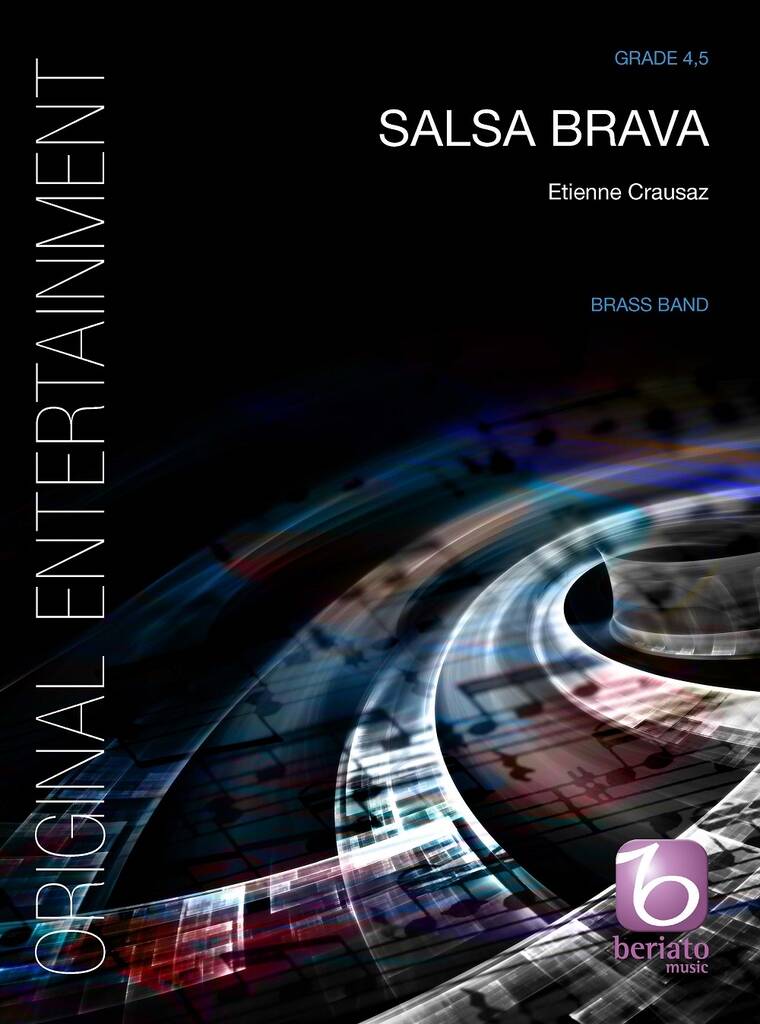
Salsa Brava - Etienne Crausaz
The Salsa Brava is a typical Spanish hot sauce that goes wonderfully well with barbecue or tapas. The Salsa is also a style of music that originated in the Caribbean, combining Cuban, Puerto Rican, and American influences.This composition is completely in keeping with this aesthetic, offering catchy melodies supported by a characteristic rhythmic patterns and highly intricate harmonies. A middle section provides space for soloists (cornet and trombone) to express themselves. The result is music which is festive, lively, and full of energy. A sure bet to charm your audience.This music is part of the musical tale La Malediction d'Aragne, written by Dominique Schweizer and commissioned by the Lyre de Courtion (dir. Dominique Morel) to mark its 100th anniversary.
Estimated dispatch 5-14 working days
-
 £1.00
£1.00JOCK MCKENZIE MINI CHRISTMAS COLLECTION Part 5 in Bb - McKenzie, Ian
Estimated dispatch 7-14 working days
-
£1.00
JOCK MCKENZIE MINI CHRISTMAS COLLECTION Part 5 in C BC - McKenzie, Ian
Estimated dispatch 7-14 working days
-
£1.00
JOCK MCKENZIE MINI CHRISTMAS COLLECTION Part 5 in Eb - McKenzie, Ian
Estimated dispatch 7-14 working days
-
£104.99
Theme Park Fun! - Wilco Moerman
In Theme Park Fun! your orchestra pays a visit to an amusement park. During your visit, you will experience some spectacular rides and attractions this theme park offers. The uniqueness of Theme Park Fun! is the interplay between music and(moving) images. Animations and illustrations support the visual composition (downloadable after ordering a set, on www.gobelinmusic.com).Part 1: The Entrance & Parade [with animation]The opening of the park is a fact. A day fullof fun and pleasure awaits! You and the other visitors will be confronted with all the rides, attractions and adventures the theme park has to offer. Which ride shall we do first?! There is so much to do and experience on this day in the park! Aparade of colorful floats and park figures is passing by.Let the fun begin!Part 2: The Haunted House [with animation]The only ride in the park that is not related to fun, is the Haunted House. Here visitors will be challengedto visit a house full of ghosts, creepy figures and other ominous things. The clock strikes twelve, there is no turning back. Ghosts are whispering, yelling, screaming... Fortunately it is almost one oclock, so we can leave this creepy placequickly.Part 3: The Swinging Galleon [with illustrations]What a huge pirate ship! Each time you swing back and forth, you will feel that weird feeling in your stomach. When you are thrown completely into the top you will have afantastic view over the park, but you can not enjoy it for long. Before you know the ship swings back the other way.Part 4: The Fairy Tale Ride [with illustrations]After all those exciting and spectacular rides and attractions,it is time for a peaceful tour in The Fairy Tale Ride. Surrounded by a fairytale setting, you will discover fable figures, talking animals and colorful designs. Such a beauty and tranquility. Having had this experience, we are ready again for thebig rides in the park!Part 5: The Bumper Cars [with illustrations]Now its time to crawl behind the wheel of the Bumper Cars! Shall we all chase the conductor?! Before you know you are hit by another visitor or you will bumpagainst someone else. In this tough ride you can prove yourself as a real driver, or perhaps as a really bad one.Part 6: The Roller Coaster [with illustrations]The largest, fastest and scariest ride in the park ... we shoulddefinitely do the Roller Coaster! All together in the train, the over-the-shoulder restraints are lowering... be ready to ride. The train leaves the station and is heading for the big lift hill. It will be very scary when the train reaches the topand the train will be plunged down the first drop! Loops, corkscrews and other spectacular coaster elements will follow... Before you know it, the ride of your life is over. Shall we ride it again?!Part 7: Leaving the Park [withanimation]Unfortunately everything comes to an end. This day in the theme park is over, but we have a lot new experiences to talk about! The memories of all the funny and spectacular rides will come up when we walk through the park to theexit. Just one look over the shoulder, the amusement park figures are waving at us. Hopefully we will come back again soon!
Estimated dispatch 5-14 working days
 View Music