
Results
-
 £34.95
I Wish I Knew How It Would Feel To Be Free - Jonathan Bates
DIFFICULTY: 1st+. DURATION: 3 minutes. This spiritual is one of the most popular anthems to come out of the civil rights movement in the US, and became an almost unofficial anthem for the movement when Nina Simone took on the song in the 1960's. This arrangement plays on the more positive and hopeful nature of achieving true freedom and peace. This piece was composed for Jaren Hornmusikkforening as part of their programme for the 2018 SIDDIS Championships held in Stavanger, Norway. .
In Stock: Estimated dispatch 1-3 working days
-
 £29.95
One Bitter December's Night - Jonathan Bates
'One Bitter December's Night' was composed for the Elland Silver Youth Band's appearance at the 2018 Youth Brass In Concert Championships, held at The Sage, Gateshead. This piece is a graphic description of the evening of 29th December, 1940 when over 100,000 bombs were dropped on London overnight in the height of the Blitz leading to the Second Great Fire of London. The music is set from the viewpoint of a young child sleeping peacefully in central London as the sound of bombs and sirens get closer and closer. .
In Stock: Estimated dispatch 1-3 working days
-
 £39.95
Red Hills of Georgia, The - Jonathan Bates
DURATION: 4 minutes. DIFFICULTY: Championship. The title of this work comes from a line in Martin Luther King Jnr's famous 'I Have a Dream ' speech, portraying the vast expanses of the plains of Georgia and the notable red hue to the surrounding mountains. This piece is very much influenced by the music of American wind band composers Samuel Hazo and Richard Saucedo, both of which are regularly inspired by the scenery of 'the big country'. This piece was composed for Jaren Hornmusikkforening as part of their programme for the 2018 SIDDIS Championships held in Stavanger, Norway. .
In Stock: Estimated dispatch 1-3 working days
-
 £59.95
That Promised Land - Jonathan Bates
DURATION: 8 minutes. DIFFICULTY: 1st+. That Promised Land was the culmination of 5 years of my personal interest in spiritual music since performing Michael Tippett's wonderful Oratorio 'A Child of Our Time' at the RNCM. Tippett's work combines original material, with music inspired and based upon spirituals, whilst all of the major 'chorus' sections are direct settings of those tunes. This was a work that had stuck with me for a long time, and one I tried to emulate in a smaller form with this work. The title is a quote from one of the verses of the spiritual 'Deep River'. This piece was composed for Jaren Hornmusikkforening as part of their programme for the 2018 SIDDIS Championships held in Stavanger, Norway. .
In Stock: Estimated dispatch 1-3 working days
-
 £8.50
£8.50CARNIVAL FOR HORN (score) - Cresswell, Tony
re-set December 2018 to coincide with inclusion of the piano accompaniment version being included on the new ATCL syllabus from Trinity College
In Stock: Estimated dispatch 1-3 working days
-
 £32.50
CARNIVAL FOR HORN (score & parts) - Cresswell, Tony
re-set December 2018 to coincide with inclusion of the piano accompaniment version being included on the new ATCL syllabus from Trinity College
In Stock: Estimated dispatch 1-3 working days
-
 £71.00
Bella Ciao - Traditional/Henk Ummels
The origin of Bella ciao is uncertain. Possibly it is derived from an older song on the same melody, also called Bella ciao, about the abuses in the rice harvest in northern Italy in the 19th century, where lower-class women performed poorly paid seasonal work under barbaric conditions. In 2018 the song became known again by the television series La casa de papel, in which the song was used multiple times. It was sung among others by the characters El Profesor and Berlin.
Estimated dispatch 10-14 working days
-
 £36.00
Edward Gregson: The World Rejoicing
DescriptionComposer's NoteIn searching for a common link between the brass band traditions of the various European countries that commissioned this work, I considered the fact that hymns have always played an important role in the relationship that brass bands have with their particular communities; and thus I turned to a well-known Lutheran chorale, Nun danket alle Gott (Now thank we all our God), written around 1636 by Martin Rinkart, with the melody attributed to Johann Cruger. A number of composers have incorporated this chorale into their music, most famously J.S.Bach in his Cantatas no. 79 and 192, and Mendelssohn in the Lobsegang movement of his 2nd Symphony (the harmonization of which is usually used when this hymn is sung).It seemed fitting therefore for me to return to a compositional form I have used many times before (Variations) and to write a work based on this hymn. I have used it in a similar way to that which I employed in my Variations on Laudate Dominum of 1976 - that is, rather than writing a set of variations using elaborations of the complete tune, I have taken various phrases from the chorale and used them within the context of other musical material, applying an overall symphonic process of continuous variation and development. The structure, or sub-divisions of the work, which is through composed and plays without a break, is as follows: Prelude, Capriccio, La Danza 1, Processional, La Danza 2, Arias and Duets, Fuga Burlesca, Chorale, and Postlude.The work is also partly autobiographical - in the manner say of Strauss's Ein Heldenleben - in that I have incorporated into the score brief quotations from many of my other major works for brass band. In that respect, The World Rejoicing sums up a particular facet of my life as a composer, and reflects the admiration I have always had for what is surely one of the great amateur music-making traditions in the world.The World Rejoicing is dedicated 'in loving memory of my brother', Bramwell Logan Gregson, who sadly passed away in the Autumn of 2018.Edward Gregson
Estimated dispatch 7-14 working days
-
 £34.95
Aureum - Paul Lovatt-Cooper
Aureum was composed to celebrate the Golden Wedding Anniversary of John and Jennifer Ward on December 7th 2018. This composition is based on a beautiful 10-bar melody that grows and develops throughout the piece.
Estimated dispatch 10-14 days
-
 £34.95
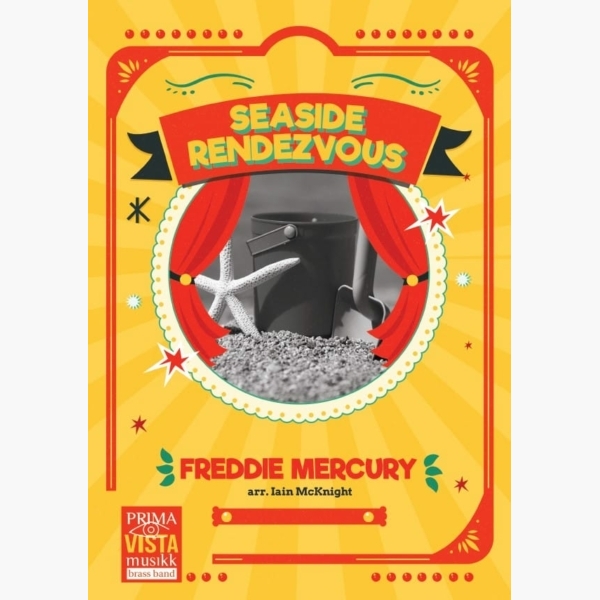
Seaside Rendezvous - Freddie Mercury - Iain McKnight
There was no greater showman in the world of rock than Freddie Mercury and, for many, no greater group than Queen. The release in 2018 of the film Bohemian Rhapsody brought the sounds of Queen to a new generation as...
Estimated dispatch 5-7 working days
 Listen to MP3
 View Music