
Results
-
 £80.00
The Unfortunate Traveller (Brass Band - Score and Parts)
Imogen Holst (1907-1984) submitted The Unfortunate Traveller (1929) as her final work as a student portfolio at the Royal College of Music, where her composition teacher was Gordon Jacob. The title was taken from Thomas Nashe's famous 1594 picaresque novel of the same title. The Suite was first performed on 12 February 1933 at her Majesty's Theatre, Carlisle, by the St. Stephen's Band, with the composer conducting. Te concert was given in memory of Holst's uncle, Dr. H.A. Lediard. Holst had been impressed with the band's performance of his A Moorside Suite at the 1928 National Brass Band Championships (The Crystal Palace, South London) and was keen to work with them. Writing in Imogen Holst, a life in music, Christopher Grogan indicates that it was Gustav Holst's suggestion to include his daughter's work in the programme, quoting Imogen Holst's remarks made in interview to The Daily Mail as follows: "....it is the first time, so far as I know, that a woman has conducted a brass band at a public concert....It has been a delight to rehearse the St. Stephen's Band. It was their performance at the Crystal Palace Festival that inspired me to write this Suite, which I have dedicated to them."Imogen Holst accompanied her father to the Crystal Palace in 1928 to hear the performances of A Moorside Suite, and was so excited by the played and, audibly, by her father's music that she decided to write a brass band piece for her final examination. Te result was The Unfortunate Traveller (1929). However, it was not possible for her to present a brass band work for examination. She arranged it for string orchestra so that it could be played before she left the RCM in July 1930. Following the premiere of the original in 1933, the manuscripts did not resurface until 1969 Imogen found them among her late mother's effects. Although she requested score and parts be destroyed, they ended up in the possession of Manchester composer John Golland, who marked up the score presumably with the intention of creating a new performing edition. The original scoring reveals a lack of experience with what can be a tricky medium.With the agreement of the Holst Foundation, a revised edition, with additional percussion, was prepared in 2011 since when the work has been fortunate to travel round the world as a concert and contest piece. The original includes drums in the March only. The title was taken from Tomas Nashe's famous 1594 picaresque novel of the same title. Several Morris Dance tunes are introduced during the course of the four short movements, including Bonnie Green Garters, Shepherd's Hey, The Rose and The Wind Blaws Cauld. Quirky twists and turns of harmony and spirited rhythms that remind us how much Imogen Holst loved tradition English dance music.In September 2025, I made a performing edition of the composer's arrangement for string orchestra. The manuscript lacks the final movement, which I arranged in a similar style, ie. without extending the upper ranges. Making this edition raised some issues regarding the accuracy of my band version and some of the solutions I used to smooth out the voicing. I have used the composer's second thoughts to refine my performing edition and to correct a textual errors.- Paul HindmarshDuration: 10.00
Estimated dispatch 7-14 working days
-
£40.00
The Unfortunate Traveller (Brass Band - Score only)
Imogen Holst (1907-1984) submitted The Unfortunate Traveller (1929) as her final work as a student portfolio at the Royal College of Music, where her composition teacher was Gordon Jacob. The title was taken from Thomas Nashe's famous 1594 picaresque novel of the same title. The Suite was first performed on 12 February 1933 at her Majesty's Theatre, Carlisle, by the St. Stephen's Band, with the composer conducting. Te concert was given in memory of Holst's uncle, Dr. H.A. Lediard. Holst had been impressed with the band's performance of his A Moorside Suite at the 1928 National Brass Band Championships (The Crystal Palace, South London) and was keen to work with them. Writing in Imogen Holst, a life in music, Christopher Grogan indicates that it was Gustav Holst's suggestion to include his daughter's work in the programme, quoting Imogen Holst's remarks made in interview to The Daily Mail as follows: "....it is the first time, so far as I know, that a woman has conducted a brass band at a public concert....It has been a delight to rehearse the St. Stephen's Band. It was their performance at the Crystal Palace Festival that inspired me to write this Suite, which I have dedicated to them."Imogen Holst accompanied her father to the Crystal Palace in 1928 to hear the performances of A Moorside Suite, and was so excited by the played and, audibly, by her father's music that she decided to write a brass band piece for her final examination. Te result was The Unfortunate Traveller (1929). However, it was not possible for her to present a brass band work for examination. She arranged it for string orchestra so that it could be played before she left the RCM in July 1930. Following the premiere of the original in 1933, the manuscripts did not resurface until 1969 Imogen found them among her late mother's effects. Although she requested score and parts be destroyed, they ended up in the possession of Manchester composer John Golland, who marked up the score presumably with the intention of creating a new performing edition. The original scoring reveals a lack of experience with what can be a tricky medium.With the agreement of the Holst Foundation, a revised edition, with additional percussion, was prepared in 2011 since when the work has been fortunate to travel round the world as a concert and contest piece. The original includes drums in the March only. The title was taken from Tomas Nashe's famous 1594 picaresque novel of the same title. Several Morris Dance tunes are introduced during the course of the four short movements, including Bonnie Green Garters, Shepherd's Hey, The Rose and The Wind Blaws Cauld. Quirky twists and turns of harmony and spirited rhythms that remind us how much Imogen Holst loved tradition English dance music.In September 2025, I made a performing edition of the composer's arrangement for string orchestra. The manuscript lacks the final movement, which I arranged in a similar style, ie. without extending the upper ranges. Making this edition raised some issues regarding the accuracy of my band version and some of the solutions I used to smooth out the voicing. I have used the composer's second thoughts to refine my performing edition and to correct a textual errors.- Paul HindmarshDuration: 10.00
Estimated dispatch 7-14 working days
-
 £74.95
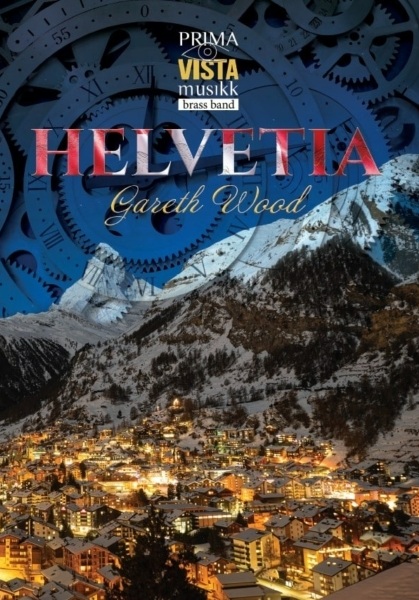
Helvetia (Brass Band - Score and Parts)
I first went to Switzerland in the early 1970's and regularly played at the Lucerne Festival with the Royal Philharmonic Orchestra. It is a beautiful city, one of my favourite European cities.In writing Helvetia (the Roman name for Switzerland) I wanted to encapsulate the moods that remind me of this wonderful place. The work is in four distinct sections and is on the whole, self-explanatory.It opens with An Alpine Dawn and sunrise, the tubas and euphoniums substituting for the Swiss Alphorns. Next The Clock Shop at Mid-day, a loud ticking, chiming and the sad sound of a cuckoo, builds into the cacophony of the mid-day chimes. The third section is A Walk to Wagner's House. Just along the lake from the centre of town is Tribschen. This walk I have done many times, and it is here that Wagner wrote 'Tristan'. I have quoted the Dresden Amen (written by J.G. Naumann) which is much used in Parsifal. The final section is The Cesta Run, the most famous bob-sleigh run in the world. As we take each corner, the feeling of speed is demonstrated as only a brass band can do!The work is dedicated to the Cory Band and also to the memory of James Watson, a great cornet player, trumpeter and conductor. It was he who got me into writing for brass band and I hope this piece is worthy.- Gareth Wood (Feb. 2011)Duration: 11.00
Estimated dispatch 7-14 working days
-
£31.95
Helvetia (Brass Band - Score only)
I first went to Switzerland in the early 1970's and regularly played at the Lucerne Festival with the Royal Philharmonic Orchestra. It is a beautiful city, one of my favourite European cities.In writing Helvetia (the Roman name for Switzerland) I wanted to encapsulate the moods that remind me of this wonderful place. The work is in four distinct sections and is on the whole, self-explanatory.It opens with An Alpine Dawn and sunrise, the tubas and euphoniums substituting for the Swiss Alphorns. Next The Clock Shop at Mid-day, a loud ticking, chiming and the sad sound of a cuckoo, builds into the cacophony of the mid-day chimes. The third section is A Walk to Wagner's House. Just along the lake from the centre of town is Tribschen. This walk I have done many times, and it is here that Wagner wrote 'Tristan'. I have quoted the Dresden Amen (written by J.G. Naumann) which is much used in Parsifal. The final section is The Cesta Run, the most famous bob-sleigh run in the world. As we take each corner, the feeling of speed is demonstrated as only a brass band can do!The work is dedicated to the Cory Band and also to the memory of James Watson, a great cornet player, trumpeter and conductor. It was he who got me into writing for brass band and I hope this piece is worthy.- Gareth Wood (Feb. 2011)Duration: 11.00
Estimated dispatch 7-14 working days
-
£21.95
Helvetia (Brass Band - Study Score)
I first went to Switzerland in the early 1970's and regularly played at the Lucerne Festival with the Royal Philharmonic Orchestra. It is a beautiful city, one of my favourite European cities.In writing Helvetia (the Roman name for Switzerland) I wanted to encapsulate the moods that remind me of this wonderful place. The work is in four distinct sections and is on the whole, self-explanatory.It opens with An Alpine Dawn and sunrise, the tubas and euphoniums substituting for the Swiss Alphorns. Next The Clock Shop at Mid-day, a loud ticking, chiming and the sad sound of a cuckoo, builds into the cacophony of the mid-day chimes. The third section is A Walk to Wagner's House. Just along the lake from the centre of town is Tribschen. This walk I have done many times, and it is here that Wagner wrote 'Tristan'. I have quoted the Dresden Amen (written by J.G. Naumann) which is much used in Parsifal. The final section is The Cesta Run, the most famous bob-sleigh run in the world. As we take each corner, the feeling of speed is demonstrated as only a brass band can do!The work is dedicated to the Cory Band and also to the memory of James Watson, a great cornet player, trumpeter and conductor. It was he who got me into writing for brass band and I hope this piece is worthy.- Gareth Wood (Feb. 2011)Duration: 11.00
Estimated dispatch 7-14 working days
-
 £59.99
Tango (Brass Band - Score and Parts)
Tango for Trumpet or Trombone solos with Brass Band accompaniment was written for Ian Porthouse and Brett Baker in 2008. The first performance was given by the Black Dyke Band conducted by Nicholas Childs, at the Black Dyke Brass Arts Festival. Suitable for 1st Section Bands and above. Duration: 9.00
Estimated dispatch 7-14 working days
-
 £100.00
And When the River Told (Brass Band - Score and Parts)
And When the River Told was commissioned by the Scottish Brass Band Association for the Scottish Open Championship, held on 20th November 2012 at the Perth Concert Hall. This colourful work takes one of Scotlands great rivers, the Tay, as its subject. Suitable for Championship Section Bands. Duration: 13.00
Estimated dispatch 7-14 working days
-
 £49.99
Lock Horns/Rage on (Brass Band - Score and Parts)
Simon Dobsons dynamic and unusual concert march Lock Horns/Rage On was commissioned by the Leyland Band and their conductor Jason Katsikaris, and formed part of their programme for the Brass in Concert Championships, held at The Sage, Gateshead on 15th November 2009. Suitable for Premier Youth/2nd Section Bands and above. Duration: 4.00
Estimated dispatch 7-14 working days
-
 £74.95
Aspects of Adiemus (Brass Band - Score and Parts)
Aspects of Adiemus is a collection from one of the world's most popular composers, Karl Jenkins. Adiemus, literally translated, means 'we will draw near' and represents a musical language which can be heard on five award winning albums from the composer.Since Adiemus has risen in popularity around the world, it has become a growing entity meaning many different things to many different people. Vocally, the spread of influence grows wider all the time, taking in Arabic and African sounds as well as "Celtic" and ecclesiastical ones. The percussion too has expanded using Indian, Middle Eastern, Japanese, Chinese and even Australian instrumentation.The evolving nature of Adiemus has meant that it has been difficult to categorise. New age, classical crossover, world music, even pop. Karl sees this as a good sign: "To me, Adiemus transcends labels. The fact that it reaches people of different backgrounds, faiths and cultures gives it a universal appeal which is special. The compositions can be spiritual, religious, meditative - it's open to 'move' people in any away they choose to experience."Ironically, the Adiemus project 'got off the ground' initially due to a television commercial for an airline. Karl Jenkins explains, "I'd been toying with a new idea, completely separate to my work in advertising, but at this time, Jenkins Ratledge were commissioned to come up with the music for an airline commercial. We presented the client with a demonstration tape of one of my completed compositions and they loved it."That composition became known as Adiemus. The music for the airline commercial was aired and immediately drew interest from the public. Karl: "It's ironic that a piece of music not originally intended for a TV commercial should end up on a TV commercial, and that this music became the springboard for the success of the Adiemus project."Expertly arranged by Peter Graham, Aspects of Adiemus features the eponymous 'Adiemus', an uplifting and instantly recognisable opener. 'Chorale - Za Ma Ba' and 'Chorale - Vocalise' are songs of sanctuary, the latter featuring a chamber group from within the band. The vibrant 'Song of the Spirit' is a cornet feature, and the finale, 'Song of the Plains' combines intense rhythmic energy with tribal harmonies. Duration is variable depending on movement selection and optional cuts.Duration: 20.00
Estimated dispatch 7-14 working days
-
 £39.99
Congestion Charge (from New London Pictures) (Brass Band - Score and Parts)
This is the third movement of Nigel Hesss New London Pictures As with all modern cities, London is over-crowded with motor vehicles. London was the first major city in Europe to adopt a Congestion Charge, and this lighthearted work includes musical images of frustrated rush hour traffic leading to a freer flowing galop. Suitable for 1st Section Bands and above. Duration: 7.00
Estimated dispatch 7-14 working days