
Results
-
 £42.95
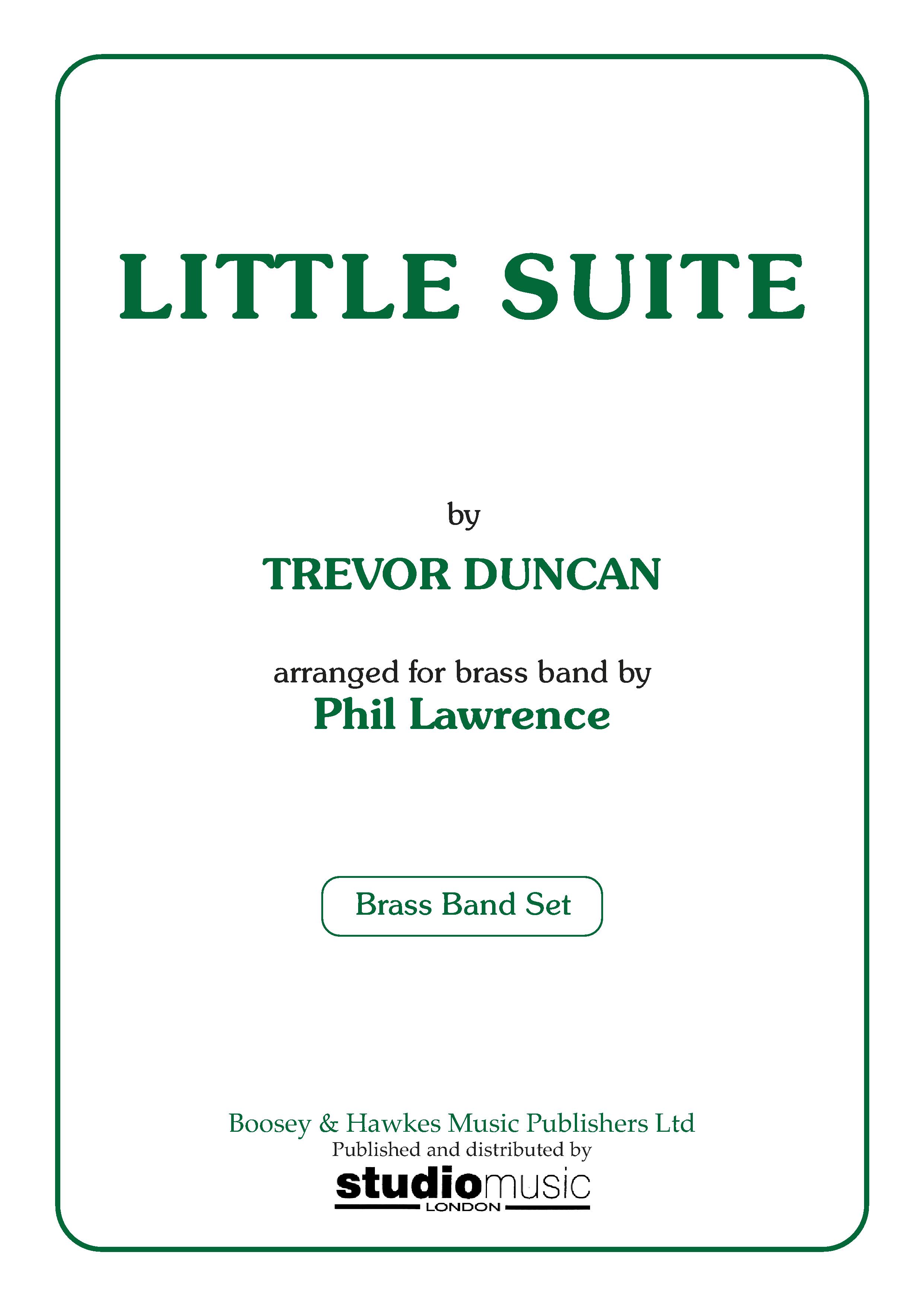
Little Suite (Brass Band - Score and Parts)
Trevor Duncan (1924 - 2005) was an English composer, particularly noted for his light music compositions. Born in London, and largely self-taught, he originally composed as a side line while working for the BBC. In the UK, he is well known for pieces such as High Heels and the March from A Little Suite, all of which gained fame as television and radio themes.Composed in 1959, and remembered by most for TV's Dr Finlay's Casebook fame, 'A Little Suite', was not necessarily inspired by Scotland, in fact it was more English in inspiration according to the composer. The piece was described by the composer as 'absolute music', and taking the three movements into account, this is not far from the mark.
Estimated dispatch 7-14 working days
-
 £70.00
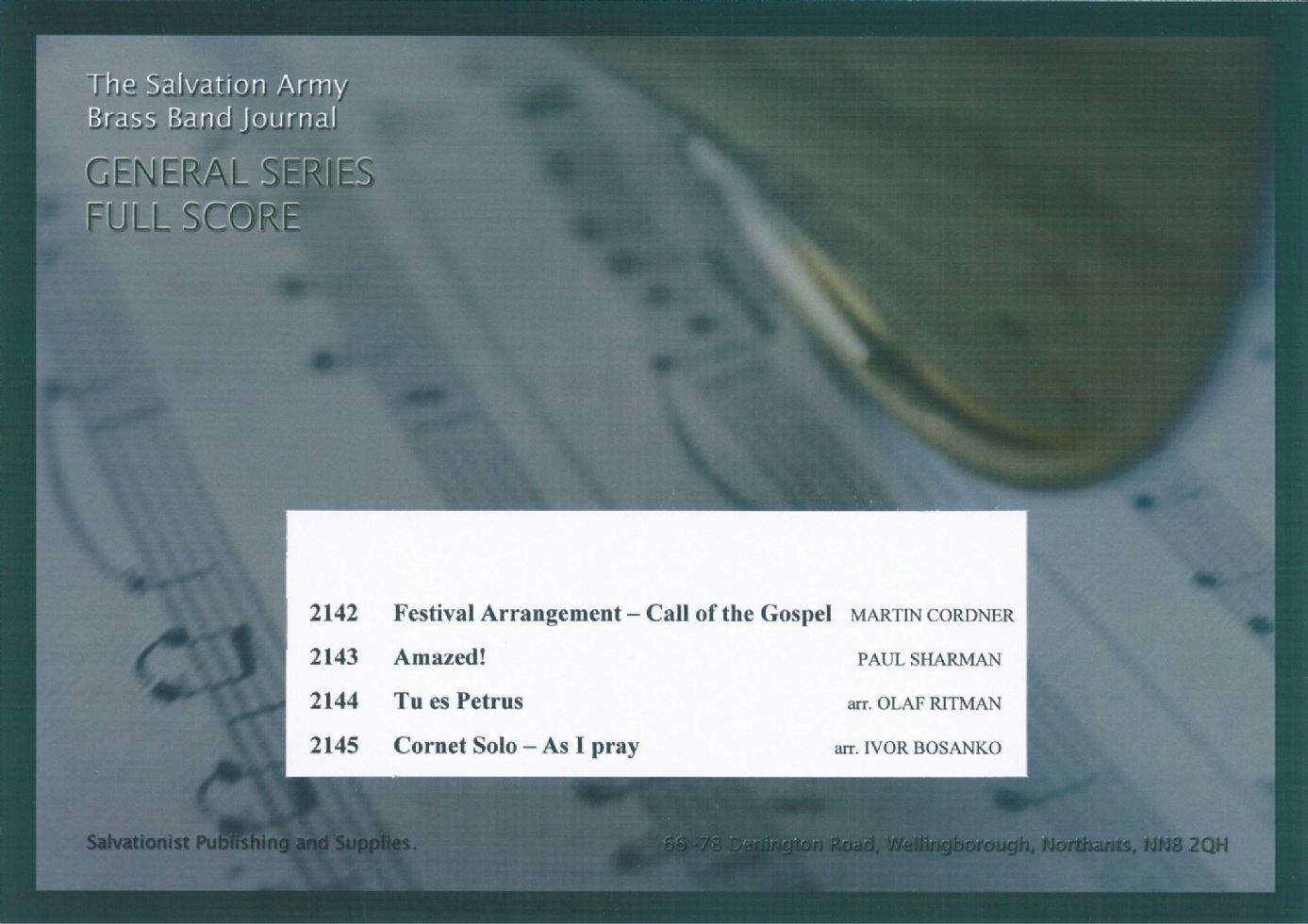
General Series Band Journal April 2015 Numbers 2142-2145
No. 2142 Festival Arrangement - Call of the Gospel (Martin Cordner)Written for the London Central Fellowship band, this foot-tapping festival arrangement treats the chorus, 'We have a gospel' in a bright, showy style.No. 2143 Amazed! (Paul Sharman)A setting of Charles Hutchison Gabriel's song, 'My Saviour's love', to which we sing his words, 'I stand amazed in the presence' (S.A.S.B. 179). Originally written for Birmingham Citadel Band, the piece aims to follow the four verses of text and is mainly up-tempo in style, depicting the amazing fact that God loves us.No. 2144 Tu es Petrus (arr. Olaf Ritman)A setting of a madrigal by Robert Pearsall. Originally entitled 'Lay a garland', the original text was swapped for the religious Latin text, 'Tu es Petrus' (You are Peter).No. 2145 Cornet Solo - As I pray (arr. Ivor Bosanko)Major Joy Webb's song, 'As I pray' (STTL Vol. 2, part 2), is arranged here as a beautiful solo for Cornet.
Estimated dispatch 7-14 working days
-
 £38.95
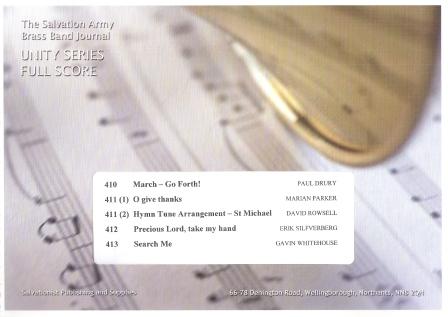
Unity Series Band Journal October 2013 Numbers 410 - 413
No. 410 March - Go Forth! (Paul Drury)This march was written as a tribute to Bandmaster Jack Spowart and the Bo'ness Salvation Army Band. The composer lives in the twon of Bo'ness and has had numerous opportunities to share with the band and the wider corps at various events. This march serves as recognition of the faithful service given in the Lord's name in the town by The Salvation Army for over 100 years. Two tunes are featured, both well-known and instantly recognisable, namely, Forward! be our watchword and We're marching on.No.411 (1) O give thanks (Marian Parker)The composer, Marian Parker, is a new contributor and is the Recruiting Sergeant at Leicester South Corps. This simple, yet rhythmic piece should not pose any technical problems for most bands and features the attractive arrangement of Joanne Pond's contemporary song, 'O give thanks'.No.411 (2) Hymn Tune Arrangement - St Michael (David Rowsell)The hymn tune 'St Michael' was composed in 1551 by French composer Louis Bourgeois and the composer provides a very useful arrangement of this historic hymn.No. 412 Precious Lord, take my hand (Erik Silfverberg O.F.)This well-known Gospel Song is a favourite of many. It has been recorded by many great artists, including Rosetta Tharpe, Elvis Presley and Aretha Franklin. The words were written by Reverend Thomas A. Dorsey, who is often known as the 'Father of Gospel song'.No. 413 Search Me (Gavin Whitehouse)The second new contributor to this journal is Gavin Whitehouse. gavin is the Assistant Music Director for the Greater New York Division and is also the USA Eastern Territorial Songster Leader. This piece combines two songs - one old and one new - which speak of a God who knows us intimately. 'Search me, O God and know my heart today' (associated with the beautiful Maori melody, 'Now is the hour') is woven with a contemporary setting of Psalm 139 by Rebecca St James, the first line of which says, 'You searchme, you know me'.
Estimated dispatch 7-14 working days
-
 £64.95
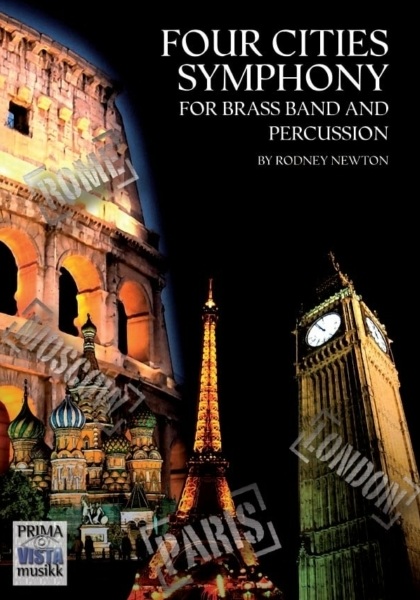
Four Cities Symphony (Brass Band - Score and Parts)
This piece was commissioned by the National Contesting Council as the 4th section test piece for the 2008 Regional Brass Band Championships of Great Britain.This symphony (the composer's 12th) has four movements played without a break. The first centres on two aspects of the city of London: its history and pageantry and its role as a busy modern metropolis.The second movement depicts Paris, its street cafes and boulevards and riverside walks, in the form of a romantic waltz.The third movement is constructed around the Gregorian chants of the Lord's Prayer (Pater noster, qui es in caelis) and the Creed (Credo in unum Deum) in an evocation of the city of Rome. After a powerful climax, mysterious tramping footsteps are heard as the ghosts or a Roman legion march through the city by night. The vision fades and the pater noster is heard once again before the movement is brought to a close with the ancient Ambrosian chant, Christus Vincit, Christus Regnet, Christus Imperat.The final movement is an evocation of the city of Moscow, with its great historic buildings, its turbulent history and its fiery traditional music. At the outset a rather dour folk-like melody is heard which is transformed into a lively Cossack dance.This work is dedicated to Howard Wilson, former principal euphonium of City of Coventry Band who, in 1972, introduced the composer to top section brass band contesting.Duration: 11.00
Estimated dispatch 7-14 working days
-
 £29.95
March: The Royal Green Jackets - Jonathan Bates
DURATION: 3'00". DIFFICULTY: 3rd+. 'The Royal Green Jackets' is a march composed for BD1 Brass as part of a set of music inspired by the British astronaut Tim Peake. . Following his graduation from the Royal Military Academy in Sandhurst in 1992, Peake became a member of the Royal Green Jackets - a former infantry regiment of the British Army, later to become The Rifles - serving as a Platoon Commander before commencing his flight training. 2 years later in 1994, Peake received his Army Flying Wings and spent 15 years serving in military operations in the likes of Yugoslavia and Afganistan. . In 2009, Peake was selected as a European Space Agency astronaut and completed his basic training in November 2010.
In Stock: Estimated dispatch 1-3 working days
-
 £12.00
Ave Maria
DescriptionJohann Sebastian Bach (1685 - 1750) was a German composer and musician of the Baroque period. Bach's compositions include the Brandenburg Concertos, the Goldberg Variations, the Mass in B minor, two Passions, and over three hundred cantatas of which approximately two hundred survive. His music is revered for its technical command, artistic beauty, and intellectual depth. Bach's abilities as an organist were highly respected during his lifetime, although he was not widely recognised as a great composer until a revival of interest in and performances of his music in the first half of the 19th century. He is now generally regarded as one of the greatest composers of all time.Charles-Francois Gounod (1818 - 1893) was a French composer, best known for his Grand Operas, most famously 'Faust', written in 1859 and his 'St Cecilia Mass' written in 1854. However possibly his most performed work is his arrangement of the latin text Ave Maria based on a work by Bach.You can listen to a computer realisation of the score while following the music below:
Estimated dispatch 7-14 working days
-
 £10.00
Kopanitsa
DescriptionKopanitsa was commissioned by Gavin Pritchard, who is also the work's dedicatee and gave the first performance with the Tongwynlais Temperance Band conducted by Gareth Pritchard at the Butlins Mineworkers Championship on 20 January 2008, winning the prize for best soloist as a result. He has recorded it on the CD "Enter the Galaxies" accompanied by the Cory Band conducted by Robert Childs.Gavin had requested a virtuoso showpiece featuring as many instruments as possible. The solo part is therefore written for vibraphone (bowed and struck), 10 x tuned tom toms, 5 x suspended cymbals plus hi-hat and a xylophone. The soloist's 'choreography' therefore forms an integral part of the performance. This can be seen to great effect in Gavin's performance of the work at the 2013 Brass in Concert Championship with Tredegar Band, available on the DVD of the event from World of Brass. A 'kopanitsa' is a Bulgarian folk dance that traditionally features two slow beats and two quick beats, reflected in the central 10/8 section. The music is deliberately Balkan in character, using the characteristic modes of Greek and Bulgarian folk music, and accelerates regularly to finish at breakneck speed. The tom-tom section marked 'ad lib.' after [D] can be improvised if the soloist wishes.You can follow the score in the preview video below!
Estimated dispatch 7-14 working days
-
£72.00
Sa ta mitt hjerte - Moldestad-Ditlevsen - Idar Torskangerpoll
This is a tune by Sigrid Moldestad (b. 1972), a Norwegian folk artist. She has based it on a warm and beautiful poem by Danish author Tove Ditlefsen. A text for and about love.Sigrid Moldestad won the "Spellemannsprisen" (the Norwegian equivalent to Grammy) in 2005 as a part of the group Gamaltnymalt. She won the price two years later, this time as solo artist for the record album Taus. Both times in the Folk Music category.So Take My Heart was released in 2012 as a part of the album Himlen har sove bort morkret.
Estimated dispatch 7-14 working days
-
£158.00
Banderole - Hakon Berge
Hakon Berge (born 22 April 1954 in Stavanger) is a Norwegian composer, conductor, arranger and music administrator, resident in Oslo. He studied at the Rogaland Conservatoire and at the Norwegian State Academy of Music.Berge has composed music for theatrical productions in venues such as the Rogaland Theatre, The National Theater in Bergen and the National Theatre in Oslo. He is also experienced in television production and was responsible for televised opera Gagarin - A Space Travel Opera(1991). He has composed a considerable number of commissions, including the music for the opening of the Alexandria Library, music for the opening of the Nobel Peace Centre in Oslo, and the test piece Brass Blot (for the European Brass Band Championships in Stavanger in 2008, in which Cory Band from South Wales won the first prize.Berge has also written the music to the documentary musical Byterminalen, also described as a rock opera, which was premiered in May 2008 in connection with the celebration of Stavanger as European City of Culture.Hakon Berge has held a number of offices in the musical life of Norway: he has been chairman both of the Norwegian Society of Composers and of TONO, the Norwegian performing rights organization.
Estimated dispatch 7-14 working days
-
 £30.00
Homage to Bach - Chris Houlding
Inspired by the master of counterpoint, Homage to Bach was written by Chris as an exercise in simplicity itself, designed to not only test the musicians playing skills and sense of style, but to encourage them to develop their "ensemble radar" through carefully listening, fine tuning, subtle dynamics and variation in articulation. The brass band has a long tradition of using chorales and hymns as a training exercise. As an alternative to existing hymn tunes, I have composed this simple chorale melody in three verses with a short introduction and links to specifically develop a quality 'tutti' band sound. Certain parts are doubled allowing performances by incomplete bands while presenting full outfits with an intonation and stylistic challenge. The printed phrasing is to be adhered to at all times regarding breaths, thus producing a seamless counterpoint. Simple yet satisfying for a quieter and atmospheric concert interlude.