
Results
-
 £33.62
The Piano Preludes (Brass Band) George Gershwin arr. Rob Bushnell
First performed by the composer at the Roosevelt Hotel in New York in 1926, The Piano Preludes (or Three Preludes) are a collection of short pieces by George Gershwin, show casing early-20th-century American classical music, as influenced by jazz. Gershwin originally planned to compose 24 preludes, wrote seven, performed only six publically and was further reduced to three when first published. The work was dedicated to friend and musical advisor Bill Daly. The first prelude begins with a five-note blues motif. It features syncopated rhythms based on the Brazilian baiao and minor-seventh chords throughout. The second prelude, which Gershwin said was "a sort of blues lullaby" consists of two sections: the first a "lazy" melody upon a steady beat of crotchets; the second the bass takes the melody, continuing with the steady beats. The third prelude was called "Spanish" by Gershwin, and features a question-and-answer type melody, starting in a minor tonality and ending in major one. This arrangement is for the British-style brass band, with alternative parts for horns in F and bass-clef lower brass. To view a follow-the-score video please visit www.youtube.com/watch?v=XqIQ0j1SWlc PDF download includes score and parts. Sheet music available from: UK - www.brassband.co.uk USA - www.solidbrassmusic.com Difficulty Level: 1st Section + Instrumentation: Soprano Cornet Eb Solo Cornet Bb Repiano Cornet Bb 2nd Cornet Bb 3rd Cornet Bb Flugel Horn Bb Solo Horn Eb 1st Horn Eb 2nd Horn Eb 1st Baritone Bb 2nd Baritone Bb 1st Trombone Bb 2nd Trombone Bb Bass Trombone Euphonium Bb Bass Eb Bass Bb Timpani Drum Kit Mallet Percussion
In Stock: Estimated dispatch 1-3 working days
-
 £44.95
Tango (Por Una Cabeza) (Cornet Solo with Brass Band)
Por una cabeza, literally translated as "by a head [of a horse]" in Spanish (meaning a horse winning a race by one head's distance), is one of the most famous and popular Argentine tangos.Composer Carlos Gardel (11 December 1890 - 24 June 1935) was a singer, songwriter and actor, and is perhaps the most prominent figure in the history of tango. The music has appeared in numerous TV and Film soundtracks, perhaps most memorably in the famous dancing scene featuring Al Pacino in Scent of a Woman. This extended arrangement for cornet (or trumpet) incorporates a cadenza and newly written interludes.
Estimated dispatch 7-14 working days
-
£44.00
The Yellow Rose of Texas - Amereican Trad. - Inge Sunde
"The Yellow Rose of Texas" is a traditional American folk song.It has become a symbol of the battle for Texan independence, and is also one of the most famous western songs of all time.Several versions of the song have been recorded, including by Elvis Presley, Willie Nelson and Mitch Miller.This is a Flex-5 SHOWBLOW arrangement, with 5 flexible parts for wind instruments, and additional parts for drums, piano and bass guitar (with chords).The arrangement, by SHOWBLOW arranger Inge Sunde, has a light swinging country & western style. Unexpected key changes togheter with melodic phrases in all instrumental parts make it fun to play.
Estimated dispatch 7-14 working days
-
£72.00
The Incredibles - Michael Giacchino - Lars Erik Gudim
Michael Giacchino (1967) has become one of the great composers scoring for Film, Television and Video Games. Music in the movies "Star Trek", "Ratatoille", "Mission Impossible III", "Sin" and "The Incredibles" has come from his hand, but even more known should be the music from the Television shows "Alias" and "Lost".In "The Incredibles", music with high energy and a lot of wind players fits well. To play this music with a wind band takes good care of this intentions. The super heroes are matched with music in all dimensions. This is well taken care of in the arrangement by Lars Erik Gudim.
Estimated dispatch 7-14 working days
-
 £34.95
I'll Walk With God - Nicholas Brodszky & Sammy Cahn - Christian Jenkins
The 1954 film, The Student Prince, is based loosely on Sigmund Romberg's operetta, with I'll Walk With God by Webster & Brodszky replacing one of the dated Romberg numbers. The part of the Prince was played by Edmund Purdom who...
Estimated dispatch 5-7 working days
-
 £44.95
Fantasy on Sempre Libera (Euphonium Solo with Brass Band)
During the 19th century the great instrumental virtuosi reined supreme. Pianists Liszt and Thalberg and violinists Paganini and Saraste amazed audiences with their wide-ranging technical and artistic abilities, fuelled by increasingly difficult paraphrases and variations on popular tunes of the day.The Fantasy on Sempre Libera looks back with affection to this period and provides an opportunity for present day euphonium virtuoso David Thornton to demonstrate the skills which mark him out as one of the world's finest players.
Estimated dispatch 7-14 working days
-
 £60.00
From the Shores of the Mighty Pacific (Cornet Solo with Brass Band - Score and Parts)
Cornet Solo with Brass BandHerbert L. Clarke (1867 - 1945) is regarded by many as one of the finest cornet players of all time, noted not only for his amazing technique but also for his warm, lyrical tone. He has left a multitude of cornet solos as well as collections of studies which are still very widely used. He was a member of The Sousa Band briefly in 1893 and then from 1898 to 1917 where he was not only the distinguished cornet soloist but also became assistant director.From The Shores Of The Mighty Pacific is an all-time favourite rondo-caprice cornet solo and was first published in 1912. A brass band arrangement was requested by Chris Lichtler, principal cornet of Brass Band of the Western Reserve, musical director Dr. Keith M. Wilkinson. Chris has performed it many times with BBWR and it was recorded by them on the CD, Without Reserve!.
Estimated dispatch 7-14 working days
-
 £30.00
The Sword and the Star
DescriptionThe Sword and the Star was written in 2006 for the Middleton Band at the request of their Musical Director, Carl Whiteoak. The inspiration for the work was the band's badge, which features a medieval archer. The town of Middeton's historical link with the symbol of the Archer came from the English victory at the Battle of Flodden in September 1513, where bowmen from Middleton and Heywood under the command of Sir Richard Assheton played a vital part in crushing the invading Scottish army. Sir Richard captured one of the Scottish commanders and presented the prisoner's sword to the St Leonard's church in Middleton in recognition of the town's contribution. As long time Lords of the Manor, the Assheton family crest was for centuries featured in the coat of arms of Middleton council, and when Middleton became part of the Metropolitan Borough of Rochdale the black star from the Assheton crest was used to represent Middleton in the new borough's coat of arms. Hence the title The Sword and the Star, for a piece which attempts to give an impression of the town as it was then and as it is now.The music is in three short sections - a fanfare, a lament and a bright scherzo - and simply aims to contrast the medieval hamlet of Middleton with the bustling urban centre it has now become. The central lament features a Scottish song called "The Flowers of the Forest", written to mourn the loss of so many of Scotland's young men on the field of Flodden; the song returns in a much more positive form at the end of the piece.
Estimated dispatch 7-14 working days
-
 £39.95
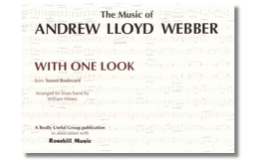
With One Look (Score and Parts) - Andrew Lloyd Webber arr. William Himes
The official authorized brass band arrangement one of the hits from Andrew Lloyd Webber's Sunset Boulevard.
Estimated dispatch 7-9 working days
-
 £41.09
Emerald Isle Fantasy (Tenor Horn Solo with Brass Band) Brian Bowen
This gorgeous solo for tenor horn and brass band features a number of much-loved Irish melodies. The solo was one of several works Brian Bowen left with BrookWright Music prior to his death in September 2022. To view a video of Art Henry performing the solo with the New York Staff Band please visit www.youtube.com/watch?v=5pgFrDwhJe8 PDF download includes score and parts. Sheet music available from: UK - www.brassband.co.uk USA - https://satradecentral.org Difficulty Level: 3rd Section + Duration: approx. 7.00 minutes Instrumentation: Tenor Horn Soloist Eb Soprano Cornet Eb 1st Cornet Bb 2nd Cornet Bb Flugel Horn Bb 1st Horn Eb 2nd Horn Eb 1st Baritone Bb 2nd Baritone Bb 1st Trombone Bb 2nd Trombone Bb Bass Trombone Euphonium Bb Bass Eb Bass Bb Percussion 1-2
In Stock: Estimated dispatch 1-3 working days