
Results
-
 £79.00
Hymn to humanity - Glorieux Francois - Vertommen Luc
Estimated dispatch 7-14 working days
-
 £49.99
Chorale for Peace - Thierry Deleruyelle
Chorale for Peace is a song of hope and peace for humanity. In commissioning this work, the wind band of Le Portel (France) wanted to pay tribute to the victims of 8 September 1943, when around 100 Allied planes dropped more than 5,000 bombs on the town of Boulogne and the surrounding area. In fact, this operation was nothing more than a diversion to make the enemy believe that a landing was imminent in the north of France. This music is slow, an adagio commemorating the human sacrifice of this operation. But more broadly, the composer also wanted to express his support for the peoples who, even today, suffer oppression. This set includes an optional choir part that offers the possibility of making an even deeper impression on the listener.
Estimated dispatch 5-14 working days
-
 £169.99
Destination Moon - Paul Raphael
Destination Moon was first performed by Cory Band at the 2017 European Championships in Ostend, Belgium, and is inspired by the Belgian comic-book hero Tintin. The first part is called 'Science' and describes the development of the theory of space travel. The second part is 'Humanity' which addresses human concerns and philosophies about our place in the universe. The third part is 'The Launch' which ends with a repetition of the words 'Earth to Moon Rocket are you receiving me?' as the rocket vanishes into a tiny speck in the sky.
Estimated dispatch 5-14 working days
-
 £94.95
Of Men and Mountains - Edward Gregson
Of Men and Mountains was commissioned by the Netherlands Brass Band Championships for their tenth anniversary contest in Drachten in December 1990. In July the previous year, Edward Gregson and his wife took the Trans Canadian Railway from Toronto to Vancouver. The journey through the Rocky Mountains was the starting point for Of Men and Mountains. Gregson writes that: 'its high peaks and shafts of sunlight breaking through the clouds, its canyons and ferocious rapids made me understand a little more about the majesty of nature and the fragility of humanity. The eternal struggle between man and nature was personified in the building of this incredible railway... hence my title (after Blake).' The work is dedicated to the memory of Eric Ball, who died shortly before the writing of the work was commenced. Of Men and Mountains is in one continuous movement with a duration of approximately 17 minutes. Its form is difficult to describe because of its motivic and accumulative nature, but it is essentially a symphonic tone poem in search of a theme, which eventually comes in its final and complete state in the majestic ending after an ever-increasing paced scherzo. Of Men and Mountains has been selected as the test pieces for the 2023 National Brass Championships of Great Britain at the Albert Hall.
Estimated dispatch 5-14 working days
-
 £154.99
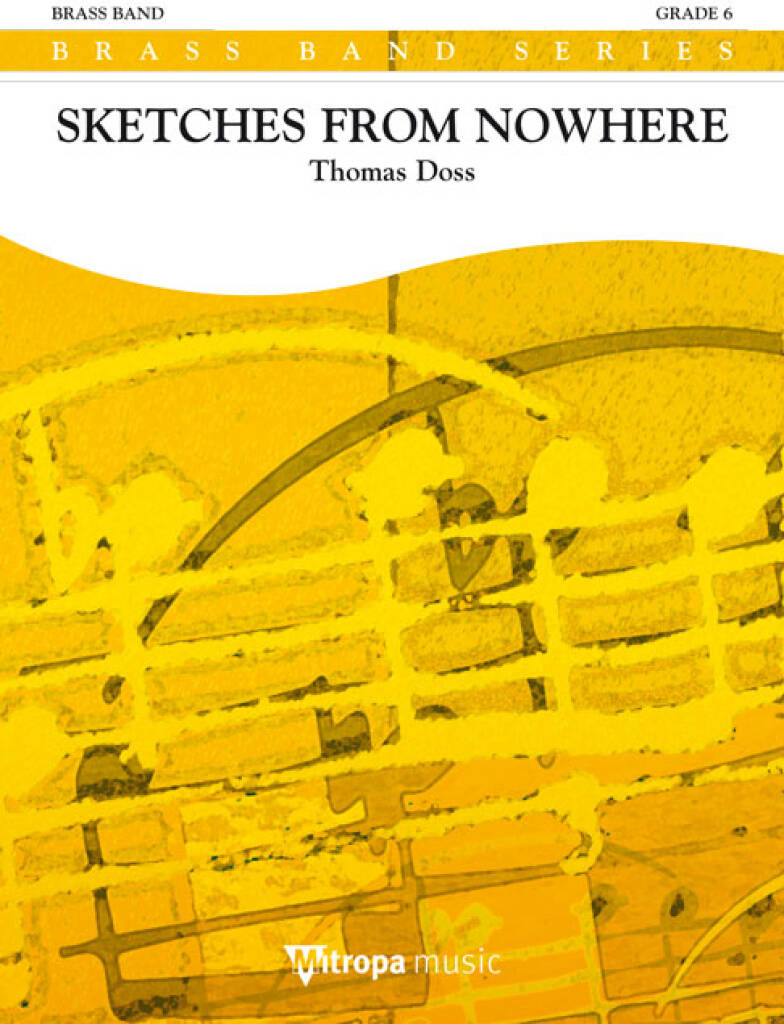
Sketches from Nowhere - Thomas Doss
Sketches from Nowhere is the second composition that Thomas Doss has written for brass band. The title was inspired by various images the composer saw in his mind's eye while working on this piece: pictures of foreign places; pictures of the creation of our world. The main motif that weaves its way from the beginning to the end of the work is meant to parallel humanity's great evolution: from its humble beginnings as mere stardust to the present day.
Estimated dispatch 5-14 working days
-
 £37.35
Fallen Souls (Brass Band) Andrew Wainwright
Fallen Souls was the winner of Grimethorpe Colliery Band's 1st Annual Composition Competition in 2023. This depictive and impactful work explores the theme of human fallibility. The piece begins with a slow, yearnful introduction that depicts a fall from grace, represented by a horn solo that reflects the innate goodness of humanity. However, the music soon becomes more agitated and dissonant as it represents the temptations that can lead us astray. The opening reaches a climax of chaos and despair, as we are shown the devastating consequences of our choices. The following section depicts the temptations of humanity. The music is chaotic and seductive in this section, with regular time changes and rhythmic instability, representing the many temptations that surround us. The section ends with a sense of uncertainty, as we are left wondering whether we will succumb to these temptations. There is a reprise of the opening horn solo, and a return to the notion of human fallibility, but this time in extended form. Again there is a build toward chaos, and the music becomes more complex and textured, reflecting the complexity of the human journey. The work ends somewhat abruptly with a blaze, leaving the listener with a sense of both hope and uncertainty. To view a rolling score video featuring Grimethorpe Colliery Band please visit www.youtube.com/watch?v=rM-p8CjnYo0 Duration: 5.00 minutes approx. Difficulty Level: 1st Section + PDF download includes parts and score. Sheet music available from www.brassband.co.uk/sheet-music/fallen-souls-brass-band-andrew-wainwright-brookwright Instrumentation: Soprano Cornet Eb Solo Cornet Bb Repiano Cornet Bb 2nd Cornet Bb 3rd Cornet Bb Flugel Horn Bb Solo Horn Eb 1st Horn Eb 2nd Horn Eb 1st Baritone Bb 2nd Baritone Bb 1st Trombone Bb 2nd Trombone Bb Bass Trombone Euphonium Bb Bass Eb Bass BbTimpani Percussion 1-3
In Stock: Estimated dispatch 1-3 working days
-
 £30.00
Edward Gregson: Music of the Angels, for Symphonic Brass and Percussion
DescriptionProgramme NoteMusic of the Angels is a dramatic work of some 16 minute's duration, scored for a large symphonic brass ensemble, including seven trumpets, and percussion. The percussion section deploys 'dark' instruments such as three tam-tams, a bass drum and two sets of timpani.The title of the work is based on a quotation from the Book of Revelations:And I saw the seven angels which stood before God; and to them were given seven trumpetsThus, the idea behind the work is a dramatic one and the composer has emphasised this by the partial spatial arrangement of the ensemble, with six solo trumpets standing centre stage, but behind the main ensemble, and the seventh trumpet off-stage throughout.The work opens with a four-note motif, dominant throughout the work, announced initially by four off-stage horns and answered by fanfare figures on four solo trumpets. Then in turn each of the first four solo trumpets announce their own cadenzas before joining together, independently playing their own music. This reaches an intense climax before subsiding into slow music which might be described as a Kyrie eleison - a lament for humanity - a cantilena for flugel horn and euphonium, accompanied by trombones. The drama soon returns with the entry of trumpets 5 and 6, playing music that is fast, more urgent and foreboding, and describing in musical terms the horsemen of the Apocalypse.At the climax of this section trumpet 7 enters dramatically, representing the words of the seventh angel ... and time shall be no more. The opening four-note motif is here transformed into a cadenza of epic proportions, to the partial accompaniment of three tam-tams (representing the Holy Trinity). The ensuing scherzo, scored for the ensemble, is fast and furious, but despite the somewhat desolate mood of this music (briefly interrupted by the re-appearance of trumpet 7), it slowly moves towards a more optimistic conclusion, transforming the 'lament for humanity' music into an affirmative and triumphant climax.This work has been commercially recorded on a critically acclaimed CD from London Brass on the Chandos label, available HERE.For more information on Edward Gregson's music please visit the composer's website: www.edwardgregson.com
Estimated dispatch 7-14 working days
-
 £48.56
Peace in Our Time (Brass Band) Andrew Wainwright
Commissioned by Armonico Consort to mark the 85th anniversary of the Coventry Blitz, Peace in Our Time is a profoundly moving reflection on humanity's enduring quest for reconciliation amidst turmoil. Originally scored for choir, orchestra, and organ, this masterful brass band transcription beautifully captures the emotional weight of John Oxenham's evocative poetry and the timeless plea of Psalm 122. The work opens in hushed reverence, where distant muted cornets, a dark bass pedal, and a fragile, militaristic snare drum set a shadowed, contemplative scene. Out of this delicate landscape emerges a poignant cornet solo that yields to the expressive voice of the solo flugel horn, carrying the opening text with quiet conviction before introducing the solemn reminder: "O pray for peace, peace in Jerusalem." As the piece progresses, the setting turns darker and more restless. Harmonic tension builds through rich brass textures to reflect the fears, divisions, and heavy costs of historical and modern conflict. From this emotional turbulence rises a bold, ceremonial fanfare that marks a dramatic turning point, ushering in a glorious, expansive setting of the poem's final verse. Yet rather than ending in simple triumph, the music gently recedes into a serene and tender stillness. The final bars leave performers and audiences alike with a quiet, lingering echo - a persistent hope for peace that resonates just as deeply today as it did 85 years ago. This substantial work is an extraordinary addition to any brass band library, serving as an ideal centerpiece for Remembrance Sunday, historical commemorations, church services or serious concert programming. To view a multimedia presentation of the piece with audio please visit www.youtube.com/watch?v=Y2BKI_GCegw The multimedia presentation is available on request withe purchase of this work - please email [email protected] to receive a link to download it. To view a video performance of the original work for choir, orchestra and organ please visit www.youtube.com/watch?v=m6o6PJJVKCo Duration: approx. 8.45 minutes Difficulty Level: 2nd Section + This PDF download includes the full score and parts. Sheet music available at www.brassband.co.uk (UK) or https://satradecentral.org (USA) Instrumentation: Soprano Cornet Eb Solo Cornet Bb Repiano Cornet Bb 2nd Cornet Bb 3rd Cornet Bb Flugel Horn Bb Solo Horn Eb 1st Horn Eb 2nd Horn Eb 1st Baritone Bb 2nd Baritone Bb 1st Trombone Bb 2nd Trombone Bb Bass Trombone Euphonium Bb Bass Eb Bass Bb Timpani Percussion 1-2
In Stock: Estimated dispatch 1-3 working days
-
 £63.51
Temperamental (Brass Band) Fendall Hill
This work by Fendall Hill was the set test for the 2021 National Brass Band Championships of New Zealand, B Grade. The composer writes: 'J.S. Bach (1685-1750) is deemed by many to be the 'Ulimate Composer'. He added an incredible proportion to the DNA of western music, and his influence is heard in the music of today. Like many artists, he was not overly recognised as a composer during his lifetime, and it took an 1829 performance of the St Matthew Passion by Mendelssohn to ignite a recognition of his place in the music world, a place he has maintained ever since. This piece starts with a similar spark of rediscovery of the music of Bach. It contains arrangements of various works, interspersed with composition based on Bach's chord structures, sections in the style of Bach, and original sections inspired by the moods created along the way. The first section explores the Toccata, and great organ works. This leads into an exploration of his choral works, and a finale based on the Preludes. The word 'Tempered' has different meanings, and all seem to apply to the music of Bach, and these appeal to the musical, engineering and spiritual aspects of my personal life. His music reaches to the humanity and divinity, it has strength, structure and order that creates frameworks in which incredible complexity reigns; and the complexity leads to a wildness, a kind of craziness that represents a range of human moods, and can change without warning. The same piece of music affects people in very different ways. I don't know if it's Bach's music, or us, but it can seem out of control and under control at the same time - the combination is highly temperamental. To view a follow-the-score video of the work please visit: https://youtu.be/zpNxITUqXZU Sheet music available from: UK - www.brassband.co.uk USA - www.solidbrassmusic.com Difficulty Level: 1st Section + Instrumentation: Soprano Cornet Eb Solo Cornet 1&2 Bb Solo Cornet 3&4 Bb 2nd Cornet Bb 3rd Cornet Bb Flugel Horn Bb Solo Horn Eb 1st Horn Eb 2nd Horn Eb 1st Baritone Bb 2nd Baritone Bb 1st Trombone Bb 2nd Trombone Bb Bass Trombone Euphonium Bb Bass Eb Bass Bb Timpani Percussion 1-4
In Stock: Estimated dispatch 1-3 working days
-
 £35.00
strange geometry
Descriptionstrange geometrywas commissioned by Morgan Griffiths and the Hammonds Saltaire Band for their performance at the Brass in Concert Championships of 2015.As a bit of a space/sci-fi geek, as well as a musician, two events during the summer of 2015 had a particular effect on me. The first was the tragic early death in a plane crash of the famous film composer James Horner. Horner's music, particularly in films like 'Star Trek II: The Wrath of Khan', 'Avatar', 'Apollo 13' and even his debut in Roger Corman's 1980 budget film 'Battle Beyond the Stars', defined for a generation the sound of sci-fi at the cinema. Along with John Williams he created the vocabulary for those who wish to express other-worldly wonder in music and his inventive talent will be much missed in an industry where originality has become something of a dirty word in recent years.The second event was the epic flyby of Pluto by the NASA New Horizons spacecraft. There are many reasons to find this mission inspiring - for example, the scientists and engineers behind it created a craft that has travelled at 37,000 mph for nine years and three billion miles to arrive within seventy-two seconds of the predicted time for the flyby. That they achieved this with such accuracy is an outstanding tribute to humanity's ingenuity and insatiable curiosity. However, the most exciting aspect of the mission was the clear, high resolution pictures of this unthinkably remote and inhospitable world beamed back to mission control. The best previous image of Pluto was an indistinct fuzzy blob - suddenly we could see mountains made of ice, glaciers of methane and carbon monoxide and nitrogen fog - features previously unimagined on a world thought to be a slightly dull ball of cold rock. The BBC's venerable astronomy programme 'The Sky at Night' waxed lyrical about these newly discovered features, referring to "the surprising discoveries of mountains and strange geometry on the surface of this cold distant world".I like to think that Horner would have been as inspired as I have been by this real-life science story, and this piece uses some of the vocabulary of the sci-fi movie soundtrack in a tribute to the memory of a great musician and to the inspirational geeks at NASA who have boldly taken us where no-one has gone before.Note: This work comes with a B4 portrait score. Listen to a preview and follow the music below!
Estimated dispatch 7-14 working days
 View Music