Searching for Wind Band Music? Visit the Wind Band Music Shop
We've found 697 matches for your search. Order by

Results

  • £43.95

    WHO IS HE? (Brass Band) - Hanby, Benjamin - Phillips, Richard

    Richard Phillips' ever-popular brass band arrangement of the Christmas hymn Who Is He? is now available in a brand new edition complete with SATB choral parts. The vocal score, which is fully compatible with the brass band version, provides a keyboard reduction for rehearsal or performance without band.

    Estimated dispatch 7-14 working days
  • £74.99

    THE BANKS OF GREEN WILLOW (Brass Band - Score and Parts) - Butterworth, George - Wilson, Duncan

    George Butterworth (1885-1916) was an English composer who died at a very young age, leaving behind few compositions. One of his best known and regularly played works is The Banks of Green Willow. People who have studied his work agree that Butterworth displayed great potential which would have flourished were it not for his untimely death. Duncan Wilson's arrangement makes Butterworth's imagination accessible. Duration: 5:00

    Estimated dispatch 7-14 working days

     PDF View Music

  • £189.95

    'The New Christmas Collection' - Full Set March Card Size

    The new Christmas Collection carol books contain all the traditional Christmas Carols, with some new 'pop' music arrangements included to add more variety to your carolling this year.


    * Note, these are not compatible with the New Christmas Praise books.

    Full list of works in The Christmas Collection:-

    • A child this day is born
    • A Christmas lullaby
    • A great and mighty wonder
    • All I want for Christmas is you
    • All my heart this night rejoices
    • Angels, from the realms of Glory (Come and worship)
    • Angels, from the realms of Glory (Iris)
    • Angels we have heard on high
    • A starry night
    • As with gladness men of old
    • Auld lang syne
    • A virgin most pure
    • Away in a manger (The manger scene)
    • Away in a manger (Traditional)
    • A winter’s tale
    • Bethlehem
    • Brightest and best (Spean)
    • Brightest and best (Traditional)
    • Calypso Carol
    • Carol for the Nativity
    • Carol of the bells
    • Carol of the drum
    • Child of Mary
    • Christians Awake!
    • Christ is born (Il est né)
    • Christ was born on Christmas Day
    • Come and join the celebration
    • Come, children, come quickly
    • Coventry Carol
    • Deck the hall
    • Ding dong! merrily on high
    • Do you hear what I hear?
    • Frosty the snowman
    • Gabriel’s Message
    • Gaudete
    • Glory in the highest
    • Glory in the highest Heaven
    • God of God, the uncreated
    • God rest you merry, gentlemen
    • Good Christian men, rejoice
    • Good King Wenceslas
    • Go, tell it on the mountain!
    • Happy Christmas (War is over)
    • Hark the glad sound!
    • Hark! the herald angels sing
    • Have yourself a merry little Christmas
    • Here we come a-wassailing
    • How far is it to Bethlehem?
    • Huron Carol
    • Infant Holy
    • In the bleak midwinter (Cranham)
    • In the bleak midwinter (Darke)
    • I saw mommy kissing Santa Claus
    • I saw three ships come sailing in
    • It came upon a midnight clear (Traditional)
    • It came upon a midnight clear (Willis)
    • It’s beginning to look a lot like Christmas
    • It’s the most wonderful time of the year
    • I wish it could be Christmas everyday
    • I wonder as I wander
    • Jesus, good above all other
    • Jingle Bells
    • Jingle bell rock
    • Joy to the world!
    • Last Christmas
    • Let it snow!
    • Little baby Jesus
    • Little children, wake and listen
    • Little Donkey
    • Little Jesus, sweetly sleep
    • Lo! he comes with clouds descending
    • Long, long ago
    • Love came down at Christmas
    • Mary’s boy child
    • Mary’s Child
    • Masters in this hall
    • Merry Christmas everyone
    • Mistletoe and wine
    • Noel
    • O Christmas tree
    • O come, all ye faithful
    • O come, Immanuel
    • O Heaven-sent King
    • O holy night!
    • O little town of Bethlehem (Christmas Carol)
    • O little town of Bethlehem (Forest Green)
    • O little town of Bethlehem (St Louis)
    • Once in royal David’s city
    • Past three o’clock
    • Patapan
    • Personent Hodie
    • Praise ye the Lord
    • Ring the bells
    • Rise up, shepherd!
    • Rockin’ around the Christmas tree
    • Rudolph, the red-nosed reindeer
    • Sans day carol
    • Santa Claus is comin’ to town
    • Saviour’s Day
    • See, amid the winter’s snow
    • Silent Night!
    • Sleigh Ride
    • Softly the night is sleeping
    • So here it is, merry Christmas
    • Stars are shining
    • Still, still, still
    • Stop the cavalry
    • Sussex Carol
    • Sweet chiming bells
    • Sweet chiming Christmas bells
    • The candle song
    • The cherry tree carol
    • The Christmas song
    • The first Nowell
    • The holly and the ivy
    • The infant King
    • The light has come
    • The shepherds’ farewell
    • The stable door
    • The star in the east
    • The twelve days of Christmas
    • The virgin Mary had a baby boy
    • They all were looking for a king
    • Thou didst leave thy throne
    • Three kings’ march
    • Unto us a boy is born
    • Walking in the air
    • We gather round the manger-bed
    • We three kings of Orient are
    • We wish you a merry Christmas
    • What child is this?
    • When a child is born
    • When Santa got stuck up the chimney
    • Whence is that goodly fragrance flowing?
    • When wise men came seeking
    • While shepherds watched (Cranbrook)
    • While shepherds watched (Handel)
    • While shepherds watched (Winchester Old)
    • White Christmas
    • Who is he?
    • Winter Wonderland
    • Worldwide Christmas message
    • Zither Carol
    • A starry night
    • Christmas Joy
    • Christmas Praise
    • Coventry Carol
    • Infant Holy
    • Mid-winter
    • Rudolph, the red-nosed reindeer
    • The everlasting light
    • To celebrate his birth
    • Yuletide Rag

    Estimated dispatch 7-14 working days
  • £79.95

    Lost Village of Imber, The - Christopher Bond

    The village of Imber on Salisbury Plain had been inhabited for over one thousand years when it was evacuated in 1943 to make way for military training in the Second World War. At the time, with preparations for the Allied invasion of Europe underway, most villagers put up no resistance, despite being upset, with the belief that they'd return once the war had concluded. To this day, Imber and its surrounding land remain a military training ground. The villagers never returned, and just the shell of what was once a community remains. Structured in three movements, it is on this very real story that the work is based, setting out the series of events of 1943 in chronological order. The first movement, On Imber Downe, portrays a sense of jollity and cohesiveness - a community of individuals living and working together before news of the evacuation had broken. Sounds of the village are heard throughout, not least in a series of percussive effects - the anvil of the blacksmith; the cowbell of the cattle and the bells of the church. The second movement, The Church of St. Giles, begins mysteriously and this sonorous, atmospheric opening depicts Imber in its desolate state and the apprehension of residents as they learn they have to leave their homes. Amidst this is the Church, a symbol of hope for villagers who one day wish to return, portrayed with a sweeping melodic passage before the music returns to the apprehension of villagers facing eviction around their sadness at losing their rural way of life. In complete contrast, the third movement, Imemerie Aeternum, portrays the arrival of the military, complete with the sounds of the ammunition, firing and tanks - sounds which were all too familiar to those living in the surround areas. To close, the Church of St. Giles theme returns in a triumphant style, representing the idea that the church has always been, even to this day, a beacon of hope for the villagers and local community - both the centrepiece and pinnacle of a very real story. The work was commissioned by Bratton Silver Band in celebration of the band's 160th Anniversary, with funding from the Arts Council National Lottery Project Grants Fund and the Brass Bands England Norman Jones Trust Fund.

    Estimated dispatch 10-14 working days
  • £79.95

    The Lost Village of Imber (Brass Band - Score and Parts) - Bond, Christopher

    The Lost Village of Imber was commissioned by Bratton Silver Band in 2019 in celebration of 160 years of the band; 1859-2019. Structured in three movements, the complete work was premiered by Cory Band at Wiltshire Music Centre in February 2020.The village of Imber on Salisbury Plain had been inhabited for over one thousand years when it was evacuated in 1943 to make way for military training in the Second World War. At the time, with preparations for the Allied invasion of Europe underway, most villagers put up no resistance, despite being upset, with the belief that they'd return once the war had concluded. To this day, Imber and its surrounding land remain a military training ground. The villagers never returned, and just the shell of what was once a community remains.Structured in three movements, it is on this very real story that the work is based, setting out the series of events of 1943 in chronological order.The first movement, On Imber Downe, portrays a sense of jollity and cohesiveness, a community of individuals living and working together before news of the evacuation had broken. Sounds of the village are heard throughout, not least in a series of percussive effects, the anvil of the blacksmith; the cowbell of the cattle and the bells of the church.The second movement, The Church of St. Giles, begins mysteriously and this sonorous, atmospheric opening depicts Imber in its desolate state and the apprehension of residents as they learn they have to leave their homes. Amidst this is the Church, a symbol of hope for villagers who one day wish to return, portrayed with a sweeping melodic passage before the music returns to the apprehension of villagers facing eviction around their sadness at losing their rural way of life.In complete contrast, the third movement, Imemerie Aeternum, portrays the arrival of the military, complete with the sounds of the ammunition, firing and tanks, sounds which were all too familiar to those living in the surround areas. To close, the Church of St. Giles theme returns in a triumphant style, representing the idea that the church has always been, even to this day, a beacon of hope for the villagers and local community, both the centrepiece and pinnacle of a very real story.Duration: 13.30

    Estimated dispatch 7-14 working days
  • £80.00

    The Unfortunate Traveller (Brass Band - Score and Parts) - Holst, Imogen - Hindmarsh, Paul

    Imogen Holst (1907-1984) submitted The Unfortunate Traveller (1929) as her final work as a student portfolio at the Royal College of Music, where her composition teacher was Gordon Jacob. The title was taken from Thomas Nashe's famous 1594 picaresque novel of the same title. The Suite was first performed on 12 February 1933 at her Majesty's Theatre, Carlisle, by the St. Stephen's Band, with the composer conducting. Te concert was given in memory of Holst's uncle, Dr. H.A. Lediard. Holst had been impressed with the band's performance of his A Moorside Suite at the 1928 National Brass Band Championships (The Crystal Palace, South London) and was keen to work with them. Writing in Imogen Holst, a life in music, Christopher Grogan indicates that it was Gustav Holst's suggestion to include his daughter's work in the programme, quoting Imogen Holst's remarks made in interview to The Daily Mail as follows: "....it is the first time, so far as I know, that a woman has conducted a brass band at a public concert....It has been a delight to rehearse the St. Stephen's Band. It was their performance at the Crystal Palace Festival that inspired me to write this Suite, which I have dedicated to them."Imogen Holst accompanied her father to the Crystal Palace in 1928 to hear the performances of A Moorside Suite, and was so excited by the played and, audibly, by her father's music that she decided to write a brass band piece for her final examination. Te result was The Unfortunate Traveller (1929). However, it was not possible for her to present a brass band work for examination. She arranged it for string orchestra so that it could be played before she left the RCM in July 1930. Following the premiere of the original in 1933, the manuscripts did not resurface until 1969 Imogen found them among her late mother's effects. Although she requested score and parts be destroyed, they ended up in the possession of Manchester composer John Golland, who marked up the score presumably with the intention of creating a new performing edition. The original scoring reveals a lack of experience with what can be a tricky medium.With the agreement of the Holst Foundation, a revised edition, with additional percussion, was prepared in 2011 since when the work has been fortunate to travel round the world as a concert and contest piece. The original includes drums in the March only. The title was taken from Tomas Nashe's famous 1594 picaresque novel of the same title. Several Morris Dance tunes are introduced during the course of the four short movements, including Bonnie Green Garters, Shepherd's Hey, The Rose and The Wind Blaws Cauld. Quirky twists and turns of harmony and spirited rhythms that remind us how much Imogen Holst loved tradition English dance music.In September 2025, I made a performing edition of the composer's arrangement for string orchestra. The manuscript lacks the final movement, which I arranged in a similar style, ie. without extending the upper ranges. Making this edition raised some issues regarding the accuracy of my band version and some of the solutions I used to smooth out the voicing. I have used the composer's second thoughts to refine my performing edition and to correct a textual errors.- Paul HindmarshDuration: 10.00

    Estimated dispatch 7-14 working days

     PDF View Music

  • £40.00

    The Unfortunate Traveller (Brass Band - Score only) - Holst, Imogen - Hindmarsh, Paul

    Imogen Holst (1907-1984) submitted The Unfortunate Traveller (1929) as her final work as a student portfolio at the Royal College of Music, where her composition teacher was Gordon Jacob. The title was taken from Thomas Nashe's famous 1594 picaresque novel of the same title. The Suite was first performed on 12 February 1933 at her Majesty's Theatre, Carlisle, by the St. Stephen's Band, with the composer conducting. Te concert was given in memory of Holst's uncle, Dr. H.A. Lediard. Holst had been impressed with the band's performance of his A Moorside Suite at the 1928 National Brass Band Championships (The Crystal Palace, South London) and was keen to work with them. Writing in Imogen Holst, a life in music, Christopher Grogan indicates that it was Gustav Holst's suggestion to include his daughter's work in the programme, quoting Imogen Holst's remarks made in interview to The Daily Mail as follows: "....it is the first time, so far as I know, that a woman has conducted a brass band at a public concert....It has been a delight to rehearse the St. Stephen's Band. It was their performance at the Crystal Palace Festival that inspired me to write this Suite, which I have dedicated to them."Imogen Holst accompanied her father to the Crystal Palace in 1928 to hear the performances of A Moorside Suite, and was so excited by the played and, audibly, by her father's music that she decided to write a brass band piece for her final examination. Te result was The Unfortunate Traveller (1929). However, it was not possible for her to present a brass band work for examination. She arranged it for string orchestra so that it could be played before she left the RCM in July 1930. Following the premiere of the original in 1933, the manuscripts did not resurface until 1969 Imogen found them among her late mother's effects. Although she requested score and parts be destroyed, they ended up in the possession of Manchester composer John Golland, who marked up the score presumably with the intention of creating a new performing edition. The original scoring reveals a lack of experience with what can be a tricky medium.With the agreement of the Holst Foundation, a revised edition, with additional percussion, was prepared in 2011 since when the work has been fortunate to travel round the world as a concert and contest piece. The original includes drums in the March only. The title was taken from Tomas Nashe's famous 1594 picaresque novel of the same title. Several Morris Dance tunes are introduced during the course of the four short movements, including Bonnie Green Garters, Shepherd's Hey, The Rose and The Wind Blaws Cauld. Quirky twists and turns of harmony and spirited rhythms that remind us how much Imogen Holst loved tradition English dance music.In September 2025, I made a performing edition of the composer's arrangement for string orchestra. The manuscript lacks the final movement, which I arranged in a similar style, ie. without extending the upper ranges. Making this edition raised some issues regarding the accuracy of my band version and some of the solutions I used to smooth out the voicing. I have used the composer's second thoughts to refine my performing edition and to correct a textual errors.- Paul HindmarshDuration: 10.00

    Estimated dispatch 7-14 working days

     PDF View Music

  • £59.99

    Bofors To The Fore Joseph Knight

    This piece was a commission to commemorate the memory of Gunner A. E. Collins who during the second world war was engaged in an action where during an advance through Belgium heavy resistance was met and he and an officer had to cover a retreat using Bofors guns. In the final report the title of this piece was actually used by the commanding officer.The piece its self is in three movements and follows the flow of the battle. The first movement called "Advance" is cautious and has the hint of battle. It starts quietly and then builds up slowly and finishes unresolved. Movement two "Engagement" starts suddenly in 7/8 and uses cyclical rhythms and clustered chords to show the horror and chaos of battle and also the firing the Bofors guns. The third movement "Safe Return" brings all of the themes from the first two movements and finishes with "The End Of The Day". The commission stated that bugle calls and "The End Of The Day" should be included.The piece is suitable for a concert work or indeed the contest stage.J Knight 2022.

    Estimated dispatch 5-9 working days
  • £29.56

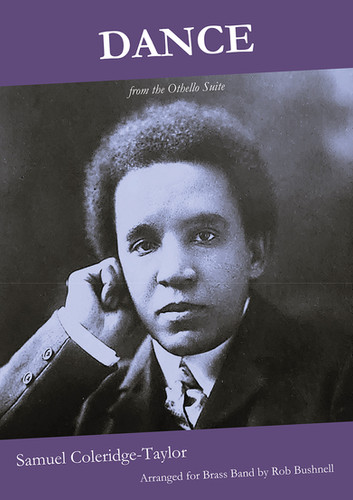
    Dance from the Othello Suite (Brass Band) Coleridge-Taylor arr. Bushnell

    Samuel Coleridge-Taylor is a British composer, who, from a young age, showed talent on the violin and entered the Royal College of Music, studying with Charles Villers Standford. His music become so popular that his Hiawatha trilogy was the second most performed choral piece (joint with Mendelssohn's Elijah, and only beaten by Handel's Messiah) with choral societies up and down the British Isles. In fact, Hiawatha was arranged by Charles Godfrey as a test-piece for the 1902 National Brass Band Championship of Great Britain, held at Crystal Palace.Commissioned by the theatre impresario Herbert Beerbohm, Coleridge-Taylor composed incidental music for His Majesty's Theatre London production of the Shakespeare play, Othello, in the West End, in 1909. In 1912, the play opened to the public, with a suite of five movements put together soon afterwards. The Dance, arranged here by Rob Bushnell, makes a great concert opener.This arrangement is for the British-style brass band, with alternative parts for horns in F and bass-clef lower brass. A recording of the original composition can be found at www.youtube.com/watch?v=OQeO_Ij9CV8 Duration: approx. 2.30 minutes Difficulty Level: 3rd Section + PDF download includes parts and score. Sheet music available at www.brassband.co.uk (UK) or www.cimarronmusic.com (USA) Instrumentation: Soprano Cornet Eb Solo Cornet Bb Repiano Cornet Bb 2nd Cornet Bb 3rd Cornet Bb Flugel Horn Bb Solo Horn Eb 1st Horn Eb 2nd Horn Eb 1st Baritone Bb 2nd Baritone Bb 1st Trombone Bb 2nd Trombone Bb Bass Trombone Euphonium Bb Bass Eb Bass Bb Timpani Percussion - Triangle, Cymbal & Bass Drum

    In Stock: Estimated dispatch 1-3 working days
  • £33.26

    Polka from 'The Bartered Bride' (Brass Band) Smetana arr. Rob Bushnell

    Considered a major contribution to the develop of Czech music, The Bartered Bride by Bedrich Smetana is a comic opera in three acts that premiered, in its final version, in 1870; having not been a great success when the original two-act version premiered at the Provisional Theatre, Prague on 30 May 1866. The opera was part of Smetana's aim to create a native Czech music after the conductor Johann von Herbeck commented that Czechs were incapable of making music of their own. Whilst he avoided the direct use of folksongs, Smetana did use numerous traditional Bohemian dance forms, such as the furiant and the polka, leading to music that was Czech in spirit. 'Sold Bride', a more accurate translation of the original Czech title (Prodana nevesta), tells the story of two lovers (Marenka and Jenik) who want to marry despite Marenka's father's obligations for his daughter to marry the son of a wealthy landowner, Micha. Scheming, condition proposals and secret identities leads to a happy ending. The polka was not in the original 1866 version. A revision in October 1866 saw the addition of a gypsy dance near the start of act 2. But by the next performance in January 1869, this had been replaced by a polka. In June 1869, a new polka replaced the January version's (as well as being moved to the end of act 1) and this is the one that we know and love today. This arrangement is for British-style brass band, with *alternative parts for horns in F and bass-clef lower brass. Instrumentation: Soprano Cornet Eb Solo Cornet Bb Repiano Cornet Bb 2nd Cornet Bb 3rd Cornet Bb Flugel Horn Bb Solo Horn Eb* 1st Horn Eb* 2nd Horn Eb* 1st Baritone Bb* 2nd Baritone Bb* 1st Trombone Bb* 2nd Trombone Bb* Bass Trombone Euphonium Bb* Bass Eb* Bass Bb* Timpani Percussion (Triangle, Cymbal(s) & Bass Drum)

    In Stock: Estimated dispatch 1-3 working days